Cylinder Number 5 Again (Bearings)

Disclaimer: Links on this page pointing to Amazon, eBay and other sites may include affiliate code. If you click them and make a purchase, we may earn a small commission.

gmail

Well-Known Member
Joined
Jun 25, 2008
Messages
870
Reaction score
290
Location
sunbury pa
this gives me 2 ideas... either go to a machine shop to have the work done or i might possibly acid port the oil galley to get the results im looking for to open it up.
but im a little concerned about acid porting the galley, dont wanna open it up too much and cause less flow in other areas.

i gotta look at this on a block i got laying around see what i come up with.

im assuming with most engine blocks the oil ports are drilled straight in so a machine shop could probley make easy work of this
 

Storm-Chaser

New Member
Joined
Jan 26, 2005
Messages
2,786
Reaction score
258
Location
Shit Louis
The crankshaft passage should be straight-through. I'm not sure on the passage through the block to the main bearing journals.
 

gmail

Well-Known Member
Joined
Jun 25, 2008
Messages
870
Reaction score
290
Location
sunbury pa
from what i remember storm-chaser when they drill the passages in blocks they will measure out 2 points and drill them till they meet so they should both be straight till they hit each other.

i mean after all how can you drill a bent angle? these are cast blocks also so unless they machine the holes and weld the blocks together which isnt the case how would it be possible.

im just wondering myself why is it not getting the right amount of flow? i mean would they have had left casting inside or drill the hole smaller? dont really make much sense to me maybe since the are all drilled the same size and the oil flows from the front of the block to the back it looses pressure by the time it reaches the number 3 main bearing.. but then again why would the 4th main get enough flow?
weird angle maybe?

i guess the only real awnser would be having a machinest look at it and even the air flow out between all the mains so it gets proper flow
 

egroce11

New Member
Joined
May 19, 2004
Messages
426
Reaction score
41
Location
Taylorsville, Ut.
I'd agree with the partially blocked passage. Did you re-use either the block or crank from the prior engine ?

Also, it is the same passage in the block to the crankshaft main bearing journal #3, that provides oil to the #3 and #5 rod bearing journals (via a passage in crankshaft).

Food for thought . . . .

Niether the block nor the crank are from the old engine. The block had to big a hole in it and the crank had chunks of metal out of it, I didn't use anything from the old block.

I'm ready to take this to the machine shop, I've got to decide whether to use all differant rods or just match the other ones in the block as it doesn't look like any of the others were hurt.

Thank you everyone for lookiing into this.

Ernie
 

yamahaSHO

E85 whore
Joined
Jul 25, 2002
Messages
10,646
Reaction score
2,516
Location
Arkansas
That is how they drill them out.


One thing we haven't taken into account is how it flows with restriction added to the other passages. Who knows, it could equal out after everything's bolted up.

Best thing you can do is take a spare block and start testing.
 

gmail

Well-Known Member
Joined
Jun 25, 2008
Messages
870
Reaction score
290
Location
sunbury pa
good point jason but then were back to the start if thats the case..

hoping this weekend ill have some free time to play around with this and see what i come up with.

now i dont have a way to flow bench this since im not even sure how you would do it short of a vaccum gauge hooked up somehow, but ill just try the thread test see how it reacts under air pressure.

basicly the same method used in testing flow in heads for different angles.

also will do the feel method :)
with any luck ill be able to use a bore scope (if it fits) to look around
 

yamahaSHO

E85 whore
Joined
Jul 25, 2002
Messages
10,646
Reaction score
2,516
Location
Arkansas
For the most part, you're probably safe <7,500 RPM. The real issues come when you're running in excess of 8k + RPM. I only run my car up to 8k RPM in the 1/4 mile as I was finishing the 1/4 in 3rd (in Denver anyway) 'round 110mph.
 

Storm-Chaser

New Member
Joined
Jan 26, 2005
Messages
2,786
Reaction score
258
Location
Shit Louis
Maybe a pin-hole in the internal casting allowing pressure to bleed-down. We all know there are never any casting imperfections. Could be some casting material that worked into the passage at some point after machining.

If I remember correctly, the fourth main bearing passage only supplies one rod bearing and the oil pressure sending unit. I'll look at the book later to verify.

I would have the machine shop look at both the block and crank. At worse they'll find nothing. Conversely, maybe he'll find a modification that will improve flow.


from what i remember storm-chaser when they drill the passages in blocks they will measure out 2 points and drill them till they meet so they should both be straight till they hit each other.

i mean after all how can you drill a bent angle? these are cast blocks also so unless they machine the holes and weld the blocks together which isnt the case how would it be possible.

im just wondering myself why is it not getting the right amount of flow? i mean would they have had left casting inside or drill the hole smaller? dont really make much sense to me maybe since the are all drilled the same size and the oil flows from the front of the block to the back it looses pressure by the time it reaches the number 3 main bearing.. but then again why would the 4th main get enough flow?
weird angle maybe?

i guess the only real awnser would be having a machinest look at it and even the air flow out between all the mains so it gets proper flow
 

SHOZ123

SHO Member
Joined
Dec 2, 2000
Messages
12,152
Reaction score
673
Location
Illinois
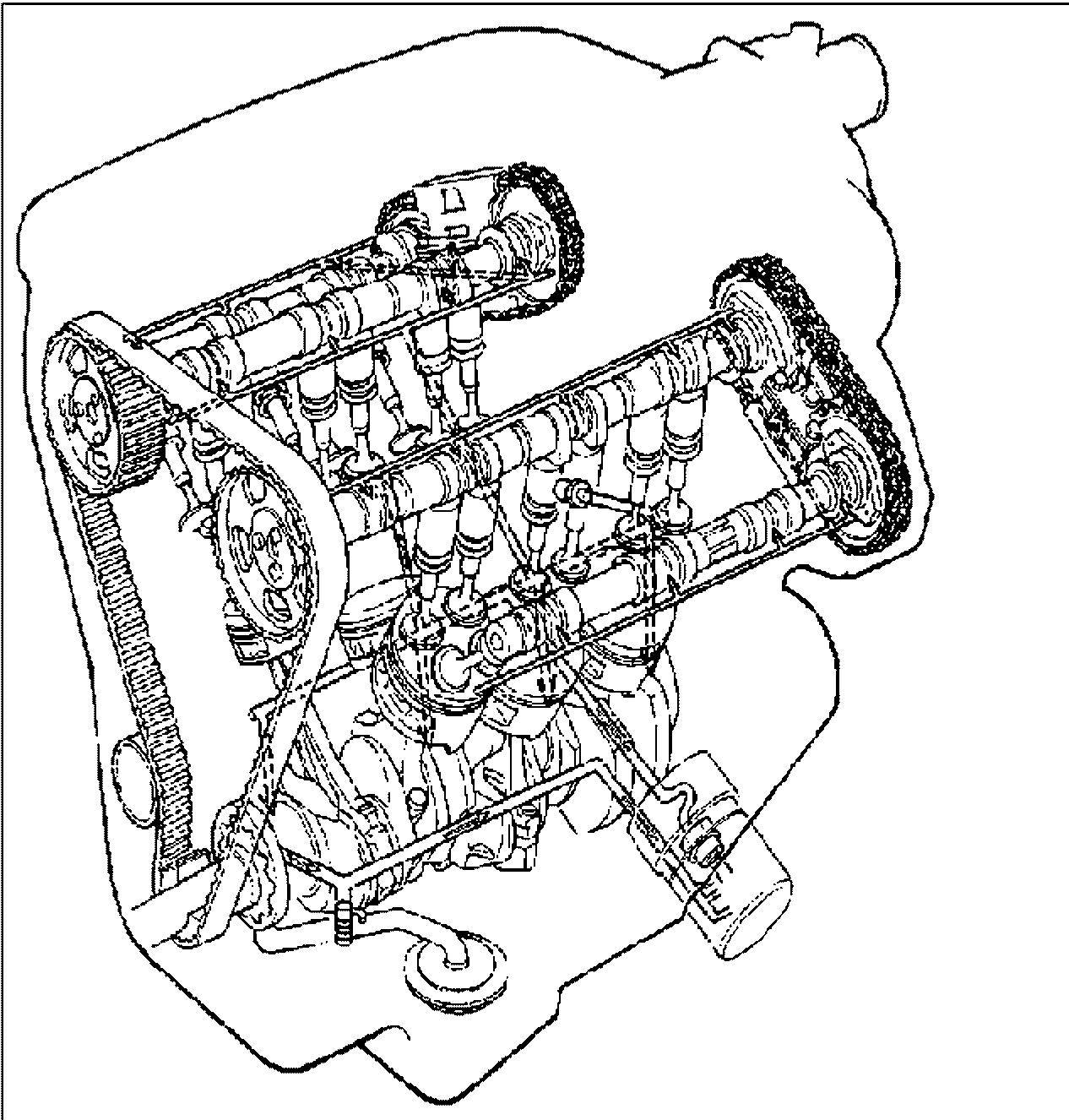
FWIW here is the drawing of the V6 oil flow.

v6-oil-system.gif
 

sho_sc

New Member
Joined
Jan 8, 2004
Messages
754
Reaction score
69
Location
Georgetown, KY
For the most part, you're probably safe <7,500 RPM. The real issues come when you're running in excess of 8k + RPM. I only run my car up to 8k RPM in the 1/4 mile as I was finishing the 1/4 in 3rd (in Denver anyway) 'round 110mph.

I guess I can put things in perspective here:

The TwEECer logs show that during the 163.442 MPH run, I was above 8K RPM for 5.5 secs in 3rd gear alone.
 

gmail

Well-Known Member
Joined
Jun 25, 2008
Messages
870
Reaction score
290
Location
sunbury pa
so brings me to what i dont get.. if you raise oil pressure your raising the chances of the oil making its way into tight areas it normally wouldnt reach under a certain psi.
 

Lorenr

Member
Joined
Apr 9, 2004
Messages
186
Reaction score
21
Location
Vancouver,WA
Drilling oil passages

When I used to build drag racing motors, I needed to spend a lot of time drilling oil passages.

Basically:

I didn't worry to much about oil pressure as long as I was close to 10 lbs of pressure for each 1000 RPM. You do not need 100 lbs for 10,000 RPM
I enlarged the drilled oil passages (One or maximum two drill sizes) from the oil pump all the way to the filter and from the filter to the gallery suppling the main bearings. Wherever possible I put a radius on any and all intersections. I enlarged the oil filter passages. Oil does not like sharp edges and you kind of need to think of it as a river. The easier it flows the smoother everything works. Resistance to flow causes turbulence.
I drilled the main oil gallery from one end to the other to be sure in was straight and not obstructed.
I drilled from the main bearing saddle to the main gallery.
I made sure the main bearings matched the supply line opening. Open the main bearing holes as necessary.
I (this is critical) chamfered the crankshaft passages supplying the rods which I believe is where a lot of your problems can be remedied.

:munch:
 

platoribs

Live to Drive
Joined
Apr 21, 2004
Messages
1,641
Reaction score
443
Location
Plat0ribs House of SHO,il
When I used to build drag racing motors, I needed to spend a lot of time drilling oil passages.

Basically:

I didn't worry to much about oil pressure as long as I was close to 10 lbs of pressure for each 1000 RPM. You do not need 100 lbs for 10,000 RPM
I enlarged the drilled oil passages (One or maximum two drill sizes) from the oil pump all the way to the filter and from the filter to the gallery suppling the main bearings. Wherever possible I put a radius on any and all intersections. I enlarged the oil filter passages. Oil does not like sharp edges and you kind of need to think of it as a river. The easier it flows the smoother everything works. Resistance to flow causes turbulence.
I drilled the main oil gallery from one end to the other to be sure in was straight and not obstructed.
I drilled from the main bearing saddle to the main gallery.
I made sure the main bearings matched the supply line opening. Open the main bearing holes as necessary.
I (this is critical) chamfered the crankshaft passages supplying the rods which I believe is where a lot of your problems can be remedied.

:munch:

Who was that masked man?:wave:
 

yamahaSHO

E85 whore
Joined
Jul 25, 2002
Messages
10,646
Reaction score
2,516
Location
Arkansas
I (this is critical) chamfered the crankshaft passages supplying the rods which I believe is where a lot of your problems can be remedied.

Not the best picture, but I remembered them already being done on our motors. The mains on the crank are also cross-drilled from the factory.

26748930009_large.jpg
 
Last edited:

gmail

Well-Known Member
Joined
Jun 25, 2008
Messages
870
Reaction score
290
Location
sunbury pa
FWIW here is the drawing of the V6 oil flow.

v6-oil-system.gif


dont wanna be rude but does anyone else have a clearer picture or even possibly color the oil flow for me because i cant read this picture very well
 

Storm-Chaser

New Member
Joined
Jan 26, 2005
Messages
2,786
Reaction score
258
Location
Shit Louis
Look here. Go to page 36 of 129 in Adobe Reader, bottom of the page. Copy the link for future reference, as it tends to "disappear" here once posted, for obvious reasons.


:theyareontome:
 

Storm-Chaser

New Member
Joined
Jan 26, 2005
Messages
2,786
Reaction score
258
Location
Shit Louis
Balancing and Blueprinting

Lorenr is describing part of the process of what use to be referred to as "blueprinting" the block. I remember having many hours in prepping a block, which included de-burring virtually every edge and radius that could be reached, painting the lifter valley to accelerate oil return to the pan, honing the lifter bores as well as the oil passages that were large enough to accept the very small bead-hones you use to be able to buy. I ran a drill through all the oil passages to ensure none were partially obstructed, and radius-edged every oil passage entrance that was accessible. It was what you did for engine-builds when you were trying to get everything possible out of the motor, while trying to make it as bullet-proof as possible - kinda comparable to Quaifeing the MTX, but much more detailed.

Ah, the good ole days before turbo-lag was eliminated . . . , and 6-71 blowers, tunnel rams, and Dominators were the word . . . .

:burnout:


When I used to build drag racing motors, I needed to spend a lot of time drilling oil passages.

Basically:

I didn't worry to much about oil pressure as long as I was close to 10 lbs of pressure for each 1000 RPM. You do not need 100 lbs for 10,000 RPM
I enlarged the drilled oil passages (One or maximum two drill sizes) from the oil pump all the way to the filter and from the filter to the gallery suppling the main bearings. Wherever possible I put a radius on any and all intersections. I enlarged the oil filter passages. Oil does not like sharp edges and you kind of need to think of it as a river. The easier it flows the smoother everything works. Resistance to flow causes turbulence.
I drilled the main oil gallery from one end to the other to be sure in was straight and not obstructed.
I drilled from the main bearing saddle to the main gallery.
I made sure the main bearings matched the supply line opening. Open the main bearing holes as necessary.
I (this is critical) chamfered the crankshaft passages supplying the rods which I believe is where a lot of your problems can be remedied.

:munch:
 

egroce11

New Member
Joined
May 19, 2004
Messages
426
Reaction score
41
Location
Taylorsville, Ut.
Again thanks every one.

The last block was basically blue printed on the last build.

From the drawings it looks like there are two relief valves, **** I haven't found one yet, thats why I've asked for the help.

Tom, have you found anything else on placing the washer yet.

Ernie
 

Off Road SHO

Moderator
Joined
Jan 16, 2002
Messages
5,684
Reaction score
1,292
Location
Arizona
Ernie,

I had a loose oil pump floating around here somewhere but have not been able to locate it. If I don't find it by Sunday afternoon, I will flip over one of these blocks that still has the pump on it and take some pics.

Tom
 

Forum statistics

Threads
107,088
Messages
1,181,318
Members
16,153
Latest member
lapochkarr

Members online

No members online now.
Back
Top