


185k miles. Mobil 1 since new, changed every 5000-7000 miles. No issues, replaced these as preventative maintenance mainly because I already had the subframe off for a clutch job and had to take the oil pump off to replace a leaking gasket. I really hope I didn't screw it up.
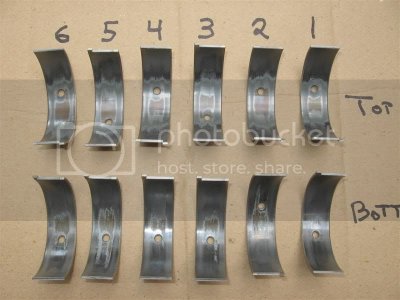
Interestingly, there were two different bearing numbers installed in my motor originally. 1,3,4,6 had bearings marked D1L, while 2 and 5 had D1A's. That suggests to me the factory fit may be more precise than we realize. The manufacturer marking on the original bearings look sort of like two concentric circles. I have no idea what company that is.
Regarding the Clevite replacement bearings, I am not all that impressed. Several had marks in the protective coating from the machine that makes the tab. The tabs are poorly formed compared to the factory original bearings which have beautifully formed tabs. Nits maybe, but indicative of some slop in quality control.
I followed the shophoenix guide, and it worked pretty well. A few lessons learned that may help others planning to do this:
1. The most difficult thing until you get the feel for it is separating the rod cap from the rod. Once the nuts are removed the trick is to just give the rod bolt a slight tap, creating a tiny gap between cap and rod. Then do the same on the other side. Now grab the cap with a gloved hand and wiggle it in all directions. If it doesn't come free, then push it back into its original position and try again. Moving the rod up too much on one side by tapping with the hammer too much will bind the cap, making it more difficult than it needs to be. Use something soft to tap on the rod bolt; I used a small plastic hammer. It doesn't take much force.
2. Once the cap is off, push the rod up off the journal just a little, no more than 1/8" or so. That actually makes sliding the old bearing half out and new one in easier. If you wait a minute or two for the oil surface tension to break, the old bearing may fall out on its own. Have something made of soft metal like brass or aluminum to push on the bearings to position them. I used a small brass screwdriver.
3. Do one rod at a time so parts are not mixed up.
4. Use assembly **** instead of motor oil. It is tacky and does not drip in your face.
5. When you dry fit the oil pan during reinstallation, first rub a water based magic marker on the rubber seals at the front and back. When you push the oil pan up, the ink will transfer to the pan and show you exactly where the RTV needs to go to get a continuous seal all the way around the pan.
6. Do not use a die to clean the rod bolt threads! They are made with high-stress rolled threads, not cut threads, and a die can damage them. They should not be messed with, the chance of creating a stress riser is too great.
Interestingly, there were two different bearing numbers installed in my motor originally. 1,3,4,6 had bearings marked D1L, while 2 and 5 had D1A's. That suggests to me the factory fit may be more precise than we realize. The manufacturer marking on the original bearings look sort of like two concentric circles. I have no idea what company that is.
Regarding the Clevite replacement bearings, I am not all that impressed. Several had marks in the protective coating from the machine that makes the tab. The tabs are poorly formed compared to the factory original bearings which have beautifully formed tabs. Nits maybe, but indicative of some slop in quality control.
I followed the shophoenix guide, and it worked pretty well. A few lessons learned that may help others planning to do this:
1. The most difficult thing until you get the feel for it is separating the rod cap from the rod. Once the nuts are removed the trick is to just give the rod bolt a slight tap, creating a tiny gap between cap and rod. Then do the same on the other side. Now grab the cap with a gloved hand and wiggle it in all directions. If it doesn't come free, then push it back into its original position and try again. Moving the rod up too much on one side by tapping with the hammer too much will bind the cap, making it more difficult than it needs to be. Use something soft to tap on the rod bolt; I used a small plastic hammer. It doesn't take much force.
2. Once the cap is off, push the rod up off the journal just a little, no more than 1/8" or so. That actually makes sliding the old bearing half out and new one in easier. If you wait a minute or two for the oil surface tension to break, the old bearing may fall out on its own. Have something made of soft metal like brass or aluminum to push on the bearings to position them. I used a small brass screwdriver.
3. Do one rod at a time so parts are not mixed up.
4. Use assembly **** instead of motor oil. It is tacky and does not drip in your face.
5. When you dry fit the oil pan during reinstallation, first rub a water based magic marker on the rubber seals at the front and back. When you push the oil pan up, the ink will transfer to the pan and show you exactly where the RTV needs to go to get a continuous seal all the way around the pan.
6. Do not use a die to clean the rod bolt threads! They are made with high-stress rolled threads, not cut threads, and a die can damage them. They should not be messed with, the chance of creating a stress riser is too great.
Last edited:


