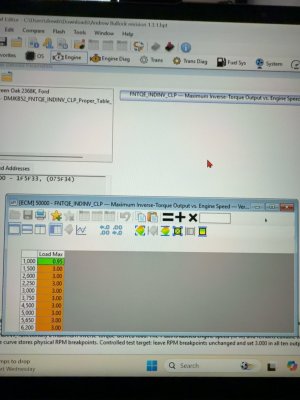
Nope. Going back to my Driver Demand max 500. From pure curiosity I was exploring the A2L with Chuck and we found and exposed this inverse torque load clip.
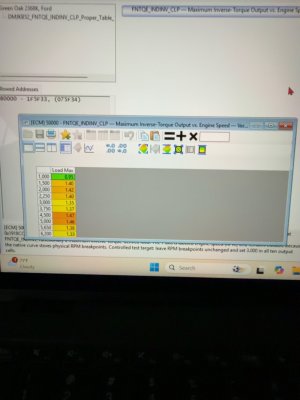
Hmmm how can that be? I’ve never seen load enforced that low. We exposed several more in a Scout pack to see the OEM values. Nothing special but we found it very interesting and it’s a real definition.
Went to bed and this morning I was looking at it and wait a min….max load on my last log was 1.46. Chuck, run the Kevlar Rev1 datalog and look for this clip being enforced. I told Chuck, “Even though my OSS modifier was 1:1 and my foot was cautious, check this clip.”
Chuck:
| Point | Scheduled torque | Raw inverse load | Clip | Logged Desired Load |
| 2,379 rpm, 46% pedal | 369 lb-ft | 1.222 | 1.391 | 1.220 |
| 2,512 rpm, 74% pedal | 443 lb-ft | 1.455 | 1.383 | 1.383 |
| 4,504 rpm, 63% pedal | 501 lb-ft | 1.613 | 1.470 | 1.467 |
| 5,052 rpm, 74% pedal | 532 lb-ft | 1.699 | 1.454 | 1.451 |
| 5,947 rpm, 61% pedal | 518 lb-ft | 1.678 | 1.353 | 1.353 |
Yes. This log makes it look like the clip was absolutely active.
Both things happened in sequence:
-Pedal position correctly selected a partial-pedal Driver Demand torque.
-That torque was converted to indicated/scheduled torque.
-The inverse table calculated a higher load.
-FNTQE_INDINV_CLP then capped that inverse output.
At the maximum-load point:
-4,504 rpm
-63% pedal
-Desired Brake Torque: 447.9 lb-ft
-Scheduled Torque: 501.3 lb-ft
-Desired Load: 1.4665
-Interpolated inverse-table result from 501.3 lb-ft: approximately 1.61
-Interpolated clip value at 4,504 rpm: approximately 1.470
The PCM delivered 1.4665—essentially the clip value, not the unrestricted inverse result.
Your partial-pedal DD request also makes sense. At roughly 63% pedal and 4,500 rpm, the Driver Demand table lands around 445–450 lb-ft, which is exactly the 447.9 lb-ft logged. So Driver Demand itself was behaving correctly. But after the brake-to-indicated conversion raised that to roughly 501 lb-ft, the inverse model wanted about 1.61 load and got chopped to 1.47.
That first row is particularly valuable. Before the inverse result reaches the clip, Desired Load follows the inverse table normally:
1.222 inverse < 1.391 clip → 1.220 logged
Then, once requested torque raises the inverse result above the curve:
1.455 inverse > 1.383 clip → 1.383 logged
That is basically a live demonstration of:
Desired inverse load ≈ minimum(raw inverse result, FNTQE_INDINV_CLP)
The strange falling Desired Load through the upper rpm range is also exactly the clip:
-Around 4,500 rpm: approximately 1.47
-5,000 rpm: approximately 1.46
-5,650 rpm: approximately 1.38
-6,200 rpm: approximately 1.33
Your logged Desired Load follows that same taper. Pedal position alone does not explain that precise rpm-shaped decline.
For a true 500 lb-ft Driver Demand request that becomes approximately 560 lb-ft indicated, the inverse table would calculate roughly:
-3,000 rpm: 1.74 load
-4,500 rpm: 1.76
-5,000 rpm: 1.77
-5,650 rpm: 1.77
-6,000 rpm: 1.78
But the current clip would only permit roughly 1.35–1.47. So yes—this little bastard is not theoretical. You hit it at only 74% maximum pedal, and then continued riding it through the pull.
Holy F shit. I then asked Chuck: in the log was the PCM closing throttle actively enforcing this clip?
Chuck: The PCM closed it. Your foot set the demand, but the large throttle closure was commanded by torque control.
Here’s the smoking gun:
At about 231.51–231.77 seconds, your pedal stayed dead steady at 69%.
During that same quarter-second:
-Desired Brake Torque stayed essentially fixed at 459 lb-ft
-ETC Torque Request stayed fixed at 459 lb-ft
-Desired Load rose to about 1.46—the hidden clip value at roughly 4,450 rpm
-Throttle Desired Angle collapsed from 80.2° to 29.5°
-Actual Throttle Angle followed from about 82° to 30°
-Throttle Position fell from essentially 100% to 36.5%
Your foot did not cause that. The PCM explicitly changed the desired blade angle while APP and requested torque remained constant.
Even more revealing, actual Air Load overshot to roughly 1.57 while Desired Load was stuck around 1.46. The PCM had already capped the inverse result, saw actual airflow exceed that clipped target, and closed the throttle hard to pull actual load back toward it.
So the sequence was: 69% APP → ~459 brake torque request → ~511 scheduled torque → inverse model wants more than ~1.46 load → hidden RPM clip outputs ~1.46 → actual load overshoots → PCM closes throttle
Your foot did move during other parts of the pull—you initially reached about 74%, dropped to 69%, and later tapered farther—but that only changed the requested torque modestly. It cannot explain a throttle blade going from fully open to approximately 40% while APP sat perfectly still.
Also, the closure continued after Torque Source returned from Trans Shift Mod to Driver Demand. So this was not merely the transmission requesting a shift reduction. Throttle Angle Source remained Torque Control, and the requested blade angle itself dropped first. That is definitive ETC intervention.
The really sneaky part is why your ordinary channels did not announce a limiter:
-Driver Demand Limit Source continued to report No Limit Active
-Torque Source reported Driver Demand
-ETC Torque Request still matched your requested brake torque
Because this clip is apparently inside the torque-to-load inverse conversion. The PCM was not clipping the displayed Driver Demand torque request—it was silently clipping the calculated load needed to produce that torque. Then the normal ETC controller closed the throttle to obey the lower load target.
As for the GUC/DMJKBL5-to-GUB/DMJKB52 change: that is now a very credible explanation for why this behavior suddenly appeared. I would phrase it carefully as:
DMJKB52 demonstrably enforces this inverse-output clip in the active Driver Demand path.
We still cannot say whether DMJKBL5 lacked the curve, had different values, or simply did not call it under the same conditions without comparing that strategy. But in this GUB log, the PCM absolutely rode the hidden curve and used the throttle to enforce it. This is a huge find.
My Driver Demand is back in play. We will see what it really can do with OSS modifier giving my foot more power and we’re using this clip as a safely limit choosing out load ceiling. As follows
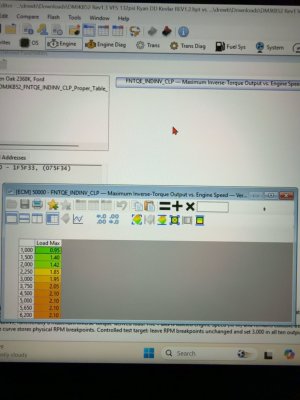
Smoothed up to about 3750rpm then in case something goes South we shut the party down at 2.1 load! Unbelievable! I am learning and expanding my operating system simultaneously. Didn’t even mean to find this hidden mother f u. C k e. R


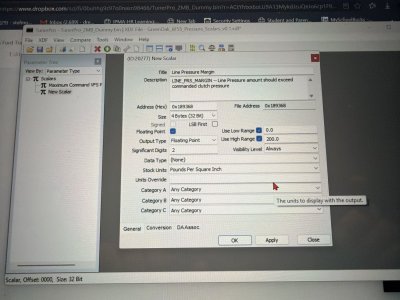
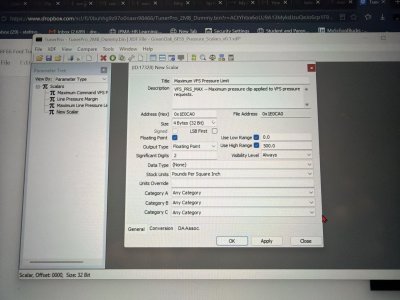
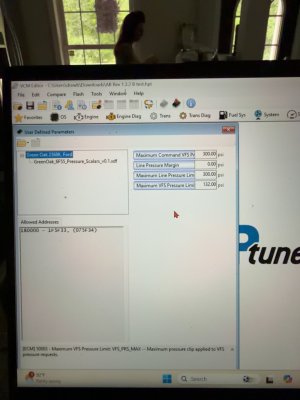
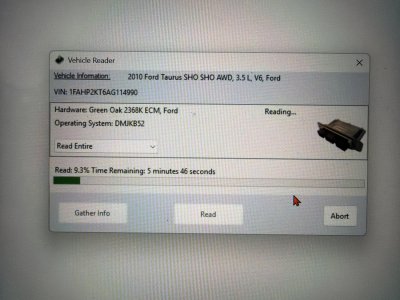


 hahahaha little digital douche