

thank you, last paragraph answered my question.Going by any generic aftermarket ring manufacturer specs, you'll find a disclaimer at the bottom that says "these are only general recommendations".
Ask your 50+ year coworker what a safe boost level is for a 10:1 compression engine. He'll probably tell you zero. Peruse multiple trusted resources spouting ancient irrelevant wisdom, they'll say a 10:1 engine can't run more than 4 psi boost on pump gas. But here we are, running 15 psi+ on factory high compression engines without hiccups.
Ask what a safe AFR is for this boosted high performance engine. They probably say 11:1 or so, and something like "anything above 12.5:1 is very dangerous." But here we are, with Ford running their 3.5L ecoboost no richer than 13.2:1 for 24 hours STRAIGHT at LeMans. I've personally ran my SHO up to 20 psi at > .90 lambda with the timing set to "yes" without repercussion.
You need to understand that old school tribal knowledge and universal recommendations are pretty much worth f*ck all on modern engines. The development of direct injection and other various technologies greatly change the operating dynamics and what is to be expected out of them. Of particular importance to our discussion is the concentration of combustion charge near the center of the piston which occurs with DI engines as well as the quenching that comes from spraying fuel straight onto the piston. Maybe, MAYBE, Ford learned through its extensive testing that their specific combustion chamber design significantly reduces heat at the rings and that tighter tolerances are warranted. It is well known that DI engines in general run much cooler than port injected engines, but I'm guessing they don't cover that in feeler gauge mechanik certification.
You also will do much better in life if you realize very early on that the average "professional" in just about any trade is teetering on the edge of total incompetence. Pay-to-play certifications, degrees, etc. mean literally nothing. If you want to become a true expert at something it will require a lot of critical thinking and independent research, not just swallowing every bit of information passed to you by someone else.
With all that out of they way, don't interpret any of this as me trying to dissuade you from opening them gaps. I highly doubt an extra couple thou will hurt performance, and if you have big power goals in mind then yes it is a must. Just, don't go thinking you've identified some fatal engineering flaw and the longevity of your engine hinges on pulling everything apart and filing your rings. Odds are much higher of you boogering the reassembly than your piston rings butting together.

You are using an out of date browser. It may not display this or other websites correctly.
You should upgrade or use an alternative browser.
You should upgrade or use an alternative browser.
piston ring swap with engine in car
- Thread starter withku
- Start date
Disclaimer: Links on this page pointing to Amazon, eBay and other sites may include affiliate code. If you click them and make a purchase, we may earn a small commission.

SM105K
Streetlight Grand Prix Champ/ IG @fafomotorsports
Since you are in AZ, a larger intercooler is a must. If you can't afford to upgrade the intercooler, then running a cheap DYI IC sprayer set up is easy. Running a colder plug is a must. Monitoring your IAT's and Knock in real time is a must. Running a TGDI spec'd oil is a must. Running non-heavy detergent fuel is a must. E30 is actually your best bet against knock and LSPI.
I probably have more documented trashing and abuse on my SHO here in the AZ heat then anyone. I have and continue to work extensively with Brad at AJPTurbo to help him develop numerous tunes for extreme heat. I run a good oil (Castrol Edge) and change it religiously every 3000 miles regardless of what Ford or Castrol say. I run good fuel (QT mostly) 91 octane when not on my E30 tune. When it is hot, I use a DYI water Intercooler sprayer when I get on it. This has mitigated unwanted knock with 160 degree IAT's.
I probably have more documented trashing and abuse on my SHO here in the AZ heat then anyone. I have and continue to work extensively with Brad at AJPTurbo to help him develop numerous tunes for extreme heat. I run a good oil (Castrol Edge) and change it religiously every 3000 miles regardless of what Ford or Castrol say. I run good fuel (QT mostly) 91 octane when not on my E30 tune. When it is hot, I use a DYI water Intercooler sprayer when I get on it. This has mitigated unwanted knock with 160 degree IAT's.

Well that's what I said yesterday too, before you went full ret ard and got the notion that you're the least bit qualified to talk sh.it to me. Everyone here is just trying to save you from chasing your clueless little puppy tail.thank you, last paragraph answered my question.
SM105K
Streetlight Grand Prix Champ/ IG @fafomotorsports
TEAM ROCKET!!!!Well that's what I said yesterday too, before you went full ret ard and got the notion that you're the least bit qualified to talk sh.it to me. Everyone here is just trying to save you from chasing your clueless little puppy tail.
So, at room temperature the thermal expansion is still holding the ring in place? Nope, not how that works. Sounds like the piston itself is compressed, almost as if it were subjected to some hammer-like force. If only there were something, maybe like some kind of abnormal combustion event, that could cause such a thing!
Downwards, indicating a downwards force. Rings are hottest, widest, most seize-y(???) during the expansion stro ke, so a seizure would cause an upward force, hence why it is typical to see top land/crown separation
Oh I can help with that! Here's the recommended ring gap from Ford Motor Company for a 2010 3.5L GTDI:
Piston ring end gap — compression (top, gauge diameter) 0.17-0.27 mm (0.0067-0.0106 in)
Piston ring end gap — compression (bottom, gauge diameter) 0.30-0.55 mm (0.0118-0.0216 in)
You've also been given two separate professional sources illustrating your damage consistent with LSPI, and not a single ACTUAL symptom of a seized ring presented.
The upper compression ring got seized because of the damage to the piston itself from a mega knock or LSPI event. It will usually deform a single piston and the rings tolerances can change. You have a single piston issue. Put the issue to rest...pull other pistons. If they are the same and in spec, it isn't the piston ring gap.
You said your intake temps never went over 160. Anything over 100 is considered hot. The SHO ECU pulls 1 degree of timing for every 10 degrees over 100 degrees. You are tuned...that plays a large role too. If your tuner doesn't understand the **** fuel in AZ and the extreme heat then you are asking for problems. The oil in your engine plays a large role too.
Shell/Chevron have a lot of additives in their fuel. Those additives have been known to be a factor in Mega Knock/LSPI events. That is the exact reason I don't run those brands. Also bad batches of fuel happen too.
so i’m genuinely curious as to why my engine failed. are these rings filed from factory? ends of ring were worn down from rubbing or file. double checked some specs
upper end gap - .009
lower end gap - .018
upper ring to groove clearance - .043
upper ring groove width - .051
none are too far out of spec. piston definitely isn’t compressed, ring gap doesn’t change.
wouldnt pre detonation do a bit more damage?
SM105K
Streetlight Grand Prix Champ/ IG @fafomotorsports
It depends. I would check to see what the other pistons rings are spec'd at. It is rare (but not out of the question) that a single piston ring set would be dramatically different. @shoblock would be the person I would like to hear from about this. I don't feel that it is a tight ring situation. If it were, the engine would not have lasted for 100k miles.so i’m genuinely curious as to why my engine failed. are these rings filed from factory? ends of ring were worn down from rubbing or file. double checked some specs
upper end gap - .009
lower end gap - .018
upper ring to groove clearance - .043
upper ring groove width - .051
none are too far out of spec. piston definitely isn’t compressed, ring gap doesn’t change.
wouldnt pre detonation do a bit more damage?
Since this is a single piston failure, most of the time it is and LSPI or Mega Knock event. You can only mitigate it and not eliminate it. Just because the piston doesn't look compressed, doesn't mean it isn't.

Bluezone
Tailgaters will be prosecuted.
Ford spec'ed the piston rings for very low drag. Almost to low.so i’m genuinely curious as to why my engine failed. are these rings filed from factory? ends of ring were worn down from rubbing or file. double checked some specs
upper end gap - .009
lower end gap - .018
upper ring to groove clearance - .043
upper ring groove width - .051
none are too far out of spec. piston definitely isn’t compressed, ring gap doesn’t change.
wouldnt pre detonation do a bit more damage?
I guess it would be better to see pictures illustrating how the (and which) ring was stuck, and a pic of the end wear. Don't know what goes down at the factory, but out in the real world you're supposed to file the gap edges after you cut them down to size, to remove any burrs.so i’m genuinely curious as to why my engine failed. are these rings filed from factory? ends of ring were worn down from rubbing or file. double checked some specs
upper end gap - .009
lower end gap - .018
upper ring to groove clearance - .043
upper ring groove width - .051
none are too far out of spec. piston definitely isn’t compressed, ring gap doesn’t change.
wouldnt pre detonation do a bit more damage?
Why are your gaps .002 smaller than they were wednesday? Are you squaring them and measuring at the right elevation in the bore? Is there perhaps a taper or out-of-round situation?
I only have Chilton to go by, but they list ring-to-groove clearance at .0015-.0031 so if I'm reading your measurements right, you've got both excessive groove width and only a .008" thick ring??? Nonetheless, I don't see a whole lot of point in trying to record groove dimensions on a smashed up piston.
Pre-ignition and detonation are two very different things, but have varied and similar consequences. The exact damage depends on the who what where when why and how long. Take a look at this diagram for a second:
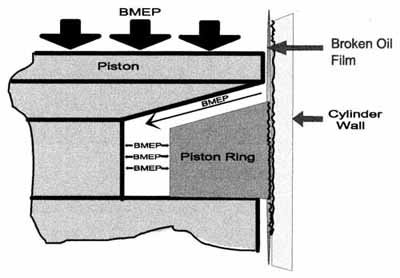
Piston rings seal by combustion chamber pressure getting between the ring and piston, excerting outward force. In the event of knock or pre-ignition, this is what happens:
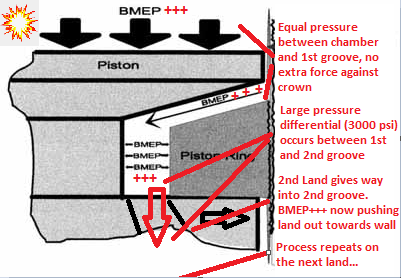
Detonation (knock) occurs after spark, where the pressure wave of the flame front becomes great enough for fuel to spontaneously explode. It can happen anywhere in the chamber.
Preignition happens before spark, when some component becomes hot enough to cause the charge to auto-ignite while the piston is still on the upstro.ke. Can originate at an overheated ground strap, hot exhaust valve, glowing carbon deposits, etc...
LSPI (low speed preignition) is generally or most stated to be caused by oil droplets being scraped into the combustion chamber and sufficiently lowering the octane to cause compression ignition (dieseling). When you think about where that oil is coming from, it seems probable that these unhappy little accidents may even begin within the ring groove itself.
In any case, all of them cause tremendous pressure spikes that crunch, melt, or twist things in a hurry.
edit: oh btw I'm no expert or authority on this, just explaining it as I see it. You probably shouldn't listen to me.
Attachments

Last edited:
luigisho
SHO Member
Well, another satisfied member...
Really many of us can get the key board ******* match going (myself certainly included at times) but, if you look at the last few threads, and parts of other ones-- members will try and focus on the best answers they can come up with without being able to look and get their hands on the actual project. There is alot of experience and certified and hobbiest mechanics (many of whom I would trust over an average certified tech all day long to work on my vehicle).
That said, nobody knows everything and diagnosing over the internet is tricky. What you will get, if enough experienced members get engaged, is a basket of good ideas.
Really many of us can get the key board ******* match going (myself certainly included at times) but, if you look at the last few threads, and parts of other ones-- members will try and focus on the best answers they can come up with without being able to look and get their hands on the actual project. There is alot of experience and certified and hobbiest mechanics (many of whom I would trust over an average certified tech all day long to work on my vehicle).
That said, nobody knows everything and diagnosing over the internet is tricky. What you will get, if enough experienced members get engaged, is a basket of good ideas.
i posted on an engine building forum and i was again told .011 is too tight even for a di engine. interesting, id like to ask the design team. and i should mention this is the first time this car was ever driven in 100+ degree ambient temps. brought it here from Michigan, piston went sometime in the first 4 months, january through april.It depends. I would check to see what the other pistons rings are spec'd at. It is rare (but not out of the question) that a single piston ring set would be dramatically different. @shoblock would be the person I would like to hear from about this. I don't feel that it is a tight ring situation. If it were, the engine would not have lasted for 100k miles.
Since this is a single piston failure, most of the time it is and LSPI or Mega Knock event. You can only mitigate it and not eliminate it. Just because the piston doesn't look compressed, doesn't mean it isn't.
the upper ring ends are shiny/plain metal, no coating like there is on the lower compression ring.I guess it would be better to see pictures illustrating how the (and which) ring was stuck, and a pic of the end wear. Don't know what goes down at the factory, but out in the real world you're supposed to file the gap edges after you cut them down to size, to remove any burrs.
Why are your gaps .002 smaller than they were wednesday? Are you squaring them and measuring at the right elevation in the bore? Is there perhaps a taper or out-of-round situation?
I only have Chilton to go by, but they list ring-to-groove clearance at .0015-.0031 so if I'm reading your measurements right, you've got both excessive groove width and only a .008" thick ring??? Nonetheless, I don't see a whole lot of point in trying to record groove dimensions on a smashed up piston.
Pre-ignition and detonation are two very different things, but have varied and similar consequences. The exact damage depends on the who what where when why and how long. Take a look at this diagram for a second:
View attachment 82573
Piston rings seal by combustion chamber pressure getting between the ring and piston, excerting outward force. In the event of knock or pre-ignition, this is what happens:
View attachment 82566
Detonation (knock) occurs after spark, where the pressure wave of the flame front becomes great enough for fuel to spontaneously explode. It can happen anywhere in the chamber.
Preignition happens before spark, when some component becomes hot enough to cause the charge to auto-ignite while the piston is still on the upstro.ke. Can originate at an overheated ground strap, hot exhaust valve, glowing carbon deposits, etc...
LSPI (low speed preignition) is generally or most stated to be caused by oil droplets being scraped into the combustion chamber and sufficiently lowering the octane to cause compression ignition (dieseling). When you think about where that oil is coming from, it seems probable that these unhappy little accidents may even begin within the ring groove itself.
In any case, all of them cause tremendous pressure spikes that crunch, melt, or twist things in a hurry.
edit: oh btw I'm no expert or authority on this, just explaining it as I see it. You probably shouldn't listen to me.
haps are smaller because i didn’t center the rings with the piston first time. and yes my piston ring is very thin, not sure what spec is.
seeing this, LSPI makes sense. considering i was sucking excess oil into my intake.
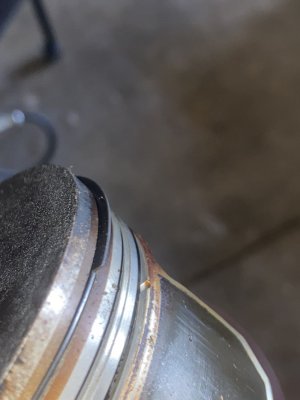
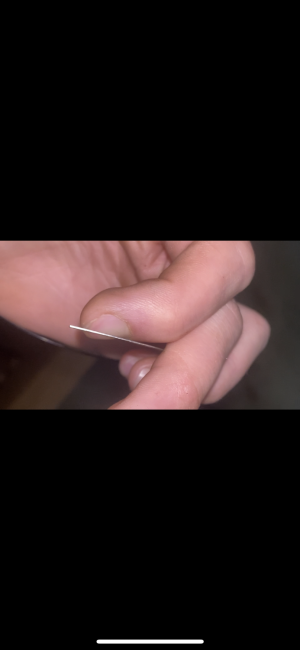
ring end was stuck in the groove horizontally, like in the picture.
ring end looks similar to wall edge of ring
Attachments
Unless you had someone like Doug Yates telling you that Ford's own spec won't work with Ford's own engines for Ford's intended use, then I again defer to Ford Motor Company over anyone else. But just do the safe thing, open the gap however much you wish and move on with life.i posted on an engine building forum and i was again told .011 is too tight even for a di engine. interesting, id like to ask the design team. and i should mention this is the first time this car was ever driven in 100+ degree ambient temps. brought it here from Michigan, piston went sometime in the first 4 months, january through april.
The running surface of the rings wearing is kinda what they're supposed to happen, and obv. if the rings were gap filed then there wouldn't be a coating there either. What you don't want is an extremely polished appearance on the ends, that would suggest closed gap. But also remember that this car was driven however many miles with a compromised piston and excessive heat passing through those rings, so who knows if anything you see is a symptom of that. Any signs of pitting or microwelding on the rings or the lands? Was there some piece of debris wedging the ring into place?the upper ring ends are shiny/plain metal, no coating like there is on the lower compression ring.
haps are smaller because i didn’t center the rings with the piston first time. and yes my piston ring is very thin, not sure what spec is.
seeing this, LSPI makes sense. considering i was sucking excess oil into my intake.
ring end was stuck in the groove horizontally, like in the picture.
ring end looks similar to wall edge of ring
Your top ring should be like .040 thick. When you measure something you really need to have it spotlessly clean. Your measurements make no sense to me so I'm going to assume a bunch of **** in the grooves still.
SM105K
Streetlight Grand Prix Champ/ IG @fafomotorsports
Here in AZ with our craptastic 91 octane, using a quality fuel (I prefer QT for 91), using a good oil (I prefer Castrol Edge in the Gold Bottle), and having a tune that is built to our environment is a must if you like to hot rod your SHO. I prefer Brad at AJP. Unfortunately you don't live in the land of 93 octane and sub 100 degree weather for 95 percent of the year anymore.i posted on an engine building forum and i was again told .011 is too tight even for a di engine. interesting, id like to ask the design team. and i should mention this is the first time this car was ever driven in 100+ degree ambient temps. brought it here from Michigan, piston went sometime in the first 4 months, january through april.
I have about 10 tunes I can load into my SHO at any given time. I have summer tunes, and winter tunes for a variety of fuels. That allows me to have complete control of my tunes instead of the varying weather conditions and fuel crappyness. Take for example, if I fill up with 91 and I am seeing excessive knock, I can go into my Livewire and select a stepped down tune. That will essentially turn the car down, lower the boost, tame the timing curve, and mitigate knock.
no putting or micro welding, no signs of debris holding ring. not sure why it was stuck, maybe some carbon? there is a little in the groove. piston is clean, ring is .017” thick. my math checks out.Unless you had someone like Doug Yates telling you that Ford's own spec won't work with Ford's own engines for Ford's intended use, then I again defer to Ford Motor Company over anyone else. But just do the safe thing, open the gap however much you wish and move on with life.
The running surface of the rings wearing is kinda what they're supposed to happen, and obv. if the rings were gap filed then there wouldn't be a coating there either. What you don't want is an extremely polished appearance on the ends, that would suggest closed gap. But also remember that this car was driven however many miles with a compromised piston and excessive heat passing through those rings, so who knows if anything you see is a symptom of that. Any signs of pitting or microwelding on the rings or the lands? Was there some piece of debris wedging the ring into place?
Your top ring should be like .040 thick. When you measure something you really need to have it spotlessly clean. Your measurements make no sense to me so I'm going to assume a bunch of **** in the grooves still.
yes i don’t plan on running lms again. it was done by my dad, i had no clue it was canned.Here in AZ with our craptastic 91 octane, using a quality fuel (I prefer QT for 91), using a good oil (I prefer Castrol Edge in the Gold Bottle), and having a tune that is built to our environment is a must if you like to hot rod your SHO. I prefer Brad at AJP. Unfortunately you don't live in the land of 93 octane and sub 100 degree weather for 95 percent of the year anymore.
I have about 10 tunes I can load into my SHO at any given time. I have summer tunes, and winter tunes for a variety of fuels. That allows me to have complete control of my tunes instead of the varying weather conditions and fuel crappyness. Take for example, if I fill up with 91 and I am seeing excessive knock, I can go into my Livewire and select a stepped down tune. That will essentially turn the car down, lower the boost, tame the timing curve, and mitigate knock.
so you’ve rebuilt, what does break in procedure look like? i heard varying rpms no load for 20-30 mins, then stay under 3k rpm with intermittent hard pulls for 1000 miles. change oil at 50, 100 , 500, and back to synthetic at 2000?Try not to scrape or pick at the valves. Use something non abrasive like crc intake turbo cleaner directly or walnut blast. Goes for all valves especially if they are nitride or similar coated. Not sure if they are coated or not, i had one out and it looked factory coated
.017" is a razor blade. Literally, I tossed one of those cheapo Harbor Freight breakaway blades in my caliper and it was .0165". Chilton shows factory rings at .046". JE specs .040" for their pistons. How does over 60% of a piston ring just vanish? Also you said:no putting or micro welding, no signs of debris holding ring. not sure why it was stuck, maybe some carbon? there is a little in the groove. piston is clean, ring is .017” thick. my math checks out.
Groove width minus groove clearance = ring width, so .051" - .043" = .008" ring width...upper ring to groove clearance - .043
upper ring groove width - .051
-or -
.051" groove - .017" ring = .034" RTG clearance...
-or-
.017" ring + .043" RTG = .060" groove...
Your measurements seem irratic and totally unreliable. But who am I to question the math of the most qualified mechanic to ever own an SHO?

Good luck with the reassembly
yeah made a typo..017" is a razor blade. Literally, I tossed one of those cheapo Harbor Freight breakaway blades in my caliper and it was .0165". Chilton shows factory rings at .046". JE specs .040" for their pistons. How does over 60% of a piston ring just vanish? Also you said:
Groove width minus groove clearance = ring width, so .051" - .043" = .008" ring width...
-or -
.051" groove - .017" ring = .034" RTG clearance...
-or-
.017" ring + .043" RTG = .060" groove...
Your measurements seem irratic and totally unreliable. But who am I to question the math of the most qualified mechanic to ever own an SHO?
Good luck with the reassembly
my new ring end gap is .013”
 how do i make the gap smaller?!?!?
351Blueblood
Member
- Joined
- Jan 5, 2018
- Messages
- 42
- Reaction score
- 23
Just for reference Ford does not get it right 100% of the time. Terminator piston to wall clearance was too tight and would scuff pistons. Ford also didn't allow hot coolant to flow out of the rear of 4.6 heads smoking the #8 exh valve guides. Famous 4.6L tick. First run of mach 1 intakes had huge casting flash in them that lowered HP from listed #'s. Changed 4 thread sparkplug holes to 9 thread to stop blowing spark plugs out of heads. Then the crazy 2 piece 3V sparkplugs that break off in heads.
Last edited:
luigisho
SHO Member
13+ Torque Specs & Engine Specs!!
13+ Torque Specs & Engine Specs!!
www.ecoboostperformanceforum.com
Similar threads

- Replies
- 3
- Views
- 1K
- Replies
- 6
- Views
- 1K
- Replies
- 2
- Views
- 767
- Replies
- 11
- Views
- 2K


