Kevlar Rev2 Summary
The pull itself was actually a major success once the data was separated from the 3–4 confusion.
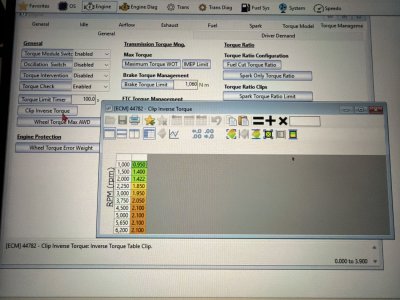
The car reached the 2.10 desired-load clip repeatedly, with actual load peaking at 2.141 in 4th. Corrected boost peaked around 24 psi, although it was closer to 22.4 psi at peak airflow. Turbo airflow reached 61.23 lb/min, basically right against the 62 lb/min Turbo FMEM limit. Engine Brake Torque peaked at 551 lb-ft in 4th. EMP stayed exceptionally good, peaking around 21 psi and remaining near or below boost. Spark ramped cleanly to the 16° ceiling with no positive knock.
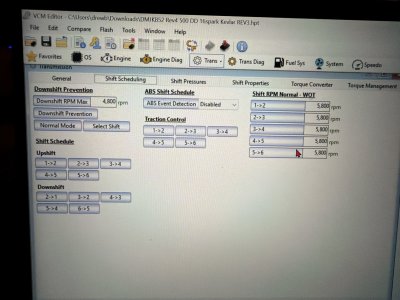
The important shift-scheduling mistake was realizing that the 6200-rpm value was telling the transmission when to begin the shift, not where I wanted the completed shift to occur. With the engine accelerating that quickly, starting the 3–4 at 6200 left almost no room before the 6600-rpm engine-speed authority became active.
At the 3–4, the PCM encountered both Engine Speed Limit and Turbo FMEM intervention. The TCM appeared to lose confidence in the handoff and commanded 3–4–3–4 before finally staying in 4th. This was not a normal clutch flare, and the converter was intentionally released during that section. The actual completed 3–4 did not show a conventional RPM flare.
Once it finally established 4th, the car was excellent. Load, airflow, boost and torque were all strong and stable. I lifted before it could perform a true WOT 4–5, so WOT 4–5 was not validated, but the later 4–5 under reduced load was smooth and showed no issue.
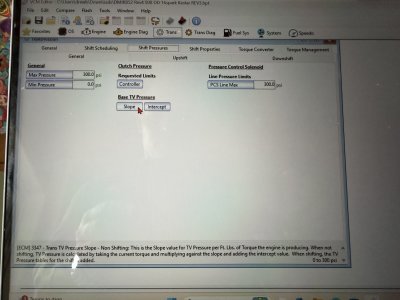
The next file now commands the WOT shifts at 5850 rpm with the goal of having the physical shift complete around 6200. I also lowered Desired TIP Max from 75.33 to 72 inHg absolute, which should bring the practical boost target down to about 21 psi. The Turbo FMEM airflow limits were raised conservatively from 60/62 to 68/70 lb/min, and I added only a small amount of low-airflow WGDC for spool. The 500 DD request, 2.10 inverse-load clip and 16° spark ceiling remain.
The torque-request discussion is still unresolved. The 500-lb-ft Driver Demand table was clearly the upstream source, but the processed ETC/brake request reached roughly 655–670 lb-ft and Scheduled Torque reached roughly 740 lb-ft before being converted into the 2.10 desired-load request.
Ryan’s position appears to be that because a 500 DD entry resulted in approximately 655 lb-ft of processed request, entering 655 DD would effectively be the same. I still do not see that supported anywhere in the data. The log consistently trends in the intuitive direction: more upstream request produces more downstream request until another limiter clips it. Raising the original DD source should not somehow neutralize the processing that increased the 500 request unless another modifier is simultaneously changed.
Later in clean 4th gear, when the active torque source returned to Driver Demand, the channels were much more coherent: roughly 516–530 lb-ft ETC/brake request, 598–610 lb-ft Scheduled Torque, 2.02–2.05 load and approximately 500–530 lb-ft Engine Brake Torque. That section strongly supports 500 DD already being enough to create approximately 2.0 load and 500-plus brake torque. I am not raising the maximum request simply because the controller processes it into a higher internal torque domain.
One of the biggest discoveries was that TIP Max is effectively the practical boost-control ceiling on this setup. The electronic bypass valves are disabled because the car uses mechanical TiAL BOVs, so the PCM cannot open the factory eBOVs to trim compressor pressure during a pull. The mechanical BOVs remain closed under boost and are not WOT boost regulators.
That leaves Desired TIP, wastegate duty and throttle as the PCM’s main pressure-control tools. The old Max Pressure value was 75.33 inHg absolute, and the log showed Desired TIP repeatedly hitting exactly 75.33. At the logged barometric pressure, that represented approximately 22.6 psi desired boost, and actual boost overshot to approximately 24 psi.
So the PCM was not accidentally wandering into that boost, it was using every bit of pressure the calibration permitted. Max Pressure has now been lowered to 72 inHg absolute, approximately 21 psi gauge at the same atmospheric pressure. Wastegate control will attempt to achieve that TIP target, while the 2.10 load clip remains the airmass ceiling and throttle remains available for intervention.
In simple terms:
Torque request → desired load → desired TIP → TIP Max ceiling → WGDC controls the turbos
With no electronic bypass-valve authority, lowering TIP Max is the cleanest direct way to reduce the boost the PCM is permitted to pursue.
The remaining concern is hydraulic. After the pull, mild acceleration was okay, but adding more load caused a shudder. When I got home, Reverse would engage and move the car a few feet, then lose holding capacity while backing up my steep driveway. I repeated that three or four times. Cycling the ignition immediately restored Reverse as though nothing had happened.
That now points toward one of two things:
1)The fluid level is marginal. This transmission has historically hesitated on the WOT 1–2 when filled only to the normal full mark, and adding one extra pint fixed it. I did not perform that intentional overfill this time.
2)The valve body/main-control and solenoid assembly is losing hydraulic stability when hot or heavily demanded.
The plan is to warm it normally, verify the fluid level correctly, add the known extra pint and retest. If TCC shudder, pressure loss or weak Reverse returns, the test is over and the valve body, solenoid assembly and TRS will be replaced.
Kevlar Rev3 is ready.