Calibration Integrity of the 2010–2012 EcoBoost SHO HPTuners

Disclaimer: Links on this page pointing to Amazon, eBay and other sites may include affiliate code. If you click them and make a purchase, we may earn a small commission.

802SHO

Boost > VE, MBT, Cams
Supporting Member
Joined
Oct 8, 2019
Messages
3,378
Reaction score
7,967
Location
Essex Junction Vermont
Hahahahahaha mystery solved. I was in VCM Editor basic view. I needed to be in Advanced View. So I exposed a missing definition in basic view but it’s in advanced view. Well, learned 2 things. We are exposing definitions properly and accurately and now we are in advanced view, which in hindsight what a crazy option hey, do you want to be able to see only some stuff yeah that’s a good idea. How about we just only look at some of the stuff and give us Control to some of it. IMG 21C0A843 5D10 434E 9095 670EAFF9C1B9
That’s ok. On track now
 

802SHO

Boost > VE, MBT, Cams
Supporting Member
Joined
Oct 8, 2019
Messages
3,378
Reaction score
7,967
Location
Essex Junction Vermont
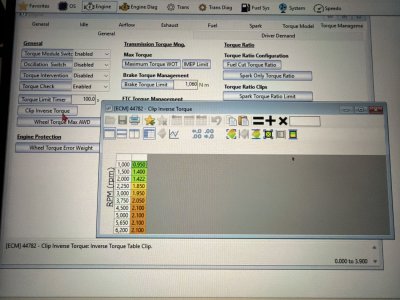
Sent this to Ryan with my revision: I may have conceded you too soon. I found and exposed an inverse torque load clip and it was exactly what was active holding the car back in my last test. I then learned that it’s already exposed and I was always in BASIC view. ‍♂️ but I’m exposing definitions perfectly.

I see you set it to 3.0 load. Maybe previously wondering why the car was holding back? I think it’s an excellent safety limiter so I ramped mine up to 2.0 load around 3,750 rpm then it’s all 2.1. In case it wants to overshoot it’ll get clipped. To me that’s perfect.

My Driver demand max 500 request is going to make about 1.8 load bc it should end up about 560-580 on IT and 1.8 range on inverse. Your explanation was too simplified there’s no log or file that supports a max driver demand request cutely landing on IT and inverse load.

I also completed my training for advanced parameters and have reset the dead system DTC’s in the new file DMJKB52. As well as disabled my annoying TPMS light in Forscan.

I’ll be testing what my Driver Demand can really do on the next test. Again my OSS is smoothed to give my cautious foot near max and as I press it more it’ll just be the max and never exceed my max with my earlier multiplier. So we will see if you were accurate. Does my 500 DD land at 1.6 load or 1.8? Only one way to find out
 

802SHO

Boost > VE, MBT, Cams
Supporting Member
Joined
Oct 8, 2019
Messages
3,378
Reaction score
7,967
Location
Essex Junction Vermont
So tuning this car is to accurately command load. Boost is merely a byproduct. It’ll command boost all on its own to satisfy the torque request if its pressure limits are reasonable and calculated just above targets, it’ll use it. My math puts this car at 1.7-1.9 load all day. Just does it do it at 18 or 20+psi? This way I’m learning to command load and calculate the boost the car will need. So it’s always a load target first, boost target second. Boost target is what I build my spark strategy around for the fuel I’m using. The silent inverse torque clip set intentionally just above my load target ensures the car always has a safety fence.

It’s an incredibly satisfying loop. Tune, log and detail and take pics.

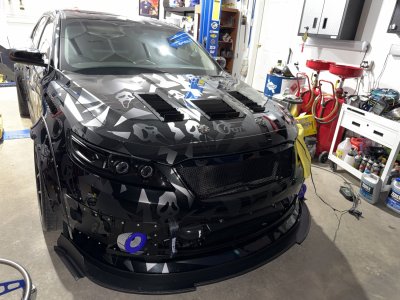
Car is ready. Clean, tuned, plenty of 93 in the fuel cell. After work it’s test time IMG 1472
 

802SHO

Boost > VE, MBT, Cams
Supporting Member
Joined
Oct 8, 2019
Messages
3,378
Reaction score
7,967
Location
Essex Junction Vermont
Kevlar Rev2 Summary

The pull itself was actually a major success once the data was separated from the 3–4 confusion.

The car reached the 2.10 desired-load clip repeatedly, with actual load peaking at 2.141 in 4th. Corrected boost peaked around 24 psi, although it was closer to 22.4 psi at peak airflow. Turbo airflow reached 61.23 lb/min, basically right against the 62 lb/min Turbo FMEM limit. Engine Brake Torque peaked at 551 lb-ft in 4th. EMP stayed exceptionally good, peaking around 21 psi and remaining near or below boost. Spark ramped cleanly to the 16° ceiling with no positive knock.

The important shift-scheduling mistake was realizing that the 6200-rpm value was telling the transmission when to begin the shift, not where I wanted the completed shift to occur. With the engine accelerating that quickly, starting the 3–4 at 6200 left almost no room before the 6600-rpm engine-speed authority became active.

At the 3–4, the PCM encountered both Engine Speed Limit and Turbo FMEM intervention. The TCM appeared to lose confidence in the handoff and commanded 3–4–3–4 before finally staying in 4th. This was not a normal clutch flare, and the converter was intentionally released during that section. The actual completed 3–4 did not show a conventional RPM flare.

Once it finally established 4th, the car was excellent. Load, airflow, boost and torque were all strong and stable. I lifted before it could perform a true WOT 4–5, so WOT 4–5 was not validated, but the later 4–5 under reduced load was smooth and showed no issue.

The next file now commands the WOT shifts at 5850 rpm with the goal of having the physical shift complete around 6200. I also lowered Desired TIP Max from 75.33 to 72 inHg absolute, which should bring the practical boost target down to about 21 psi. The Turbo FMEM airflow limits were raised conservatively from 60/62 to 68/70 lb/min, and I added only a small amount of low-airflow WGDC for spool. The 500 DD request, 2.10 inverse-load clip and 16° spark ceiling remain.

The torque-request discussion is still unresolved. The 500-lb-ft Driver Demand table was clearly the upstream source, but the processed ETC/brake request reached roughly 655–670 lb-ft and Scheduled Torque reached roughly 740 lb-ft before being converted into the 2.10 desired-load request.

Ryan’s position appears to be that because a 500 DD entry resulted in approximately 655 lb-ft of processed request, entering 655 DD would effectively be the same. I still do not see that supported anywhere in the data. The log consistently trends in the intuitive direction: more upstream request produces more downstream request until another limiter clips it. Raising the original DD source should not somehow neutralize the processing that increased the 500 request unless another modifier is simultaneously changed.

Later in clean 4th gear, when the active torque source returned to Driver Demand, the channels were much more coherent: roughly 516–530 lb-ft ETC/brake request, 598–610 lb-ft Scheduled Torque, 2.02–2.05 load and approximately 500–530 lb-ft Engine Brake Torque. That section strongly supports 500 DD already being enough to create approximately 2.0 load and 500-plus brake torque. I am not raising the maximum request simply because the controller processes it into a higher internal torque domain.

One of the biggest discoveries was that TIP Max is effectively the practical boost-control ceiling on this setup. The electronic bypass valves are disabled because the car uses mechanical TiAL BOVs, so the PCM cannot open the factory eBOVs to trim compressor pressure during a pull. The mechanical BOVs remain closed under boost and are not WOT boost regulators.

That leaves Desired TIP, wastegate duty and throttle as the PCM’s main pressure-control tools. The old Max Pressure value was 75.33 inHg absolute, and the log showed Desired TIP repeatedly hitting exactly 75.33. At the logged barometric pressure, that represented approximately 22.6 psi desired boost, and actual boost overshot to approximately 24 psi.

So the PCM was not accidentally wandering into that boost, it was using every bit of pressure the calibration permitted. Max Pressure has now been lowered to 72 inHg absolute, approximately 21 psi gauge at the same atmospheric pressure. Wastegate control will attempt to achieve that TIP target, while the 2.10 load clip remains the airmass ceiling and throttle remains available for intervention.

In simple terms:

Torque request → desired load → desired TIP → TIP Max ceiling → WGDC controls the turbos

With no electronic bypass-valve authority, lowering TIP Max is the cleanest direct way to reduce the boost the PCM is permitted to pursue.

The remaining concern is hydraulic. After the pull, mild acceleration was okay, but adding more load caused a shudder. When I got home, Reverse would engage and move the car a few feet, then lose holding capacity while backing up my steep driveway. I repeated that three or four times. Cycling the ignition immediately restored Reverse as though nothing had happened.

That now points toward one of two things:

1)The fluid level is marginal. This transmission has historically hesitated on the WOT 1–2 when filled only to the normal full mark, and adding one extra pint fixed it. I did not perform that intentional overfill this time.
2)The valve body/main-control and solenoid assembly is losing hydraulic stability when hot or heavily demanded.

The plan is to warm it normally, verify the fluid level correctly, add the known extra pint and retest. If TCC shudder, pressure loss or weak Reverse returns, the test is over and the valve body, solenoid assembly and TRS will be replaced.

Kevlar Rev3 is ready.
 

802SHO

Boost > VE, MBT, Cams
Supporting Member
Joined
Oct 8, 2019
Messages
3,378
Reaction score
7,967
Location
Essex Junction Vermont
IMG 1596
Kevlar Rev3 update:

Tonight’s pull was the cleanest yet. The new 72-inHg TIP ceiling worked exactly as intended, holding Desired TIP to roughly 21 psi while actual boost peaked around 22.1 psi. The car carried 2.0-plus load, peaked at 2.149 actual load and approximately 543 lb-ft Engine Brake Torque, with no positive knock, no Turbo FMEM and no Engine Speed Limit intervention.

The added transmission fluid also looks extremely promising. After ending up slightly over one additional quart, Reverse worked before the pull and still worked afterward on the same key cycle. That is the strongest evidence yet that the previous TCC shudder and weak Reverse may have been caused by insufficient fluid volume rather than a failed valve body or solenoid assembly.

I did manually command the 3–4 while beginning to lift, so that was not a valid full-torque shift test. However, it still proved the new engine calibration stayed stable without the previous 3–4–3–4 confusion.

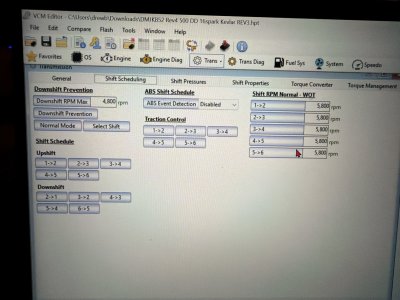
I lowered every WOT shift-start value another 50 rpm:IMG 9E75FE8E 26E0 45C1 BDC7 FE53674C8D58
These values tell the transmission when to begin shifting, not where the completed shift occurs. With the expected 300–500 rpm carry during clutch application, 5,800 should place the actual completed shifts close to the 6,200-rpm target while maintaining plenty of distance from the 6,600-rpm engine-speed limit.

We also added a small deceleration crackle experiment:
-Closed-throttle DFCO delay: 0.15 second
-Warm decel spark cap:
-2,500 rpm: 10°
-3,000 rpm: 5°
-4,000 rpm: 0°

It worked far more effectively than expected. A loaded pull followed by a complete lift produced a rapid string of pops rather than one isolated crack. I left the spark the same but reduced closed-throttle delay to 0.05 and will retest. That should slow it down a bit. I want to try to get it to be OEM+ just a crackle here and there more than normal.

Tomorrow’s test will be the real validation:
-Full automatic 3–4 at WOT
-Actual completed shift RPM
-Sustained 4th-gear load and airflow
-TCC holding after the shift
-Reverse operation after another full heat cycle
-Confirmation that the added fluid solved the hydraulic instability

For the first time it’s looking real coherent
 
Last edited:

802SHO

Boost > VE, MBT, Cams
Supporting Member
Joined
Oct 8, 2019
Messages
3,378
Reaction score
7,967
Location
Essex Junction Vermont
Funny if it was just low trans fluid. Honestly that’s best case scenario. Once hot gets finicky. Sure. We’ll see.

Today isn’t a fishing trip it’s validation. Does the TCM shift around 6200rpm? Does the TCM maintain hydraulic pressure once hot? Does load hold at 2.1? Does the TCC recover and hold? Does Reverse work at max temp?

If the answer is Yes, then this may be the first genuinely dialed in 93 octane tune and run pretty damn hard. Would be worthy of a full pull I’d say. And see if it can be dialed in further depending on the datalog.
 

802SHO

Boost > VE, MBT, Cams
Supporting Member
Joined
Oct 8, 2019
Messages
3,378
Reaction score
7,967
Location
Essex Junction Vermont
Kevlar Rev3 Results - Engine

Kevlar Rev3 was the most coherent the car has felt to date. The revised OSS modifier immediately improved pedal response during normal driving, and the engine calibration behaved almost exactly as intended.

Current engine strategy:

• Driver Demand capped at 500 lb-ft
• Inverse Load clip limited to 2.15
• Desired TIP limited to 72.0 inHg absolute
• Spark limited to approximately 16°
• Turbo airflow protection limits raised conservatively instead of disabled
• Revised OSS modifier for improved low and mid pedal response

Overall WOT results:

Peak Boost: 21.7 psi
Peak Turbo Airflow: 58.9 lb/min
Peak Actual Load: 2.09
Peak Engine Brake Torque: 541 lb-ft
Peak EMP: 19.9 psi

Fuel pressure, lambda and system voltage all remained stable.

Spark remained between approximately 12.25-15.5° with no positive knock throughout the pull.

Most importantly, the previous Turbo FMEM event never occurred. The PCM stayed inside the intended operating window while maintaining the new 72 inHg TIP ceiling.

One thing worth mentioning is the established 4th gear section.

It was NOT a clean power-on 3-4 shift. The transmission suffered a severe flare and the PCM performed a complete torque reduction after Engine Speed Limit was reached. Once the transmission finally recovered and established 4th gear, however, the engine rebuilt boost, airflow and torque remarkably well.

During the recovered 4th gear section:

• Desired Load remained fixed at 2.15
• Actual Load rebuilt and remained above 2.0
• Desired TIP stayed fixed at 72.0 inHg
• Actual TIP tracked very closely to the commanded ceiling
• Airflow stabilized around 50 lb/min
• Engine Brake Torque remained strong and stable
• Spark recovered smoothly with no knock activity

That is probably the biggest takeaway from this revision.

The engine was able to recover from a complete shift-related power interruption and still sustain over 2.0 actual load in 4th gear.

A proper hydraulic 3-4 handoff should inherently produce even better numbers because turbine speed, boost, exhaust energy and airflow would all be maintained through the shift instead of having to rebuild afterwards.

Overall I'm extremely happy with where the engine calibration has ended up on 93 octane.
 

802SHO

Boost > VE, MBT, Cams
Supporting Member
Joined
Oct 8, 2019
Messages
3,378
Reaction score
7,967
Location
Essex Junction Vermont
Kevlar Rev3 Results - Transmission

Unfortunately the transmission continued to confirm a hydraulic problem.

The first WOT shift was not a scheduling issue.

The shift was already being requested around 5800 RPM (OEM is approximately 6200 RPM), yet the clutch-to-clutch handoff still failed.

The sequence was essentially:

Shift initiated
→ Hydraulic clutch handoff flared
→ Engine/input speed accelerated
→ Engine Speed Limit reached
→ PCM removed nearly all engine torque
→ Transmission finally recovered

The limiter was the reaction, not the cause.

After recovering, the transmission eventually established 4th gear, but later gear changes also showed delayed clutch application and repeated gear requests before completing.

After the pull things deteriorated quickly.

Forward gears became usable only below approximately 1/4 throttle.

Anything beyond that produced significant shudder.

Reverse would barely move the car on flat ground and would no longer back the car up my driveway.

Cycling the ignition immediately restored Reverse, although only temporarily.

While attempting to diagnose it I also briefly lost TRS reporting while driving before it eventually repopulated.

The Reverse datalog was probably the most useful information gathered.

Reverse initially applied and moved the car.

As load increased, output speed dropped to zero while engine and transmission input speed continued increasing.

The controller was commanding very high line pressure, yet Reverse could no longer hold the vehicle.

The pressure PIDs are commanded/calculated values rather than actual measured hydraulic pressure, so the PCM was clearly requesting pressure, but the transmission was no longer producing enough clutch holding force under load.

I also noticed a small amount of dark residue beginning to appear on the transmission dipstick.

At this point I don't believe there is much more useful information to gain by continuing WOT testing with this transmission.
 

802SHO

Boost > VE, MBT, Cams
Supporting Member
Joined
Oct 8, 2019
Messages
3,378
Reaction score
7,967
Location
Essex Junction Vermont
Next Steps

The engine calibration has answered most of the questions I was trying to solve.

At this point I don't want to risk the expensive transmission components until I know exactly what happened internally.

Current parts waiting to go in:

• Precision Stage 3 converter
• New valve body
• New solenoid body
• New TRS

That's roughly $4,000 worth of transmission parts.

I'm not willing to gamble those parts on the current transmission without first understanding the condition of the Kevlar build.

I'm also replacing the passenger side engine mount with a new Ford mount simply to remove another mechanical variable from the car.

Before doing anything else I'll be pulling a transmission fluid sample and sending it to Blackstone Laboratories for analysis.

I'm also seriously considering picking up a complete 2015 Taurus 6F55 with approximately 40,000 miles that I found locally for around $500.

If I go that route I'll install it as a complete assembly with its original converter, valve body, solenoid body and TRS.

I'll drain it completely, replace the filter, refill it with fresh Mercon LV, enter the correct solenoid strategy into GUB, perform the adaptive relearn and continue testing the current Kevlar Rev3 engine calibration.

That would let me finish the 93 octane engine development while removing the failing transmission from the equation.

Meanwhile I'll work with Kevin to determine whether the Kevlar transmission should be split for internal inspection before installing the Stage 3 converter and the new hydraulic components.

Overall I actually consider Kevlar Rev3 a success.

The engine now behaves like a coherent torque model instead of multiple systems fighting one another.

The transmission has simply reached the point where it is limiting any additional progress.
 

802SHO

Boost > VE, MBT, Cams
Supporting Member
Joined
Oct 8, 2019
Messages
3,378
Reaction score
7,967
Location
Essex Junction Vermont
Next Steps Confirmed: Autopsy of the Current 6F55. I have now confirmed the plan with Kevin, who built the transmission.

He agreed that testing with the used transmission is the better approach and will allow us to work out the timing for opening the current unit and determining exactly what failed.

I’ll also send another fluid sample to Blackstone before teardown. The previous sample reported 1% insolubles, which Blackstone considered high. Since then, the transmission has had three drain-and-fills and has only been driven approximately 350 miles, so the new results should be useful when compared with the internal inspection.
 

Forum statistics

Threads
107,154
Messages
1,181,988
Members
16,206
Latest member
brainmax61

Members online

Back
Top