

You are using an out of date browser. It may not display this or other websites correctly.
You should upgrade or use an alternative browser.
You should upgrade or use an alternative browser.
BBS and ported intake runners
- Thread starter shotime1994
- Start date
Disclaimer: Links on this page pointing to Amazon, eBay and other sites may include affiliate code. If you click them and make a purchase, we may earn a small commission.

jonmon6691
No dough SHO
FYI, taking the horns out will increase the resonant RPM, not decrease it. Shorter = higher RPM. That's why the secondaries are short and the primaries are long.
Yes, but to a completely un-usable number like 12k rpms
victorymike18
New Member
...They are just there to quiet the sound. The long runners do not have them and I think if they were an important part to how the intake works they would have them as well.
I'm not a guru when it comes to these motors, but I can say with some certainty that the air horns are not there for the sole purpose of reducing sound...
The way I see it, they have at least two purposes:
First, as mentioned: they are likely calculated to lengthen the secondary runners to tune into a helmholtz resonance, and improve peak power.
Second: the plenum wall on the port entry side is riddled with bumps, and bulges. Air drawn from there would likely be very turbulent, and not enter the port as smoothly. By drawing from the center(ish) of the plenum, the air enters the runner smoothly.
I'm not sure why the primaries don't have air horns. Maybe the engineers were more focused on the secondaires, and felt the primaries did their job well enough.
On another note: The air horns provide a reasonable radiused entry into the port. David Vizard has done experiments (a long time ago) to show the improvements of using a radiused entry, and which types flow better. Believe it or not, a surprising amount of air is drawn from all around the air horn, and not just from the area in front of it. Vizards experiment proves this:

Last edited:

I made up a set of BBB airhorns to help smooth the transition into the port ( get rid of the nasty step when you get rid of the factory air horns) and get into some clean air away from all the casting crap on the plenum wall. I made them on a lathe so i matched the outer diameter to fit the plenum hole and the inner diameter to match the BBB size. The airhorn walls are pretty think and i was able to flair the tube a little and make a smooth radious. I guess it would close to number 3 in the above chart. I made a couple different shapes and length but it boiled down to installation, once you build them you have to install them, I had to install these by inserting them in the cross over tube hole.

P.S They were installed with no welding, just some set screw drilled and tapped from the outside.
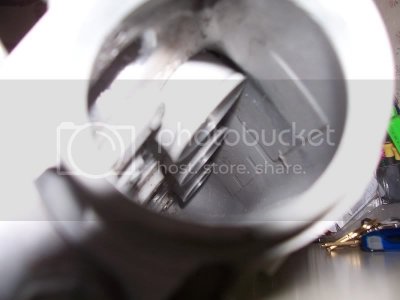
I also tried a set of curved ones ( mandrel bent aluminum) but could not get them installed after they were flaired ( sort of cutting up and re welding the plenums) and running tubes with out a bell mouth is a waste. If you realy need to mod your intake farther then this I would suggest just starting from scratch.
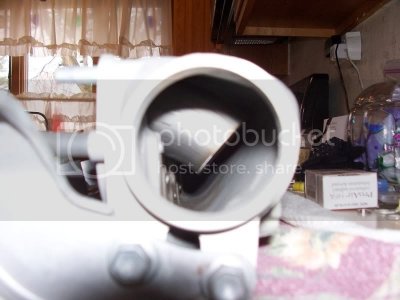
To be honest this is all guess work , with out a flow bench and dyno numbers Im just duplicating what seems to work in other proven intake systems.
P.S They were installed with no welding, just some set screw drilled and tapped from the outside.
I also tried a set of curved ones ( mandrel bent aluminum) but could not get them installed after they were flaired ( sort of cutting up and re welding the plenums) and running tubes with out a bell mouth is a waste. If you realy need to mod your intake farther then this I would suggest just starting from scratch.
To be honest this is all guess work , with out a flow bench and dyno numbers Im just duplicating what seems to work in other proven intake systems.
Last edited:
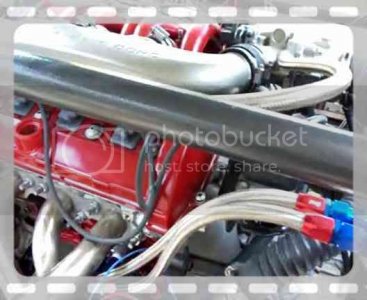
On my intake, I plan on removing the entire butterfly assembly, and then fabbing some new larger horns. I have two EH intakes, so I could dyno a stock intake, an EH/BBB intake with horna, then my monster no BB's/EH intake with big horns (in fact, I am right now laying claim to the name BIG HORN INTAKE!!!)
Sorry , BIG HORN INTAKE is already taken , and installed on a running engine

Last edited:
SHOGUN88
1994 MTX
I just beveled all the ports and the secondaries like the old sho shop ones. Im sure its not as good as horns but it helps.


_JR_
New Member
Great thread timing guys!
I'm picking up my BBB's this friday!
I asked about the intake horns as i had no clue what they were. Thanks for posting the pictures up above!
This thread has helped me understand things a bit better.
Hopefully the tech that i have do the work knows which gasket he needs and which one he wont lol. I only plan on putting my BBB's in when i get my cobra calipers put on. Hoping to do all the mods in one day.
Never mind, i just noticed this thread has a 2nd page....I'm in the same boat as Vnuk on this one
I'm picking up my BBB's this friday!
I asked about the intake horns as i had no clue what they were. Thanks for posting the pictures up above!
This thread has helped me understand things a bit better.
Hopefully the tech that i have do the work knows which gasket he needs and which one he wont lol. I only plan on putting my BBB's in when i get my cobra calipers put on. Hoping to do all the mods in one day.
Never mind, i just noticed this thread has a 2nd page....I'm in the same boat as Vnuk on this one
Last edited:

jonheese
Used-To-Know-It-All
My understanding of the current state of affairs was that the horns are good on an unmodified intact tract (their length is important in the Helmholtz tuning), but if you have BBBs, then leaving them in just restricts the intake path (since the interior cross-sectional area of the horns is less than the butterflies).
I didn't think there was really any discussion of the above "facts".
So, if you have BBBs, you'll want to remove the horns to really get any improved flow from them, but know that you will be changing the intake "tune" a bit, in effect raising the resonant RPM of the secondary tract.
If you don't have BBBs, then leave the horns in, because they do serve an important purpose for making power.
The majority of the discussion above was about making custom big-bore horns to keep the intact tract length tuned while getting full flow from the BBBs.
I didn't think there was really any discussion of the above "facts".
So, if you have BBBs, you'll want to remove the horns to really get any improved flow from them, but know that you will be changing the intake "tune" a bit, in effect raising the resonant RPM of the secondary tract.
If you don't have BBBs, then leave the horns in, because they do serve an important purpose for making power.
The majority of the discussion above was about making custom big-bore horns to keep the intact tract length tuned while getting full flow from the BBBs.
Last edited:
kconnor
Member
Engineering Departments are notorious penny pinchers. You can be certain that those air horns serve an important purpose otherwise they would not have spent the money putting them in. My guess would be intake tuning. I think the only way to tell if the horns impede BBB airflow would be to flow each one individually. The butterflies have the plate and shaft obstructing flow; the horns don't have to deal with that. Because of that reason, I wouldn’t be surprised if the horn flowed as well or better than the BBB.
Last edited:

Engineering Departments are notorious penny pinchers. You can be certain that those air horns serve an important purpose otherwise they would not have spent the money putting them in. My guess would be intake tuning. I think the only way to tell if the horns impede BBB airflow would be to flow each one individually. The butterflies have the plate and shaft obstructing flow; the horns don't have to deal with that. Because of that reason, I wouldn’t be surprised if the horn flowed as well or better than the BBB.
You got that backwards. Engineers will spend what they need to do what they want in general ( I am an engineer). Accountants are the penny pinchers.
The horns have a smaller diameter thenthe BBBs so they are a restriction. Simple fact.
jonheese
Used-To-Know-It-All
I agree with your conclusion, but I think the justification isn't quite accurate. A big part of predicting flow is looking at the cross-sectional area, which is clearly affected largely by diameter, but that's not the whole story. As kconnor points out, the butterfly plate and shaft do reduce the cross-sectional area of the butterfly, and will impede flow to a certain degree.The horns have a smaller diameter thenthe BBBs so they are a restriction. Simple fact.
Luckily it's a simple math problem to determine the rough numbers involved. Pi * (horn-diameter/2)^2 gives you the cross-sectional area of the horn, and pi * (BBB diameter/2)^2 - area-of-shaft gives you the (rough) cross-sectional area of the BBB. Compare those two numbers and that will tell you whether or not the horns are a restriction. I don't have the dimensions in front of me at the moment, but I can measure them later if anyone wants.
Another thing to keep in mind about this topic is that the horns are venturis, meaning that they have flared ends. This increases the velocity and reduces the pressure of the air flowing through it. This effect is often used in engine intakes, often at the carb inlet and the head port.
Think Weber carb horns:

So yeah, that's something to keep in mind when you pull them. You're losing that Venturi effect.
jonheese
Used-To-Know-It-All
Agreed. Just waiting on someone to do it.
Agreed. Just waiting on someone to do it.
Everyones waiting on everyone. Why not do it?
jonheese
Used-To-Know-It-All
Once my car is put back together and running, I'd be happy to. Just need to find a dyno.
SHO SPD
SHO member #480
The only purpose to remove them is when you install BBBs. You wont improve anything if you remove them "for fun".
It will improve sound IMO
Thats worth it to me whatever the loss or gainturbo79
SHO Member
I agree with your conclusion, but I think the justification isn't quite accurate. A big part of predicting flow is looking at the cross-sectional area, which is clearly affected largely by diameter, but that's not the whole story. As kconnor points out, the butterfly plate and shaft do reduce the cross-sectional area of the butterfly, and will impede flow to a certain degree.
Luckily it's a simple math problem to determine the rough numbers involved. Pi * (horn-diameter/2)^2 gives you the cross-sectional area of the horn, and pi * (BBB diameter/2)^2 - area-of-shaft gives you the (rough) cross-sectional area of the BBB. Compare those two numbers and that will tell you whether or not the horns are a restriction. I don't have the dimensions in front of me at the moment, but I can measure them later if anyone wants.
Another thing to keep in mind about this topic is that the horns are venturis, meaning that they have flared ends. This increases the velocity and reduces the pressure of the air flowing through it. This effect is often used in engine intakes, often at the carb inlet and the head port.
Think Weber carb horns:
So yeah, that's something to keep in mind when you pull them. You're losing that Venturi effect.
In addition to the Weber example you show, I recall that Hilborn makes direct port fuel injection systems (used often on sprint cars, IIRC) that use tuned velocity stacks. You never see these systems without these stacks, and they come in various lengths.
It's kind of hard to ignore that photo of the Beemer V8 system...
Pic of sprint car engine: http://www.world-sprintcar-guide.com/sprint-car-engines.html
Pics of Hilborn injector systems. Don't see very many without velocity stacks: http://www.hilborninjection.com/category.asp?Id=187
So, I'm not big on just removing velocity stacks without some research, even with BBBs.
It might be possible to use the bases of the SHO stacks to make a stack that has the same diameter as the BBBs. I'd buy a set if they were well engineered and could be bolted on like the originals.
Last edited:
jonheese
Used-To-Know-It-All
There ya go: velocity stack. I knew there was a name for them that I forgot. Yup, that's exactly what I was thinking of.
I'm reminded of the cover of Smokey Yunick's "Power Secrets", with the SBC and its monstrous velocity stack:

I'm reminded of the cover of Smokey Yunick's "Power Secrets", with the SBC and its monstrous velocity stack:
Similar threads

- Replies
- 2
- Views
- 612


