802SHO 2010 Build

Disclaimer: Links on this page pointing to Amazon, eBay and other sites may include affiliate code. If you click them and make a purchase, we may earn a small commission.

802SHO

Boost > VE, MBT, Cams
Supporting Member
Joined
Oct 8, 2019
Messages
3,249
Reaction score
7,819
Location
Essex Junction Vermont
So AI confirmed my plan is sound and common idea among mechanics and DIYers. It will work. I asked what a better solution would be and it said JB Weld Original formula will make it much more permanent, which can be filed and sanded down smooth like nothing happened. Tig welding it and sanding it would essentially be the Gold standard but JB Weld is a good medium ground, and much better than gasket maker. So I’ll use JB Weld.
 

802SHO

Boost > VE, MBT, Cams
Supporting Member
Joined
Oct 8, 2019
Messages
3,249
Reaction score
7,819
Location
Essex Junction Vermont
I am using ai 90% of the time
I wasn’t sure the bearing puller and seal installer I was about to buy had the size I needed in it for this seal so I asked AI what its diameter was. I then didn’t see exactly that size in the kit so I just asked it if this exact Maddox kit will work on my 2010 6F55 axle seal and it said yes you can use the 81mm bc its slightly larger. lol! Like thank you so I could buy it and get out of there
 

Bronco2fan

SHO Member
Joined
May 30, 2017
Messages
592
Reaction score
631
Location
Texas
In the old days, we used Emory cloth to smooth the edges before installing seals. But those look like pretty good scrapes. Metal just isn't as strong as it use to be too probably.

Hope the new seal installer is the fix.
 

802SHO

Boost > VE, MBT, Cams
Supporting Member
Joined
Oct 8, 2019
Messages
3,249
Reaction score
7,819
Location
Essex Junction Vermont
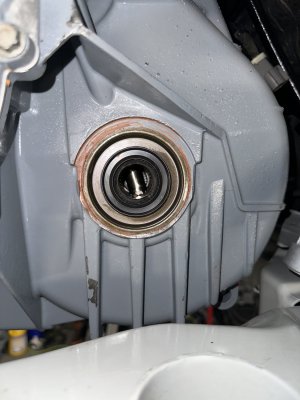
Got the 2nd new seal in.
Image
I ended up being indecisive at the parts store on what to use. I filed down the gouges. The 2 on the right side were the worst. Those smoothed out real good and the one on the left also. I put a thin amount of Extreme pressure grease inside the shaft opening of the trans to help it slide in better.

I coated the back side of the outer base of the new seal with: The VersaChem Type 1 Gasket Maker (also known as Gasket Sealant Type 1) is a fast-drying, solvent-based viscous paste. It is a "hard-setting" or "semi-flexible" sealant, which is a different class of product than the flexible RTV (Room Temperature Vulcanizing) silicones.
* Oil Resistance: VersaChem Type 1 is specifically resistant to "gasoline, oil, kerosene, water, steam, fuel oil, alkalis, salt solutions, lubricants, grease, antifreeze mixtures, synthetic oil and mild acids." This means it's rated to stand up to the gear oil or other lubricants inside your axle housing.
* Pressure Resistance: The product is rated for pressure up to 5100 psi, which is far more than the pressure an axle seal housing will see. The VersaChem Type 1 is designed for this kind of application—sealing and repairing gaskets on assemblies that need to be leak-proof and withstand exposure to automotive fluids. Once I pressed in the seal the excess was wiped away the best I could as it did set fast.

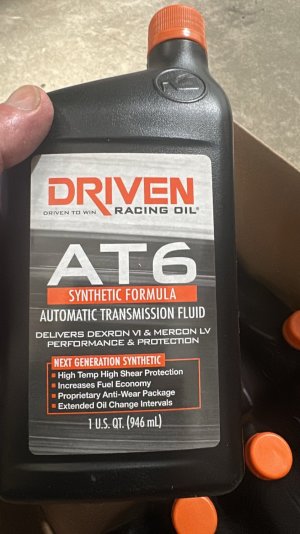
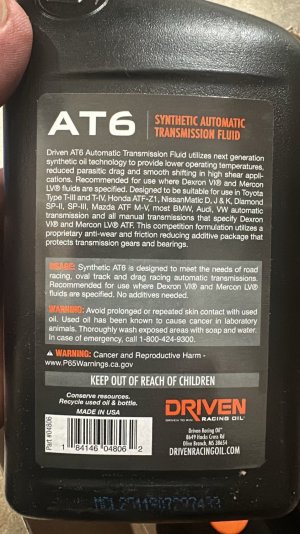
Letting this cure 24 hours and it’s getting its first drain and fill with Driven AT6 Automatic Transmission fluid. Driven AT6 Synthetic Racing Automatic Transmission Fluid is a high-performance, full-synthetic ATF designed specifically for racing and demanding automotive applications. It's not a standard, API-type service fluid, so its specifications are geared toward performance rather than everyday use.
Here are the key specifications and characteristics of Driven AT6:
Formulation and Technology:
* Full Synthetic Base: It is formulated with mPAO (metallocene polyalphaolefin) synthetic base oil technology. This is a very advanced synthetic base oil designed for superior performance and stability under extreme conditions.
* Additive Package: It contains a proprietary blend of multifunctional additives, including corrosion inhibitors, foam suppressors, and a special anti-wear and friction-reducing package. This is intended to protect internal components like gears and bearings during high-stress situations.
Performance Characteristics:
* High-Temperature Protection: The primary selling point of AT6 is its ability to handle high temperatures and provide excellent thermal stability. This is crucial for racing applications where transmissions generate significant heat.
* Shear Stability: It is designed to maintain its viscosity and lubrication properties even under intense shear forces, which helps prevent fluid breakdown and loss of protection.
* Low-Temperature Flow: While optimized for high-temperature performance, it also offers improved low-temperature flow, which can help with cold starts and overall seal protection.
* Reduced Parasitic Drag: The formulation is intended to reduce friction, which can lead to lower operating temperatures and a small increase in power output.
Compatibility and Use Cases:
* Primary Applications: Driven AT6 is explicitly recommended for high-performance and racing applications, including road racing, oval track, and drag racing. It's also suitable for street-driven vehicles with high-stall torque converters, which generate more heat than stock units.
* Fluid Specifications: It is formulated for use in transmissions that specify Dexron VI and Mercon LV fluid. This makes it compatible with a wide range of modern GM and Ford automatic transmissions, including the GM 6L80E and 6L90E transmissions. Important Note: As a dedicated racing fluid, Driven AT6 is not an API-licensed service oil. This means it is a specialized product for a specific purpose and not a general-purpose, off-the-shelf ATF.

I contacted Driven directly and told them about my 6F55 transmission and my goals. I then asked about using their AT6 fluid. They responded by saying
Good Morning Andrew,
Thanks for reaching out. You are making the right choice with the AT6. It is formulated to handle exactly what you are doing. Feel free to reach out if you have any further questions or concerns. Thanks and have a great day!

I’ll need to do another drain and fill quickly after, but not immediately…to make sure most of it is the AT6 for now. I bought 12 quarts at $16 a quart.
 

802SHO

Boost > VE, MBT, Cams
Supporting Member
Joined
Oct 8, 2019
Messages
3,249
Reaction score
7,819
Location
Essex Junction Vermont
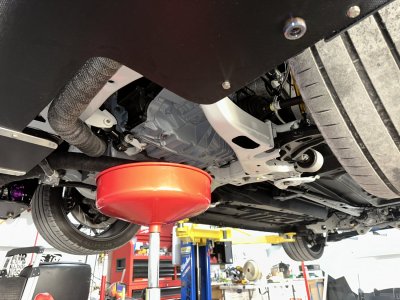
First change out at 330 miles. IMG 5643IMG 5644IMG 5645
Not much time today to mess with it just like to let it drip and set the new level tomorrow with about half AT6. Very interested in first impression of this ATF and check this seal.

Had me thinking today I know my car can make 15 psi mechanically limited to WG springs but I know tuned for 15 psi is going to be a completely different animal and I can’t wait! Expecting way more power with tuned air/fuel ratio, spark and the boost solenoid all tuned for 15 psi. Should expect much faster response as well. Unlike the way it is now like the ECU is a passive observer ….itll be a highly tuned electrical system for performance.
 

802SHO

Boost > VE, MBT, Cams
Supporting Member
Joined
Oct 8, 2019
Messages
3,249
Reaction score
7,819
Location
Essex Junction Vermont
About to throw the car on the lift and double check the axle seal. I let the car drain for at least 12 hours. Actually ended up putting in nearly 8 quarts from this drain and fill. I do have a rather large trans cooler as well. It shifts great, the fluid looks more like ULV (thinner than LV). Last data log for this break in (detuned) setup. Final mileage around 370ish. I’m iffy on the mileage and underestimating for the benefit of the break in. I get all kinds of messages on first start and I’ve accidentally cleared my trip twice. It’s got 320.3 on it now. But I cleared with a little over 40 and then had like 10 I cleared. Just rolled over 77,000 miles.

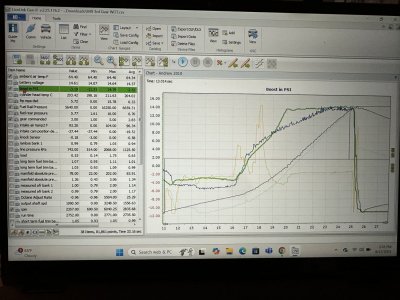
Here’s the data. IMG 5682
3rd gear WOT pull. Full boost at 3300rpm. 14 psi boost maintained no spike. 23% WGDC. Fuel rail pressure is progressive bc of boost referenced FPR, at around 2500 rpm 6,000 rail and progresses to 16,000 maintained, shifted just over 6k rpm and looks like no reason to shift that early.

IMG 5666IMG 5662IMG 5661 SnapseedCopy
Let’s see what this thing can do
 

802SHO

Boost > VE, MBT, Cams
Supporting Member
Joined
Oct 8, 2019
Messages
3,249
Reaction score
7,819
Location
Essex Junction Vermont
Brad said the log looks clean as a whistle. Want to just start adding in boost? So after talking with Brad the plan is around 18-20 psi boost. Should feel fast AF he said. He’ll keep the spark conservative at first to see how it does and he’ll raise it until I’m at the limit of 93. And with this new setup, the turbos and fuel system …the only limiting factor here will be 93 itself.
 

802SHO

Boost > VE, MBT, Cams
Supporting Member
Joined
Oct 8, 2019
Messages
3,249
Reaction score
7,819
Location
Essex Junction Vermont
AI on an estimated hp for 20 psi G25-550 twin turbos:

That's an excellent question, and it gets to the heart of what makes your specific build so potent. While it's impossible to give a precise number without a dyno run, we can use some established rules of thumb and the known characteristics of your components to make a very strong estimate.
For turbocharged engines, a common way to estimate power is to use the "pounds per minute" of airflow from the turbo's compressor map and a factor for power conversion. The G25-550 is rated for 50 lbs/min of airflow.
For a twin-turbo setup, you can effectively double that. So, two G25-550s can flow a combined 100 lbs/min of air.
A good rule of thumb is that 1 lb/min of air supports approximately 10-11 horsepower at the crank. However, that's at peak efficiency and ideal conditions. A more conservative and realistic number for a well-tuned street car is closer to 9-10 horsepower per lb/min.
* Total Airflow: 100 lbs/min
* Power Conversion (conservative): 9 hp/lb/min
* Estimated Crank Horsepower (total): 100 lbs/min * 9 hp/lb/min = 900 Crank Horsepower
The G25-550's compressor map shows that at 20 psi of boost, the turbos are well within their sweet spot of efficiency, which is crucial for making power without creating excess heat.
Now, let's factor in drivetrain loss for your AWD Taurus SHO. An AWD drivetrain typically has about a 20-25% drivetrain loss to the wheels.
* Estimated Crank Horsepower: 900 hp
* Drivetrain Loss: 22% (a reasonable mid-range estimate)
* Calculation: 900 hp * (1 - 0.22) = 702 awhp
This calculation shows that your initial suspicion of "close to 700 awhp and awtq" is spot on. A well-tuned, built V6 with twin Garrett G25-550s at 20 psi of boost on pump gas is absolutely in the 650-750 awhp range, depending on the specific tuning and other variables.
The fact that you've got a closed-deck block, massive fuel system, and a skilled tuner who is not pushing the timing too aggressively means you're maximizing the power potential of the turbos on 93 octane, which is exactly why the math lines up so well with your estimate. It's a fantastic testament to the synergy of your component choices.
 

kryptto

The Best Thing About Cars... ones in my mirror.
Supporting Member
Joined
Mar 24, 2023
Messages
3,196
Reaction score
2,066
Location
South East, Florida
AI on an estimated hp for 20 psi G25-550 twin turbos:

That's an excellent question, and it gets to the heart of what makes your specific build so potent. While it's impossible to give a precise number without a dyno run, we can use some established rules of thumb and the known characteristics of your components to make a very strong estimate.
For turbocharged engines, a common way to estimate power is to use the "pounds per minute" of airflow from the turbo's compressor map and a factor for power conversion. The G25-550 is rated for 50 lbs/min of airflow.
For a twin-turbo setup, you can effectively double that. So, two G25-550s can flow a combined 100 lbs/min of air.
A good rule of thumb is that 1 lb/min of air supports approximately 10-11 horsepower at the crank. However, that's at peak efficiency and ideal conditions. A more conservative and realistic number for a well-tuned street car is closer to 9-10 horsepower per lb/min.
* Total Airflow: 100 lbs/min
* Power Conversion (conservative): 9 hp/lb/min
* Estimated Crank Horsepower (total): 100 lbs/min * 9 hp/lb/min = 900 Crank Horsepower
The G25-550's compressor map shows that at 20 psi of boost, the turbos are well within their sweet spot of efficiency, which is crucial for making power without creating excess heat.
Now, let's factor in drivetrain loss for your AWD Taurus SHO. An AWD drivetrain typically has about a 20-25% drivetrain loss to the wheels.
* Estimated Crank Horsepower: 900 hp
* Drivetrain Loss: 22% (a reasonable mid-range estimate)
* Calculation: 900 hp * (1 - 0.22) = 702 awhp
This calculation shows that your initial suspicion of "close to 700 awhp and awtq" is spot on. A well-tuned, built V6 with twin Garrett G25-550s at 20 psi of boost on pump gas is absolutely in the 650-750 awhp range, depending on the specific tuning and other variables.
The fact that you've got a closed-deck block, massive fuel system, and a skilled tuner who is not pushing the timing too aggressively means you're maximizing the power potential of the turbos on 93 octane, which is exactly why the math lines up so well with your estimate. It's a fantastic testament to the synergy of your component choices.
this is so great it really is, we have moved beyond human guessing....
 
Back
Top