SHO motor project, new to SHO motor.

Disclaimer: Links on this page pointing to Amazon, eBay and other sites may include affiliate code. If you click them and make a purchase, we may earn a small commission.

Zach'sV6

Member
Joined
Apr 8, 2010
Messages
59
Reaction score
11
Location
Texas
Also, continuing on the exhaust...

If you go strictly by the numbers, the "ideal" exhaust layout for this motor and a 3500lb car is:

1x 2.5in-2.5out reactive muffler ~8-10" long (like a flowmaster or something)

1x side branch resonator, 2.5in diameter, you can play with the length depending on what drone (Hz) you need to cancel out, but between 28" and 40" is typically good enough. Locate it anywhere between the muffler and the 1st resonator (above) halfway is a good place.

I'll go in to side branch resonators later if there is any interest. If you want to see what a car with SBR's sounds like, look up "370z saclam" on google or youtube. SBRs are NOT "backpressure tubes"...there's no such thing.

If you really want to get technical with your car and go for that exotic car type sound, you can design a Herschel-Quincke tube set for your car (Ferrari's have this, so to NSX's, where it looks like a nest of interconnected exhaust pipes that loop back on each other) I might tackle this later.

If you split the exhaust like I will, cap it off with 2x absorptive mufflers (like a vibrant or a magnaflow)

-Zach'sV6
 

shomethe$$$

SHO Member
Joined
Sep 10, 2007
Messages
480
Reaction score
131
Location
Washington D.C.
I'm not a fan of the stepped header and reversion chambers, some builders live by them but I've mostly only seen them on N/A vehicles, it just goes against Bernoulli's principles.

I did a thread sometime back with a thorough air flow analysis, I think put some information regarding maintaining good low rpm velocity, reducing reversion and good high rpm flow without killing backpressure.
 

Zach'sV6

Member
Joined
Apr 8, 2010
Messages
59
Reaction score
11
Location
Texas
Remember though, Bernoulli's principles only apply to incompressible fluids and compressible fluids at low mach numbers neither of which apply to an exhaust system. This is especially true within the header and doubly so near the exhaust valve.

Also, exhaust gas isn't a steady state fluid. Density, temperature (heat addition and rejection), and viscosity are all time dependent variables in fresh exhaust gas.

Even better, the stagnation points change based on the loading and speed of the engine.

Then, there are regions withing the exhaust system where the flow changes from supersonic to transonic to subsonic. (again, based on load and speed).

Add to that viscosity changes...and so on.

It's best described using some pretty intense mathematics. (Rayleigh, Fanno, Navier-Stokes equations, RANS)

Anyway, at the end of the day, the point is to keep the velocity high over a wide range of engine speeds and conditions, which ultimately leads you to stepped headers. Another way of saying it: minimize the "bad" effects of an exhaust system tuned to perform optimally at a certain RPM (in my case, around 6000rpm) on an engine operating outside of that rpm range.

-Zach'sV6
 
Last edited:

shomethe$$$

SHO Member
Joined
Sep 10, 2007
Messages
480
Reaction score
131
Location
Washington D.C.
I guess for the analysis I did, I assumed exhaust velocities that were well below the speed of sound in a 1500 degree medium, so that's why I went by Bernoulli's and not the compressible equations, so going by what you said stepped headers could by a good adder.
 

Zach'sV6

Member
Joined
Apr 8, 2010
Messages
59
Reaction score
11
Location
Texas
Given a standard header with a standard collector vs. a stepped header with a merge collector (12deg convergent and 3deg divergent cone and accompanying reducer)

Under the same conditions, the gains are 15-25% over a comparable conventional header of the same length at the design RPM.

All other things being equal (<---the important phrase here), if you gain 20hp with a regular header, you might gain 25hp with a stepped header and a merge collector. The advantage being, too, that the step/merge combo will perform better over a wider rpm range. You see them on race cars for the same reason they use titanium exhaust tubing...slight advantage here...slight advantage there...all adds up to a winning car.

Really, it's only 5hp at best, but...since I have to build them myself anyway it's kind of an "as long as you're in there" thing. Also, it doesn't cost any more as long as I build them myself...if I had to buy them...well, go price stepped headers/merge collectors and you'll see what I mean.

-Zach'sV6
 

Twisted6

New Member
Joined
Apr 10, 2010
Messages
36
Reaction score
0
Location
Charlotte, NC
I just want to say thank you to zach for this plethora of information. It will be a great help as I move towards the same stages in my RWD project.
 

Zach'sV6

Member
Joined
Apr 8, 2010
Messages
59
Reaction score
11
Location
Texas
I'm still here...still working on the project. Not much to report.

Two things:

1) shophoenixproject.com is down...looks like whoever runs it no longer owns the domain name. Too bad, it was a good site imho.

2) I'm thinking of doing the electric power steering pump conversion ala Toyota MR2. -IF- I do it (it's fairly straightforward) I'll post it as I go.

It'll be for a Mustang in my case, but I can't see it being too hard for any other car, SHO included.

-Zach'sV6
 

firebat45

SHO Member
Joined
May 7, 2008
Messages
869
Reaction score
472
Location
Edmonton
Great thread, looks like you really know your stuff.

I'm dissappointed that SHOPP is down too.

Not to start the huge engine debate up again, but that heavily modded SHO engine in the salt flat car isn't that crazy when it comes to the bore and stroke. It was a 3.0, bored to 3 9/16" and destroked to 3". A stock 3.2 has a larger bore than that, and the stock stroke for a SHO is only 3.1". He must have been running some crazy cams and porting, because the extra power certainly didn't come from the displacement.

Someone mentioned variable cams being (relatively) simple to retrofit mechanically, and the electrical part would be the killer. Care to elaborate? Start a new thread or PM me maybe? Running Megasquirt, it seems to me that the electrical is the easy part. The company that makes Megasquirt even has a standalone variable cam control box.

Zach, I'm trying to source an MR2 setup as well for my cars. It's a very simple retrofit, a lot of guys do it for the extra power and simplified engine. You could also look into using the rack from an S2000, I saw a few go on ebay for real cheap. If you do go the MR2 route, try to get the steering computer and relays as well, so you don't have to have the pump running constantly. Most people do that, but it doesn't sit right with me, having the motor run constantly when it was meant for intermittent use. Not something you'd want to fail.
 

Zach'sV6

Member
Joined
Apr 8, 2010
Messages
59
Reaction score
11
Location
Texas
Great thread, looks like you really know your stuff.

I had to show my wife that, hehe. It won't help me win an arguement but thanks for the ammo anyway.

So, HP is a function of TQ and RPM. If any engine is generating sufficient TQ at some ungodly RPM, it will make huge HP.

Consider an F1 engine. They are limited to 2.5L but with the use of AlBe connecting rods and pneumatic valve springs they get up to 20,000rpm. They only make about 200ft-lb of TQ but it's at 18-20k rpm...so you get 700+ hp.

On an SHO engine, the physics don't change, just the path you take to get there. If you hog the ports, use aluminum rods, 4 bolt mains, peen the crank, use lightweight pistons, and radical cams, you can get engine to some unbelievable RPM and, thus, some pretty radical HP numbers. But...you better have some serious walking around money.

Oh, I talked to Bill Miller at BME. He will make aluminum rods for the SHO engine for about $1200 IIRC. He guaranteed them to outlast the car if the engine is allowed to warm up before being driven hard. Also, they are MUCH stronger than the stock rods and free up some rotating weight which leads to more hp (same reason Ferrari uses flat-plane cranks in their V8...lighter = more hp)

For variable cam timing. I was looking at the Porsche 968 variocam system which seems to be the easiest to retrofit to a SHO. VarioCam varies the timing of the intake valves by adjusting the tension on the timing chain connecting the intake and exhaust camshafts, which is radically simpler than other systems. I'll think about it a little more and then post again, but it might be very very simple and be able to be done with a simple rpm switch.

Go here and you'll see what I mean: http://www.928sg.com/heads.htm

-Zach'sV6
 
Last edited:

jonheese

Used-To-Know-It-All
Joined
Oct 28, 2004
Messages
892
Reaction score
626
Location
Fogelsville, PA
For variable cam timing. I was looking at the Porsche 968 variocam system which seems to be the easiest to retrofit to a SHO. VarioCam varies the timing of the intake valves by adjusting the tension on the timing chain connecting the intake and exhaust camshafts, which is radically simpler than other systems. I'll think about it a little more and then post again, but it might be very very simple and be able to be done with a simple rpm switch.

Go here and you'll see what I mean: http://www.928sg.com/heads.htm

-Zach'sV6
This.
 

firebat45

SHO Member
Joined
May 7, 2008
Messages
869
Reaction score
472
Location
Edmonton
Very interesting, but the Porsche setup drives the exhaust cam with the timing belt, and the intake with the chain. Slack in the chain advances timing. SHOs drive the intake cams though, and advancing the exhaust is not the same effect.

Definitely worth looking into though.
 

Zach'sV6

Member
Joined
Apr 8, 2010
Messages
59
Reaction score
11
Location
Texas
yeah, it's far from a perfect solution...it's a start though.

I suppose there could be a way to make a pulley that allows for advancing the cam...something like what an airplane uses to adjust the pitch of the prop...oil pressure driven...or electrical...some kind of swashplate.

-Zach'sV6
 

Zach'sV6

Member
Joined
Apr 8, 2010
Messages
59
Reaction score
11
Location
Texas
Ugh, i just want it in the car...then i'll think about variable cam timing more...or just buy a set of tri-flows and live with what I have.

-Zach'sV6
 

Zach'sV6

Member
Joined
Apr 8, 2010
Messages
59
Reaction score
11
Location
Texas
Come to think of it...

I could probably rig up something that advances or retards the entire valvetrain. As I understand it, advancing the cams gives you a little boost in low end torque and retarding the cams gives you a bit more high end power. I may be overthinking this.

-Z
 

stangracr67

Member
Joined
Feb 13, 2005
Messages
50
Reaction score
2
Location
south bend, in
Nice work so far. Do you have any more info on having a flywheel made? Ive got a Datsun 260Z and a 94 3.2 engine. Will the mustang type flywheel fit inside the adaptor plate? I like the idea of having clutch options. Also did you have to have the crank machined for a pilot bearing?
 

firebat45

SHO Member
Joined
May 7, 2008
Messages
869
Reaction score
472
Location
Edmonton
Nice work so far. Do you have any more info on having a flywheel made? Ive got a Datsun 260Z and a 94 3.2 engine. Will the mustang type flywheel fit inside the adaptor plate? I like the idea of having clutch options. Also did you have to have the crank machined for a pilot bearing?


I'm not sure about a Mustang clutch fitting (though I would lean towards saying yes, it would fit). I do know that the SHO crank has a indent for a pilot bearing already though. If you can't find one that fits, you can make a bushing relatively easily. OffroadSHO does this, he uses something called Oilite, some sort of oil-impregnated brass or something.
 

Off Road SHO

Moderator
Joined
Jan 16, 2002
Messages
5,684
Reaction score
1,292
Location
Arizona
I don't make the OilLite bushings myself, I have them made by a machine shop whose lathe is much more accurate than mine. I also have a needle bearing that fits the T-5 to the SHO crank.

A Mustang clutch (the pressure plate) does not bolt up to the SHO flywheel. The people at Cannfield can probably make you a flywheel that bolts up to the SHO crank, has an extra long snout to account for any adaptor thickness, and is drilled for the Mustang V-8 clutch.

Tom
 

NovaSS

Project MINIGUN
Joined
Aug 22, 2005
Messages
532
Reaction score
580
Location
Maryland
A came up with a design to advance / retard timing on sbc a while ago, its used a longer timing chain for a raided cam block and had idlers on either side that were connected on a common shaft, the idlers would move side to side allowing the slack to move from the load side to idler side, this would advance or retard cam timing a few degrees while running. You could do the same thing to a show, you would have to add a second belt idler to the timing belt across from the factory one and link them together so you could countrol them together.

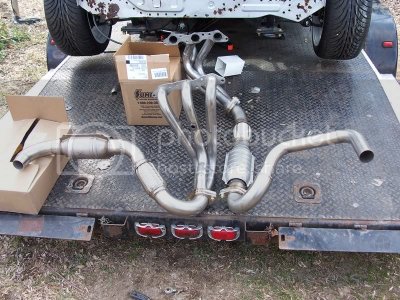
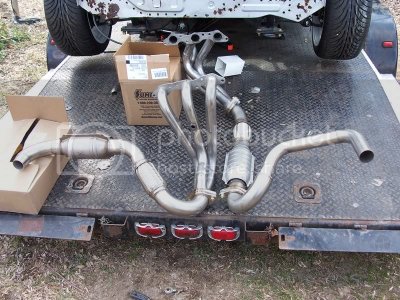
As for exhaust. I spent a bunch of time building up a set of headers for a sho project but in the end it came down to packaging, I wanted longer primarys and almost went to a step design but in the end I settled on these, While not perfect they are stainless and used merge collectors. I also wanted cat conveters. 1 5/8 priamarry, 2 1/4 collectors to the cats then down to 2 going into mufflers ( not shown) as the exhaust cools you dont need as much cross section .

100 1081
 
Last edited:
Back
Top