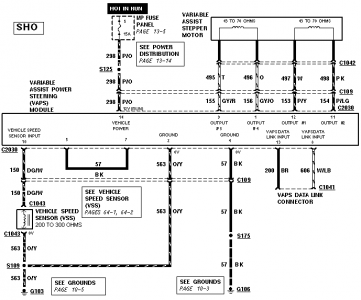
In the far distant past, I can remember a discussion (may have been with Terry) where, under a special circumstance, the rack can be fooled into making the default something other than maximum boost.
I have no idea where this VAPS thing gets it's electrical signal to reduce the boost, but since I have no signal, can I remove the module, cap it off, and carry on?
The racks are different enough that the service manual says a VAPS rack can't be serviced, and must be replaced as a unit, vs. the normal one with service procedures for mechanics. That should indicate there is more to it than just the external servo and pressure fittings, that one shouldn't just plug up the hole.
The assist valve will likely be at the high assist setting, unless the vehicle got into a crash that disabled the battery before the VAPS could detect the car stopped.
The previous method is to disable it when driving. From
ShoTimes:
First locate the VAPS module it is on the LH side of the dash to the right of the column. There should be a purple with orange stripe wire going to it. Cut this wire and splice in a switch to turn it on and off. Next here is how it works. According to the manual the motor is infinite in adjustment but there are four basic control modes.
Idle- this is max boost for parking and Reverse
20 mph- first adjustment made to lower boost
40mph - next adjustment made only about 1/3rd boost
60mph- last adjustment should no boost or very little
after you have the switch in place get up to the speed you like hold it steady for a few seconds and turn the switch off. Now slow down and see what you think. Once you play with it for a few minutes you will find out what you like. Everybody will be different. My self I want a little more boost at speed because of larger tires and UDP's that slow the P/S pump my car requires a little more effort to turn through the curvy canyons that I drive in. My brothers SHO that is bone stock on the other hand felt better with less boost. So to each his own.
With the VAPS module and it wired up, one could instead run the self-test, and disable it quickly with a switch when it reaches the desired assist.
With the VAPS module, and the ability to simulate the VSS signal, one could avoid the driving part also.
There is no clear documentation of how to manually operate the primary and secondary stepper motor actuators in the servo without a VAPS module. Setting to conflicting positions could cause problems. We know at most from the service manual that when testing the two module wires to either actuator (when parked), one wire should measure above 10V and the other under 2V (which one - not documented). With the hoses disconnected, one can view a spring that moves a bit inside the bottom port when the diagnostic goes through the motions (if you can get a view of that with a borescope, etc)