

You are using an out of date browser. It may not display this or other websites correctly.
You should upgrade or use an alternative browser.
You should upgrade or use an alternative browser.
4k RPM activation
- Thread starter svtnos
- Start date
Disclaimer: Links on this page pointing to Amazon, eBay and other sites may include affiliate code. If you click them and make a purchase, we may earn a small commission.
Power Surge
SHO Member
It's controlled by the computer. The PCM activates a vacuum solenoid that opens the butterfly runners and switches them over to the shorter runners.
0V3RC10CK3D
New Member
To open them at a different RPM range? You can reprogram it with a chip. I think it's 3800 when they open by default though.
Last edited:

dantheman68
Kinda Big deal
yes, you can tap into the wire... i dont know how that would help you... when the secondaries are closed, both wires send voltage to the IAS, and then at ~4K one of the wires grounds to the PCM activating the solenoid, and shutting off vaccum

93rev2sev
SHO Member
I smell manual secondary runner control...
NiNeTy Fo SHO
No-mo-SHO Man
Yes you do...but it will help you none as they are set at the most optimal place from the factory. They open at 3950 rpms. Unless you go forced induction, there really is no point in changing them.
Open them earlier and you loose torque...open them later and your choking the engine until they open.
Open them earlier and you loose torque...open them later and your choking the engine until they open.
SHOtime2511
CGP
Yes you do...but it will help you none as they are set at the most optimal place from the factory. They open at 3950 rpms. Unless you go forced induction, there really is no point in changing them.
Open them earlier and you loose torque...open them later and your choking the engine until they open.
agreed,the factory knew what was best.
Power Surge
SHO Member
Yes you do...but it will help you none as they are set at the most optimal place from the factory. They open at 3950 rpms. Unless you go forced induction, there really is no point in changing them.
Open them earlier and you loose torque...open them later and your choking the engine until they open.
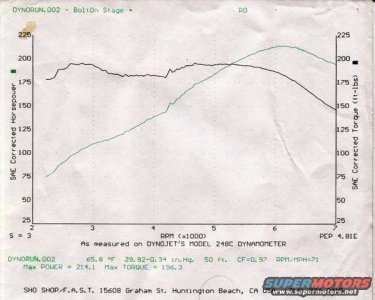
I disagree. If you look at the dyno graph from my stock 90, you can see how much power AND torque picks up once the secondary runners open. You can see on the graph that they could certainly benefit from opening sooner.
When I tune 4 valve 4.6 cars with IMRCs, I open them sooner as well and it always nets a power increase with no loss in torque.

JustinSane
SHO OFF
every ones dyno graphs will jump up when the secondarys open, that alone isnt proof you would gain from having them open sooner, i think if you would have them open sooner or from the get go you would see a drop in low end torque and the dyno graphn would mearly not have that **** but rather a more sloped reading. rig them to stay open and do a dyno run and you will see what we mean. of course as stated this dont pertain as much to a forced induction setup.

jedhead
New Member
I have mine open at 3500rpm. The power does not come on as abrutly.
Bob
Bob
NiNeTy Fo SHO
No-mo-SHO Man
I disagree. If you look at the dyno graph from my stock 90, you can see how much power AND torque picks up once the secondary runners open. You can see on the graph that they could certainly benefit from opening sooner.
When I tune 4 valve 4.6 cars with IMRCs, I open them sooner as well and it always nets a power increase with no loss in torque.
I was basically repeating what I had read others write about changing them and the experience that they had when they tried. Basically, they gained nothing.
Also, the 4 valve 4.6 are a totally different animal...yes they are 4 valve motors like the SHO, but they have no secondary tracks like the SHO intake whatsoever. The 4 valves are always running I believe, so how do you "open then sooner" on a 4.6. The secondary runners open on the SHO at 4K...the valves are always running. I find this hard to believe...as I do own one and have never seen or ready anything about what you are saying anywhere...and I frequent quite a few forums.
Last edited:

Calypso
**** Deer
Believe me, having the secondaries open earlier is not that great. They are stuck open on my old '93, and man does that thing suck below 4K.

ritmusic2k
wears a tux.
In answer to one of your first questions - the system does get more fuel when the secondaries are open, simply because there is more air coming into the cylinder. The EEC is striving to maintain a proper A/F ratio. I don't know, but I'd assume the fuel map is already tailored to this profile so it doesn't have to 'learn' to add more fuel by watching the O2s.
This is kinda secondary (sorry for the pun) to your main question that's already been answered, but I felt like chiming in
This is kinda secondary (sorry for the pun) to your main question that's already been answered, but I felt like chiming in
In answer to one of your first questions - the system does get more fuel when the secondaries are open, simply because there is more air coming into the cylinder. The EEC is striving to maintain a proper A/F ratio. I don't know, but I'd assume the fuel map is already tailored to this profile so it doesn't have to 'learn' to add more fuel by watching the O2s.
This is kinda secondary (sorry for the pun) to your main question that's already been answered, but I felt like chiming in
thank u i was just about to reask that question...

Actually at WOT you are not getting extra fuel as this is based on fixed fuel tables being open loop and all. More fuel is added because of the extra air but the AF ratio is probably set lean if it's anything like the V8. And the timing maybe flat too.
Last edited:
hawkeye18
Sorta cares
IIRC the factory programming is pig rich at WOT. Ford did not want to risk damaging the cylinders. I might be wrong, but I heard Ted Breaux talking about it.
Power Surge
SHO Member
Also, the 4 valve 4.6 are a totally different animal...yes they are 4 valve motors like the SHO, but they have no secondary tracks like the SHO intake whatsoever. The 4 valves are always running I believe, so how do you "open then sooner" on a 4.6. The secondary runners open on the SHO at 4K...the valves are always running. I find this hard to believe...as I do own one and have never seen or ready anything about what you are saying anywhere...and I frequent quite a few forums.
I'm not quite sure what you mean. You don't seem to have a good understanding of the DOHC 4.6 motors. They have intake butterflies just like the SHO motor does, for the same reason - to help promote low end torque.
Heck, even the new Mustang 3V 4.6 has them.
IIRC the factory programming is pig rich at WOT. Ford did not want to risk damaging the cylinders. I might be wrong, but I heard Ted Breaux talking about it.
That id true above the secondary opening rpm. What I doubt is at rpms below 3800. There if it like the V8 it is looking for stoich from the WOT factory tables.
Similar threads
- Replies
- 0
- Views
- 661
- Replies
- 70
- Views
- 7K
- Replies
- 85
- Views
- 6K


