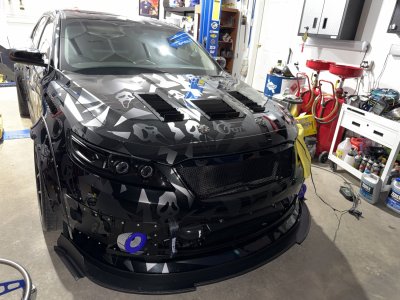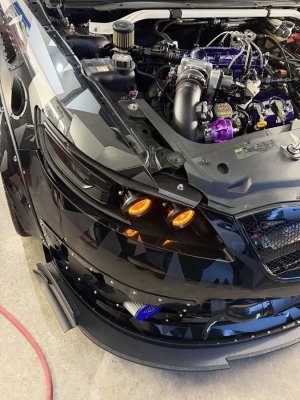
Kevlar Rev3 update:
Tonight’s pull was the cleanest yet. The new 72-inHg TIP ceiling worked exactly as intended, holding Desired TIP to roughly 21 psi while actual boost peaked around 22.1 psi. The car carried 2.0-plus load, peaked at 2.149 actual load and approximately 543 lb-ft Engine Brake Torque, with no positive knock, no Turbo FMEM and no Engine Speed Limit intervention.
The added transmission fluid also looks extremely promising. After ending up slightly over one additional quart, Reverse worked before the pull and still worked afterward on the same key cycle. That is the strongest evidence yet that the previous TCC shudder and weak Reverse may have been caused by insufficient fluid volume rather than a failed valve body or solenoid assembly.
I did manually command the 3–4 while beginning to lift, so that was not a valid full-torque shift test. However, it still proved the new engine calibration stayed stable without the previous 3–4–3–4 confusion.
I lowered every WOT shift-start value another 50 rpm:
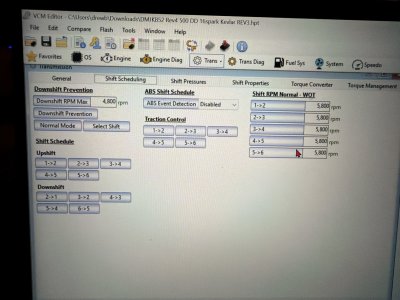
These values tell the transmission when to begin shifting, not where the completed shift occurs. With the expected 300–500 rpm carry during clutch application, 5,800 should place the actual completed shifts close to the 6,200-rpm target while maintaining plenty of distance from the 6,600-rpm engine-speed limit.
We also added a small deceleration crackle experiment:
-Closed-throttle DFCO delay: 0.15 second
-Warm decel spark cap:
-2,500 rpm: 10°
-3,000 rpm: 5°
-4,000 rpm: 0°
It worked far more effectively than expected. A loaded pull followed by a complete lift produced a rapid string of pops rather than one isolated crack. I left the spark the same but reduced closed-throttle delay to 0.05 and will retest. That should slow it down a bit. I want to try to get it to be OEM+ just a crackle here and there more than normal.
Tomorrow’s test will be the real validation:
-Full automatic 3–4 at WOT
-Actual completed shift RPM
-Sustained 4th-gear load and airflow
-TCC holding after the shift
-Reverse operation after another full heat cycle
-Confirmation that the added fluid solved the hydraulic instability
For the first time it’s looking real coherent


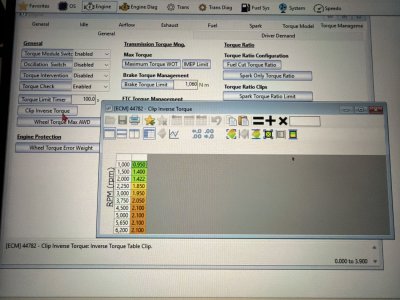
 but I’m exposing definitions perfectly.