What is the dwell time on our v6?

Disclaimer: Links on this page pointing to Amazon, eBay and other sites may include affiliate code. If you click them and make a purchase, we may earn a small commission.

Phoenix

SHOHOLIC
Joined
Mar 2, 2007
Messages
3,767
Reaction score
1,646
Location
QC , Canada
I got this question asked by the guy whos gonna make me some perfomance COPs , anyone knows this?
 

rubydist

SHO Master
Staff member
Super Moderators
Joined
Jun 25, 2007
Messages
7,521
Reaction score
3,399
Location
Denver
My understanding is that the dwell is adjusted by the pcm to provide full saturation of the coils and not excess.
 

gmail

Well-Known Member
Joined
Jun 25, 2008
Messages
870
Reaction score
290
Location
sunbury pa
the poeple who know the exact dwell time would be the guys who have the stock ford files on the factory tune.

from messing around with MS certain cars had different dwell im assuming age of the coilpack is a major factor..
my white car has a 80k coil pack on it and i got 1.3 dwell time on that..
not the one parts car i played with i was about 1.8 ms and it was a 240k or so mile car.

i cant explain exactly why the higher mileage one had more dwell time..

dwell changes as engine speed and other factors come in.
bump start method if i recall had dwell of like 8ms in there.


i asked dwell time before on here and no one answered me so i dont mean to be rude just dont expect a 100% answer..

if you can get info off the explorer guys thats your best bet since they run the same coil pack im sure the pcm makes the same dwell..

id say a dwell of 1.3ms is about right that was off my car which had a full 60k not even a full 10k miles ago.
 

Phoenix

SHOHOLIC
Joined
Mar 2, 2007
Messages
3,767
Reaction score
1,646
Location
QC , Canada
Any guestimates as to the gains that could be seen from cop's?

Nope , the only thing is that these cops gives about a 15-25hp on a 400hp motor 4.6. Thats it , no proof its gonna do anything on our engines but thats what im about to find out.
 

Ashley_MTX

New Member
Joined
Aug 28, 2009
Messages
282
Reaction score
118
Location
North Carolina
Alright I'm showing my newb status here but I've asked a couple of people and they don't seem sure either. Can someone explain dwell? This isn't a term I've heard before-- do I normally just hear it termed differently?

P.S. This is a thread hi-jack. Blame James and Babs.
 

rubydist

SHO Master
Staff member
Super Moderators
Joined
Jun 25, 2007
Messages
7,521
Reaction score
3,399
Location
Denver
Alright I'm showing my newb status here but I've asked a couple of people and they don't seem sure either. Can someone explain dwell? This isn't a term I've heard before-- do I normally just hear it termed differently?

P.S. This is a thread hi-jack. Blame James and Babs.

The short answer is that the dwell is the amount of time that the coil is being charged. When the current flow to the coil is shut off, spark is triggered at the appropriate pair of spark plugs, depending on which coil was just dropped.
 

gmorrell

Never been a noob...
Joined
Nov 28, 2000
Messages
806
Reaction score
540
Location
Colorado Springs, CO
Not a hijack, it's a legitimate question.

An ignition coil works by storing magnetic energy, and then releasing that stored magnetic energy rapidly into the coil secondary, which produces a rather high voltage that produces an arc at the spark plug.

There's a nice little interactive tutorial on ignition coil function here:
http://www.magnet.fsu.edu/education/tutorials/java/ignitioncoil/index.html

The ignition coil has a primary winding, this is connected to the vehicle's 12V electrical system and the ignition control system, in our case the DIS module, and this is how we use electric current to put magnetic energy into the ignition coil.

The ignition coil primary has inductance, which is a fancy word that we EE's use meaning AC resistance, sort of like the DC resistance you might read with an ohm-meter, but AC resistance can change with time and frequency - it's complicated...

When the ignition system turns on the 12V to the ignition coil primary, the DC current starts out very small,and the stored magnetic field (energy) starts out at essentially zero. Over a period of several milliseconds, the current increases, and the magnetic field increases until we get to a point where the ignition coil's steel core can't hold any more magnetic field (stored energy), at this point, we say that the core is "saturated" - it's holding as much energy as it can. Additionally at this point, the current into the coil primary levels off. As long as we always charge the ignition coil primary to the point where the core is saturated, the ignition coil will give us the most powerful spark it can. The magnetic saturation time is fixed by the design of the ignition coil: It's determined primarily by the amount of Iron and Copper in the coil.

"Dwell time" is the amount of time the ignition system decides it's going to charge the coil primary. It may be shorter or longer than the coil magnetic's saturation time, depending on operating conditions. During periods of low load, DIS may back off the dwell time to keep coil heating to a minimum, during periods of high load, or when starting the engine, DIS may increase dwell to saturation or beyond to give maximum spark energy.

Edit: I should add that DIS doesn't set dwell, EEC sets dwell. Dwell and ignition event timing are communicated from EEC to DIS through the SPOUT signal. If SPOUT is disconnected or lost, DIS fixes dwell to a built-in default, and spark timing is fixed at 10º BTDC per the crank sensor.
 
Last edited:

tdoughboy37

Member
Joined
Oct 15, 2006
Messages
105
Reaction score
7
Location
lincoln, ne
Nope , the only thing is that these cops gives about a 15-25hp on a 400hp motor 4.6. Thats it , no proof its gonna do anything on our engines but thats what im about to find out.

Here's hoping.... That would be a nice bump for our cars
 

SHOZ123

SHO Member
Joined
Dec 2, 2000
Messages
12,152
Reaction score
673
Location
Illinois
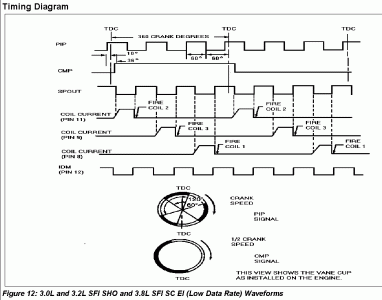
Here's a diagram of the SHO coil timing.

V6 timing waveforms


The 3.0L and 3.2L SFI SHO and 3.8L SFI SC EI (Low Data Rate) Ignition System ( «Figure 11») consists of a crankshaft-mounted hall (PIP) sensor, a camshaft-driven hall (CMP)sensor, a 6-tower coil pack, and an Ignition Control Module (ICM).

The Electronic Ignition (EI) low data rate system eliminates the distributor by using multiple ignition coils. Each coil fires two spark plugs at the same time. The plugs are paired so that as one fires during the compression cycle, the other fires during the exhaust stroke. The next time the coil is fired, the plug that was on exhaust will be on compression and the one that was on compression will be on exhaust (the spark in the exhaust cylinder is wasted but little of the coil energy is lost). Three coils are mounted together in a "coil pack". The coil pack has three coil wires, one for each coil. The crankshaft sensor is a digital-output hall device (PIP) that responds to a rotating metallic vane mounted on the crankshaft damper assembly.

The 3.0L and 3.2L SHO CID signal is generated by a hall device mounted at the end of the rear camshaft. The vane cup has one tooth and is driven by the camshaft. The 3.8L SC camshaft sensor is a hall device, but it is mounted in the normal distributor location.

The PIP output is a 50-percent duty cycle signal that provides base spark timing information. The CMP sensor signal output is also a 50-percent duty cycle signal, and is required so that the ICM knows which coil to fire and for fuel timing in the PCM. CID is high (B+) half of the cam revolution (180 degrees) and low the other half ( «Figure 12»).

The PCM determines spark angle using the PIP signal to establish base timing. SPOUT is sent from the PCM to the ICM and serves two purposes: the leading edge fires the coil and the trailing edge controls the dwell time. This feature is called CCD or Computer-Controlled Dwell.

The Ignition Diagnostic Monitor (IDM) is an output from the ICM that provides diagnostic information concerning the ignition system to the PCM for self-test and is also the input signal for the vehicle tachometer. If the CMP circuit fails and an attempt to start the engine is made, the ICM will randomly select one of the three coils to fire. If hard starting results, turning the key off and then cranking again will result in another "guess." Several attempts may be needed until the proper coil is selected allowing the vehicle to be started and driven until repairs can be made. The Failure Mode Effects Management (FMEM) system attempts to keep the vehicle driveable in spite of certain system failures that prevent the PCM from providing spark angle or dwell commands. The PCM opens the SPOUT line and the ICM fires the coils directly from the PIP input. This results in a fixed spark angle of 10 degrees and fixed dwell.
 

Ashley_MTX

New Member
Joined
Aug 28, 2009
Messages
282
Reaction score
118
Location
North Carolina
...wow. Not quite as fun as the interactive page where I could turn the whole thing on and off. But VERY useful and informative. :)
 

SHOZ123

SHO Member
Joined
Dec 2, 2000
Messages
12,152
Reaction score
673
Location
Illinois
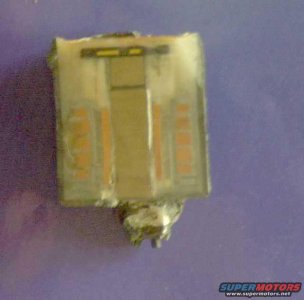
Here is a picture of the V8 COP cut in half. You can see the windings.

Cpp cut open 4
 

rubydist

SHO Master
Staff member
Super Moderators
Joined
Jun 25, 2007
Messages
7,521
Reaction score
3,399
Location
Denver
...wow. Not quite as fun as the interactive page where I could turn the whole thing on and off. But VERY useful and informative. :)

lol
now you know why I gave you the 'short answer' .....
;)
 

Forum statistics

Threads
107,088
Messages
1,181,315
Members
16,153
Latest member
lapochkarr

Members online

Back
Top