Not a hijack, it's a legitimate question.
An ignition coil works by storing magnetic energy, and then releasing that stored magnetic energy rapidly into the coil secondary, which produces a rather high voltage that produces an arc at the spark plug.
There's a nice little interactive tutorial on ignition coil function here:
http://www.magnet.fsu.edu/education/tutorials/java/ignitioncoil/index.html
The ignition coil has a primary winding, this is connected to the vehicle's 12V electrical system and the ignition control system, in our case the DIS module, and this is how we use electric current to put magnetic energy into the ignition coil.
The ignition coil primary has inductance, which is a fancy word that we EE's use meaning AC resistance, sort of like the DC resistance you might read with an ohm-meter, but AC resistance can change with time and frequency - it's complicated...
When the ignition system turns on the 12V to the ignition coil primary, the DC current starts out very small,and the stored magnetic field (energy) starts out at essentially zero. Over a period of several milliseconds, the current increases, and the magnetic field increases until we get to a point where the ignition coil's steel core can't hold any more magnetic field (stored energy), at this point, we say that the core is "saturated" - it's holding as much energy as it can. Additionally at this point, the current into the coil primary levels off. As long as we always charge the ignition coil primary to the point where the core is saturated, the ignition coil will give us the most powerful spark it can. The magnetic saturation time is fixed by the design of the ignition coil: It's determined primarily by the amount of Iron and Copper in the coil.
"Dwell time" is the amount of time the
ignition system decides it's going to charge the coil primary. It may be shorter or longer than the coil magnetic's saturation time, depending on operating conditions. During periods of low load, DIS may back off the dwell time to keep coil heating to a minimum, during periods of high load, or when starting the engine, DIS may increase dwell to saturation or beyond to give maximum spark energy.
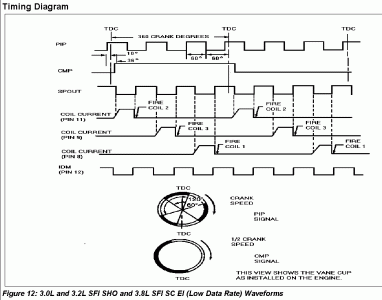
Edit: I should add that DIS doesn't set dwell, EEC sets dwell. Dwell and ignition event timing are communicated from EEC to DIS through the SPOUT signal. If SPOUT is disconnected or lost, DIS fixes dwell to a built-in default, and spark timing is fixed at 10º BTDC per the crank sensor.