mechanical component but electronically controlled.
2011 Taurus Workshop Manual
Torque Converter Clutch (TCC) Solenoid
The TCC solenoid is used in the transaxle control system to control the application, modulation and release of the torque converter clutch.
Electronic System Description
The PCM and its input/output network controls the following operations:
- Shift timing
- Line pressure (shift feel)
- Torque Converter Clutch (TCC)
The transaxle control is separate from the engine control strategy in the PCM, although some of the input signals are shared. When determining the best operating strategy for transaxle operation, the PCM uses input information from certain engine-related and driver-demand related sensors and switches.
In addition, the PCM receives input signals from certain transaxle-related sensors and switches. The PCM also uses these signals when determining transaxle operating strategy.
Using all of these input signals, the PCM can determine when the time and conditions are right for a shift, or when to apply or release the TCC . It will also determine the best line pressure needed to optimize shift engagement feel. To accomplish this, the PCM uses output solenoids to control transaxle operation.
The following provides a brief description of each of the sensors and actuators used to control transaxle operation.
Drive Test — Torque Converter Clutch (TCC) Control
The output state control values for TCC_OSC to engage or disengage the TCC are as follows:
- 0 — PCM in normal control of TCC and output state control is cancelled
- 1 or OFF — Commands PCM to keep the TCC from engaging
- 2 or ON — Commands PCM to engage the TCC using a normal ramp rate
- 3 or ON — Commands PCM to engage the TCC using a fast ramp rate
Controlling the TCC will assist the technician in testing the operation of the torque converter for engagements and disengagements. Also, the technician may find it easier to evaluate upshifts and downshifts by first using output state control to keep the TCC from engaging.
Vehicle requirements must be met when using TCC_OSC Controlling the TCC .
When sending the TCC_OSC value [1 or OFF], the engine must be running with the transaxle in the DRIVE position and the vehicle speed must be greater than 5 km/h (3 mph).
When sending the TCC_OSC value [2 or 3 or ON], the engine must be running with the selector lever in the DRIVE position, transaxle in 3rd, 4th, 5th or 6th gear, transaxle temperature between 4°C (40°F) and 121°C (250°F), the vehicle speed must be below 24 km/h (15 mph) and engine speed greater than 1,100 rpm with minimal engine load.
PCM Transaxle Connector — C1381T (3.5L Gasoline Turbocharged Direct Injection (GTDI))
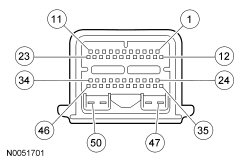
Pin Number | Circuit Function |
|---|
1 | Turbine Shaft Speed (TSS)/Output Shaft Speed (OSS) Power |
10 | Shift Solenoid D (SSD) |
11 | Shift Solenoid E (SSE) |
16 | Turbine Shaft Speed (TSS) Sensor Signal |
17 | Transmission Range (TR)1 |
19 | Transmission Fluid Temperature (TFT) Sensor Supply |
25 | OSS Sensor Signal |
26 | TR 2 |
27 | TR 4 |
28 | TR 3 |
34 | Line Pressure Control (LPC) |
36 | TR / TSS / OSS Ground |
41 | TFT Signal Return |
43 | Shift Solenoid B (SSB) |
44 | Shift Solenoid C (SSC) |
45 | Shift Solenoid A (SSA) |
46 | Torque Converter Clutch (TCC) Solenoid |
50 | Transaxle Solenoid Power Control Voltage |
Transaxle Vehicle Harness Connector — C168
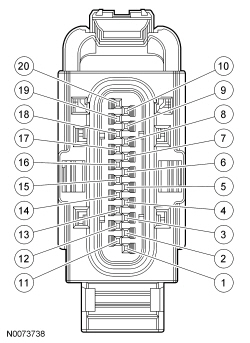
Pin Number | Circuit Function |
|---|
1 | Shift Solenoid E (SSE) |
2 | Transmission Fluid Temperature (TFT) Sensor Supply |
3 | TFT Signal Return |
4 | Transmission Range (TR)1 |
5 | TR 2 |
6 | TR 3 |
7 | TR 4 |
8 | TR Sensor Ground |
9 | Turbine Shaft Speed (TSS)/Output Shaft Speed (OSS) Sensor Ground |
10 | OSS Sensor Signal |
11 | Not Used |
12 | Shift Solenoid D (SSD) |
13 | Shift Solenoid A (SSA) |
14 | Torque Converter Clutch (TCC) Solenoid |
15 | Transaxle Solenoid Power Control Voltage |
16 | Shift Solenoid B (SSB) |
17 | Shift Solenoid C (SSC) |
18 | Line Pressure Control (LPC) |
19 | TSS Sensor Signal |
20 | TSS / OSS Sensor Power Supply |
if this is a solenoid issue, get a new solenoid body assembly and filter.