
I am going to installing a fuel cell with external fuel pump...can someone please share the specs on the low pressure fuel pump...ex fuel pressure and gph? I am trying to choose a replacement pump, and I want to start with these specs. Thanks.

You are using an out of date browser. It may not display this or other websites correctly.
You should upgrade or use an alternative browser.
You should upgrade or use an alternative browser.
SHOkart - Low pressure fuel pump specs
- Thread starter sparris
- Start date
Disclaimer: Links on this page pointing to Amazon, eBay and other sites may include affiliate code. If you click them and make a purchase, we may earn a small commission.
luigisho
SHO Member
Info from 3rd post here
https://www.ecoboostperformanceforum.com/index.php?topic=6059.0
2013's have a different LPFP than the 2010-12's.
1st gen LPFP run at a fixed 65PSI
2013+ is variable that runs between 51 and 75 psi.
HPFP input pressure rated for 58-101 PSI (4-7bar)
This unit states 24GPM
I think the sending unit with integrated fuel pump part number is DA5Z-9H307-F. There is a second fuel sending unit on the other side of the saddle tank I think but the diagram pic doesn't look like a big pump housed in it.
https://www.ecoboostperformanceforum.com/index.php?topic=6059.0
2013's have a different LPFP than the 2010-12's.
1st gen LPFP run at a fixed 65PSI
2013+ is variable that runs between 51 and 75 psi.
HPFP input pressure rated for 58-101 PSI (4-7bar)
This unit states 24GPM
I think the sending unit with integrated fuel pump part number is DA5Z-9H307-F. There is a second fuel sending unit on the other side of the saddle tank I think but the diagram pic doesn't look like a big pump housed in it.
Last edited:

Ecoboost_xsport
SHO Member
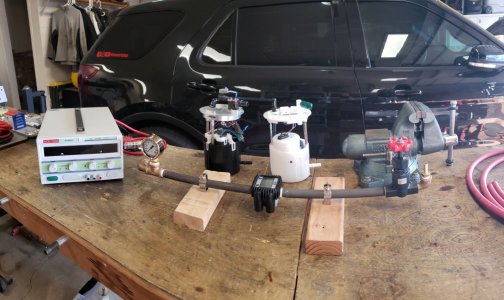
Currently doing testing on all the different LPFP setups...
OEM, DW300c, Hellcat and my custom Dual Pump setup.
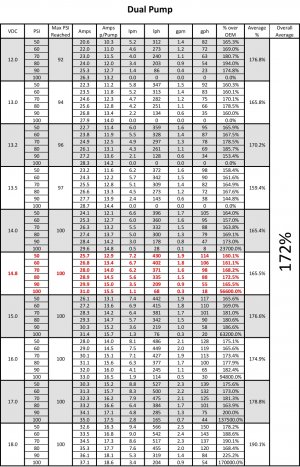
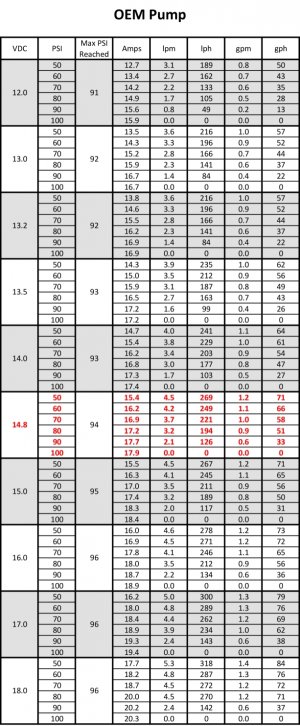
Here are a few teaser pics and some VERY preliminary results with the OEM and Dual Pump setup. Next up to be tested are the DW300c and Hellcat. Red bold values are where the OEM voltage output to the pump sits at during WOT.
Keep in mind these results are based on flows THROUGH the LPFP module (not the pump by itself) and with THIS particular test setup. The important numbers to look at are IMPROVEMENT over OEM, as flow within the vehicle could differ slightly. This test is an apples to apples comparison.
Full YT video in the works.
OEM, DW300c, Hellcat and my custom Dual Pump setup.
Here are a few teaser pics and some VERY preliminary results with the OEM and Dual Pump setup. Next up to be tested are the DW300c and Hellcat. Red bold values are where the OEM voltage output to the pump sits at during WOT.
Keep in mind these results are based on flows THROUGH the LPFP module (not the pump by itself) and with THIS particular test setup. The important numbers to look at are IMPROVEMENT over OEM, as flow within the vehicle could differ slightly. This test is an apples to apples comparison.
Full YT video in the works.
Attachments
Ecoboost_xsport
SHO Member
24GPM seems VERY high. That equates to about 5451LPH, which is the units of measurement most pumps are rated by (free flowing, zero PSI or sometimes ~40PSI, not inside a fuel module). I've never heard of a "Walbro 5500" or "DW5000".Info from 3rd post here
https://www.ecoboostperformanceforum.com/index.php?topic=6059.0
2013's have a different LPFP than the 2010-12's.
1st gen LPFP run at a fixed 65PSI
2013+ is variable that runs between 51 and 75 psi.
HPFP input pressure rated for 58-101 PSI (4-7bar)
This unit states 24GPM
I think the sending unit with integrated fuel pump part number is DA5Z-9H307-F. There is a second fuel sending unit on the other side of the saddle tank I think but the diagram pic doesn't look like a big pump housed in it.
GPH...maybe...but that seems pretty low...only about 90LPH.
luigisho
SHO Member
You are correct. If you look at the Rock Auto link to the pump average flow rating is listed as 24 GP. I assume that means 24 gph. Maybe the average means that it is variable flow rate?24GPM seems VERY high. That equates to about 5451LPH, which is the units of measurement most pumps are rated by (free flowing, zero PSI or sometimes ~40PSI, not inside a fuel module). I've never heard of a "Walbro 5500" or "DW5000".
GPH...maybe...but that seems pretty low...only about 90LPH.
You've been messing with low pressure fuel pumps, what do you think this reference means?
Ecoboost_xsport
SHO Member
That's a very good question...seems a bit ambiguous. It says "Average" but average over what? I'd lean toward GPH, though, as 90LPH COULD be an average value across different PSI ranges. And it being an OEM unit, I wouldn't expect high volumes from it....still seems a bit low for a GPH value.You are correct. If you look at the Rock Auto link to the pump average flow rating is listed as 24 GP. I assume that means 24 gph. Maybe the average means that it is variable flow rate?
You've been messing with low pressure fuel pumps, what do you think this reference means?
Last edited:
luigisho
SHO Member
I agree. The GPM was a brain fart but the variable I was able to find on the interwebs was listed in PSI and not gph or lph so I inferred average to be variable?? I have the older cars with fixed LPH rating single pumps so a little different point of reference.That's a very good question...seems a bit ambiguous. It says "Average" but average over what? I'd lean toward GPH, though, as 90LPH COULD be an average value across different PSI ranges. And it being an OEM unit, I wouldn't expect high volumes from it....still seems a bit low for a GPM value.
Ecoboost_xsport
SHO Member
My question is...what are you trying to accomplish? It is true that the LPFP fails at OEM voltage levels at higher power and especially when going the route of e85. It took a DW300c at 17vdc to get me close, but I still think it lacks.I am looking at a 15 gallon aluminum fuel cell with foam. Also a 200lph/52gph at 75psi fuel pump and pressure regulator. I would be bypassing all the OEM fuel components up to the HPFP. This should work, right?
To your question...it's possible...but how are you controlling this pump? And what pump are you talking about? Remember, this is a pulse width modulated returnless-style system. Any attempt at using components from a return-style system won't really work properly. I have a Torqbyte PM3 module I have been working on to try and get it to work with the platform. It would essentially replace the FPDM, with the signals being cloned in order to have it play nicely. The hard part is the FPDM needs an Event Signal from the SRS module in order to fire off...this has proven problematic to clone thus far.
I also have another system from VaporWorx I am experimenting with that is much more simple and I think will actually work better. It essentially clones the power signal of the OEM FPDM itself and runs in parallel with the OEM unit, allowing for multiple pumps to be used.
I have a dual pump module that should work well to address any fueling concerns (see the above flow rate results) especially if using e85.
Last edited:
Ecoboost_xsport
SHO Member
I am looking at a 15 gallon aluminum fuel cell with foam. Also a 200lph/52gph at 75psi fuel pump and pressure regulator. I would be bypassing all the OEM fuel components up to the HPFP. This should work, right?
BTW, 200lph@75psi seems very underwhelming. If you look at my test results of the OEM module, between 70-80psi at OEM voltage (14.8vdc), the stock unit can basically put that volume out. Just replace your old module with a new one for about $200 and be done with it, if that's the goal you're after...
I am building a tube chassis mid engine car using the engine from a 2010 SHO. Also, it appears that there is a return line going back to the tank...is this line used for something else?My question is...what are you trying to accomplish? It is true that the LPFP fails at OEM voltage levels at higher power and especially when going the route of e85. It took a DW300c at 17vdc to get me close, but I still think it lacks.
To your question...it's possible...but how are you controlling this pump? And what pump are you talking about? Remember, this is a pulse width modulated returnless-style system. Any attempt at using components from a return-style system won't really work properly. I have a Torqbyte PM3 module I have been working on to try and get it to work with the platform. It would essentially replace the FPDM, with the signals being cloned in order to have it play nicely. The hard part is the FPDM needs an Event Signal from the SRS module in order to fire off...this has proven problematic to clone thus far.
I also have another system from VaporWorx I am experimenting with that is much more simple and I think will actually work better. It essentially clones the power signal of the OEM FPDM itself and runs in parallel with the OEM unit, allowing for multiple pumps to be used.
I have a dual pump module that should work well to address any fueling concerns (see the above flow rate results) especially if using e85.
Ecoboost_xsport
SHO Member
Ahhh, OK...what engine management will you use? a factory PCM? if so, you'll still run into the same issues and might be OK just using your fuel cell with the factory FPDM and LPFP.I am building a tube chassis mid engine car using the engine from a 2010 SHO. Also, it appears that there is a return line going back to the tank...is this line used for something else?
...but if you're going aftermarket management...disregard everything I'm saying, LOL.
As for the line you are referring to, where on the tank is it? On top of the LPFP hat? That's for the EVAP stuff...
Ecoboost_xsport
SHO Member
You'll still need to likely keep it return-less, as the fuel rail has no return capability (pressure ranges are near the 2000psi range, post-HPFP). I have heard of people "fooling" a return-less system by creating a short bypass loop back to the tank allowing for use of a traditional fuel pressure regulator and using boost as a reference for it, but it isn't ideal....from what I've heard. I can't speak on that application as I haven't made that conversion on anything. I tend to prefer return-less systems as they create less heat.I am building a tube chassis mid engine car using the engine from a 2010 SHO. Also, it appears that there is a return line going back to the tank...is this line used for something else?
I was hoping that delivering a constant flow of fuel at a given psi would satisfy the requirements of the HPFP, returning left over fuel to the tank. Does the stock fuel pump system only deliver to the HPFP what it is requiring at a given time with the ability to regulate the flow therefore never having anything left to return to the tank. In layman's terms, can you tell me how this system works?You'll still need to likely keep it return-less, as the fuel rail has no return capability (pressure ranges are near the 2000psi range, post-HPFP). I have heard of people "fooling" a return-less system by creating a short bypass loop back to the tank allowing for use of a traditional fuel pressure regulator and using boost as a reference for it, but it isn't ideal....from what I've heard. I can't speak on that application as I haven't made that conversion on anything. I tend to prefer return-less systems as they create less heat.
Ecoboost_xsport
SHO Member
I was hoping that delivering a constant flow of fuel at a given psi would satisfy the requirements of the HPFP, returning left over fuel to the tank. Does the stock fuel pump system only deliver to the HPFP what it is requiring at a given time with the ability to regulate the flow therefore never having anything left to return to the tank. In layman's terms, can you tell me how this system work?
Prepare for an oversimplification...
But yes, it is a return-less fuel system, as most modern cars on the road are. Fuel pumps are modulated using pulse width signals and deliver only what is needed. If the system over pressurizes for some reason, there is a pressure relief valve within the LPFP that will allow it to leak by. In this platform it is set to 90psi.
A traditional return-style system found on older vehicles has fuel delivered at a constant rate to the fuel rail, with the injectors using what they need and the excess being returned to the tank. The issue with this is that the fuel heats up tremendously (even in my test bench from above, the fuel I was returning to my "tank" was heated an additional 30deg over ambient within a span of about only an hour). The other, more pressing, drawback, is that fuel is returning AFTER the injectors use it from the fuel rail, so that would mean dealing with pressures approaching (and higher, in some cases) 2000psi since this engine isn't simply a "return-less system" but also a "return-less, direct injection system". That is WAY too much to deal with and return to the tank. The pressures within the fuel rail are so precisely measured that any release of that pressure (IE, a line returning to the tank) will not allow the injectors to open or perform properly.
As you can see...the complexity of the fuel system begins to mount...
Last edited:
Ecoboost_xsport
SHO Member
I have found that others doing ecoboost swaps have installed the regulator and return at the tank, creating a return less system from the rail. I will give this a try
Swap into what? Lol.
You CANNOT connect a return line from the rail post-HPFP....you are dealing with up to 2000psi. Your injectors will not operate properly and there are no regulators that can handle those levels of pressure.
What you are referring to is what I ALREADY explained to you, essentially tricking the system by bypassing and adding a return line to the tank and using a boost reference with your regulator. But this is all done pre-HPFP and isn't ideal because you're limited by the pressure your regulator is set to. Keep in mind, the system on the low pressure side can see upwards of 100psi at times.
Your bypass line back to the tank would be just after it leaves the pump and before the regulator.
And you never answered if you are using a factory PCM or going aftermarket management. Theres a ton of capability to do more of what you're looking for when going aftermarket, but you're still contending with the factory logic if using the factory PCM.
You are over-complicating your system when it has already been designed for you. If all you want is [email protected] use the OEM FPDM and the OEM fuel module in your fuel cell....easy, peasy. And if you need a little more fuel, use the DW300c drop in pump. What you are trying to do is for ppl who want WAY MORE fuel and are either adding a pump or changing to a larger pump. No one is using the SHO 3.5 for swaps currently, you're thinking of those ppl using the F150 3.5...a COMPLETELY different animal.
Your goal is stock pumping capacity and you are reinventing a system that doesn't need to be reinvented. Had you said you wanted [email protected]'d have different answers for you. Think a little before you actually make your system LESS capable.
Last edited:
Ecoboost_xsport
SHO Member
I have found that others doing ecoboost swaps have installed the regulator and return at the tank, creating a return less system from the rail. I will give this a try
I guess I should've asked first....
Have you found that the level of fueling from the stock pump is inadequate for your needs?
If so, how did you discover this and much do you need? This will dictate the direction you should go.
If not....just use the factory PCM, factory FPDM and factory LPFP. That would be up and running in no time, have minimal customization needs and you'll have the full range of capability. You'd also be able to install the drop in DW300c if you found you needed a bit more fuel.
Similar threads
- Replies
- 1
- Views
- 494


- Replies
- 13
- Views
- 2K
- Replies
- 4
- Views
- 2K

- Replies
- 9
- Views
- 780


