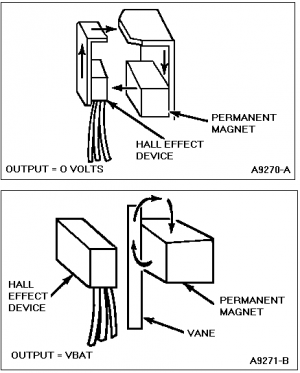
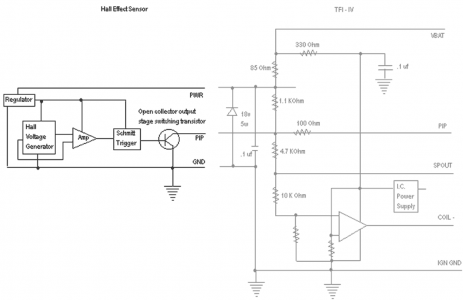
The majority of Ford crankshaft position sensors, especially 1996 and after, appear to be two-wire sensors without battery power or digital converter - they require a bias voltage of about 2 volts from the PCM, and put out 0.5V AC when pulsing. Completely incompatible.
With similar wiring, the Ranger CKP has an
integrated magnet in the center, and the sensor has
two vane slots, each with its own output, with sensors on the top and bottom. This includes the sensor for DIS ignitions on 89-93 Mustang 2.3l, Ranger 2.3L 89-98, Mazda B2300: (Ford/Mazda parts E9TZ6C315A F07E6C315AC F0TZ6C315B, F0TZ6C351A F1TZ6C315A F1TZ6C351A, F4ZZ6C315A F4ZZ6C351A F4ZZ9C351A, ZZMO18082 F0TZ6C315C F27E6C315BA, ZZM018370 PC10 5S1744 SU221 CSS60)
Here is testing this sensor:
The 2.3L's two hall sensors have quite different timing outputs, as can be seen by the crankshaft hub vanes:
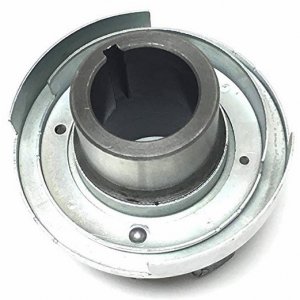
It might be possible to cut off the bottom sensor, and use the top for both PIP outputs on the SHO, rewiring the connector. However if such a modified sensor was mounted by the two bolts, the gap would be far too wide. One of the two sensors probably responds to
reverse N-S magnetic polarity. The signal conversion circuitry is probably the full length of the body, prohibiting this anyway (along with the different shape back).
It is possible the SHO's dual PIP outputs are also two-sensors-in-one, not timed the same, side-by-side in the sensor body. There's no literature documenting if this is true, you'd literally have to crack open a bad SHO CKP to see how it is made, or hook a dual-trace oscilloscope up to both PIP outputs (which might be possible on a running car, by tapping wires near "DIS Module" and ECM, since the actual connector is buried.
I might be able to do the latter, but time would be better spent cold-calling sensor manufacturers to ask WTF??
Some other two-pin hall effect sensors, like Focus, Econoline 150 have a similar two-bolt body shape, but of course are electrically incompatible, and would take electronics to make the 0V-12V pulses.