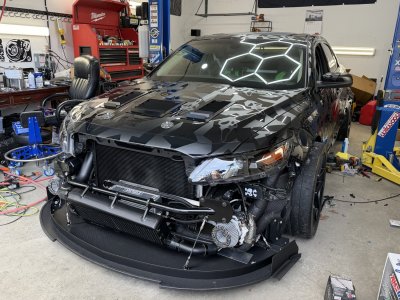
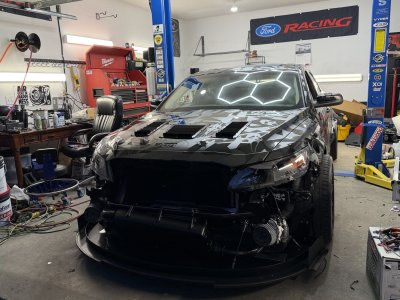
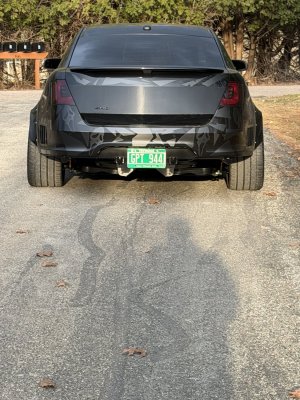
802SHO 2010 Build

Disclaimer: Links on this page pointing to Amazon, eBay and other sites may include affiliate code. If you click them and make a purchase, we may earn a small commission.

802SHO

Boost > VE, MBT, Cams
Supporting Member
Joined
Oct 8, 2019
Messages
3,249
Reaction score
7,819
Location
Essex Junction Vermont
Getting the piggybacks (any system that is nonoem in additon to your build) to play nice and have everything jive is an art itself. It's a long battle and anybody who's saying you're taking too long has not experienced this level of build. This isn't a carbed 350 that you just rejet and twist some screws.
Exactly. I’m not an experienced builder or a shop. I’m literally an auto detailer at heart who ended up in drywall, while teaching myself window tint, mechanic work, and mild fab along the way. I’m learning as I go and choosing to do as much of it myself as possible.

I’m sharing my first real look at what’s involved here. Not necessarily what it takes for everyone, more like what it has taken me to get to this point.
 

Bronco2fan

SHO Member
Joined
May 30, 2017
Messages
592
Reaction score
631
Location
Texas
As I've said before, you're at the level where the majority of us read what is being attempted and can hardly comprehend it. I don't understand 2/3 rds of it, but good reading. You'll be ready when you're ready.
 

802SHO

Boost > VE, MBT, Cams
Supporting Member
Joined
Oct 8, 2019
Messages
3,249
Reaction score
7,819
Location
Essex Junction Vermont
As I've said before, you're at the level where the majority of us read what is being attempted and can hardly comprehend it. I don't understand 2/3 rds of it, but good reading. You'll be ready when you're ready.
Appreciate that. A lot of this thread is me learning in public while trying to make a modern torque-based platform cooperate with a very non-OEM setup. It’ll be ready when it’s ready, but I’m a lot closer than ever
Are custom ECUs a thing?
Yeah and 100% a direct solution here. The correct tool for the job. It’s just with a 6 cylinder GDI it’s slim pickings. Syvecs or MoTeC. Both are about the cost of my built motor +. In a way that’s not surprising.

I’m confident there’s a version of the OEM ECU that does work. It’s time consuming either way I think but cheaper to do this route for now. It’s like I need to budget $15k at least for sending my car to EMS to get MoTeC installed as a piggyback and tuned. Dead system clean up would be a breeze and it would eliminate unnecessary handshakes and permission for the engine to do what’s it’s built for, pump air and the transmission too would just shift. Plus cool features, a real launch control, boost by gear, anti-lag.

I’m still cleaning up this setup mechanically too so I’m still at the next logical step, clean up and make the system honest. Then see how far I get with the OEM ECU. Standalone after that would be the last step, arguably should be the first.
 

802SHO

Boost > VE, MBT, Cams
Supporting Member
Joined
Oct 8, 2019
Messages
3,249
Reaction score
7,819
Location
Essex Junction Vermont
I ruled out the 11psi BOV spring being a solution. When I removed the BOV to take the 12psi spring out, I found the rubber gasket was pinched and inward into the pipe a little. That explains not seeing it open when I stabbed the throttle testing it last but hearing the pppsssshhhhh bc it must have come out of the base.

I installed the 11psi spring anyway and it cracked open a hair at 19 inHG. At 21 on my hand pump it was open a good amount, slightly less than the 10psi spring. I tested it at idle anyway and yeah…back to the 12psi spring tomorrow. Good data though.

I superglued the rubber gasket to the bottom of the BOV…..it goes on sideways, the TIAL clamp is not like a VBand clamp that works by a hinge and those are easy put one side on, hinge it under and back around. The TIAL clamp you have to bend open, so the BOV you got in one hand and you’re trying to bend the clamp to get around the mating surface and in the slot….meanwhile the rubber gasket can fall victim to gravity and hang down, get caught in the clamp and pinched in the ******. Superglue just allows it to stay exactly where it needs to be.

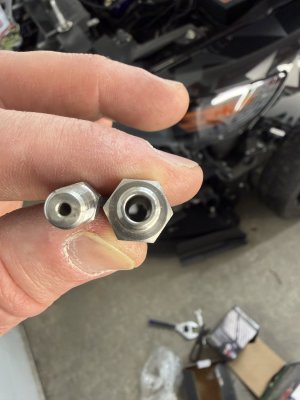
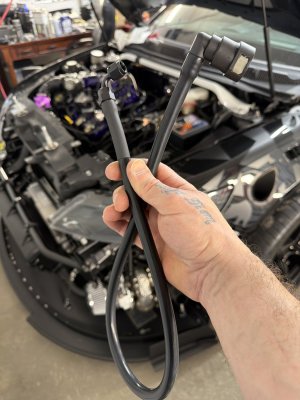
The FPR I swapped the orifice to the 1/8 NPT to -4AN. Made a new hose IMG 8775IMG CAA2A161 DBD5 4E87 AAAA F1F20200A0C8IMG 8779
Then I pretty much have the gauge reading, pump and transient all figured out with throttle stabs and lifts. I was concerned with the fuel pressure transient for a minute. Looked ugly on the gauge at first glance. But digging into it more, it all checks out.

The low side setup is an Aeromotive 3.5 GPM brushless spur gear TVS pump with throttle input fed to the TVS controller through a JMS TPS harness. So when I stab the throttle, pump speed goes up. When I lift, pump speed comes back down. At the same time the manifold referenced FPR is reacting to boost/vacuum. So there are multiple things moving at once on a quick rev.

What I found is this: On throttle stab, the system goes rich. STFT will swing hard negative, even around -25, to clear the rev. So tip-in is rich.

On throttle lift, the wideband goes leaner. So the brief dip I’m seeing on the low side gauge is not a rich choke event on lift. It’s a transient event. Most importantly, high pressure desired and actual stay right on top of each other, if anything actual is a hair heavy. So the HPFP is not being starved and the low side system is doing its job.

So the conclusion is simple.

The scary looking low side transient is not a fuel supply failure. It’s a normal stacked transient from throttle input changing pump speed through the TVS while the manifold referenced FPR is also reacting. Gauge makes it look dramatic, but the data says the system checks out.

So the remaining cleanup is not “fuel system broken.” It’s transient calibration on throttle entry. That’s a much better problem to have.

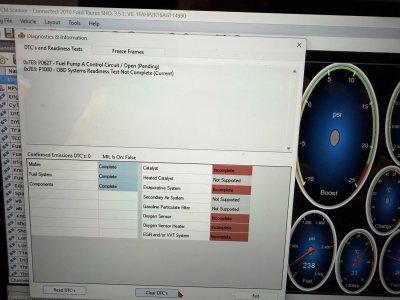
I also did some tests with my TCM power sequence and keeping it tight, powering TCM just before hitting start and firing up the engine that seems to keep TCM (fuse 49 codes) at bay. After about 15 min of idling and checking my FPR and 11psi BOV I shut it down and left TCM powered on….then I turned ignition back on and checked for DTC’s. IMG 8783
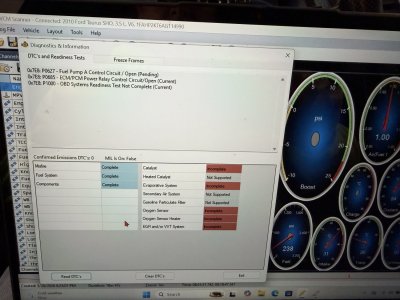
That fuel code will be disabled but I’m basically back to P1000. Which hasn’t been the case since 2020. Then I left ignition on, turned TCM power off and cycled the ignition off and on a couple times and rechecked…IMG 8784
Another fuse 49 related code. I’ll get P0685, P0689 or P1602. By playing with sequence of manually powering TCM on my switch panel I can make them go away or come back. So that’s great data. The bypassed BJB powering fuse 49’s load path works and if my sequence isn’t tight it gets flagged.

Which leads me to believe fuse 49 being dead and not tied to ignition is the reason for the codes coming and going. My next verification is to use a slot on my switched 12 volt distribution block to jump power to fuse 49 again…bc I believe it will allow that load path to register at all times. Ignition on with the real direct power off manually and with engine on and it manually powered externally out of the BJB. So at all times it’s satisfied but also it’s legit powered only when needed.

I’ll wire up switched 12 volt back to fuse 49 (I left it dead after I bypassed it) and swap my 12psi BOV spring back in and take it for a test drive tomorrow.

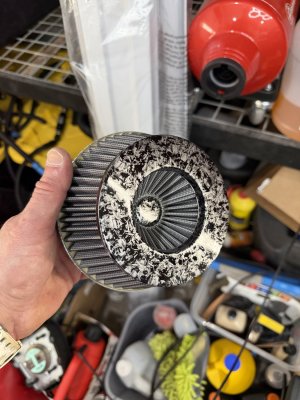
I wrapped the front chrome on my new cone filters with the same vinyl as my interior trim panel above my deleted glove box. IMG 8766IMG 8767
Looks good. I really like the white filter media. IMG 8759IMG 8768IMG 8773
 

802SHO

Boost > VE, MBT, Cams
Supporting Member
Joined
Oct 8, 2019
Messages
3,249
Reaction score
7,819
Location
Essex Junction Vermont
Quick add to the FPR explanation. The concerning gauge reading that warranted me looking into it was:

-70psi manifold referenced at hot idle.
-80psi on throttle stab
-60psi throttle lift transient drop
-70psi constant fast recovery (in the gauge)

-TPS signal increase/decreases pump speed
-manifold reference on throttle stab decreases vacuum and increases regulator pressure
-manifold reference increases vacuum on throttle let out
-TIP in is rich. Trims remove fuel and wideband go lean.
-gauge shows that big transient dip

The equivalent of a true 60psi reading on that pressure gauge would equal -40 inHG the way it’s set up. It’s a transient undershoot the gauge exaggerates, not a true steady 60 psi condition

All is good and for a base map TIP in being rich is tunable. Load is the real metric anyway. Thats when the numbers hold the most weight.
 

802SHO

Boost > VE, MBT, Cams
Supporting Member
Joined
Oct 8, 2019
Messages
3,249
Reaction score
7,819
Location
Essex Junction Vermont
Transmission came back from the dead :finger:
Like what did I miss? Like nothing happened :lol:

I completed 3 laps from my street to the main road and back around. 20+ min 30+ with idle time. Felt peppy moving from a dead stop. Shifts good, sounds good…data looks good for now. I had to realize I need to collect data to really know for sure. So I only did a mildish throttle multi gear pull on my last lap.

This is a moment that feels so good it brings a tear to your eye. I’ve been trying so hard to understand it and putting in so much effort from so many different angles to fix the system. This moment, all that effort actually felt like it mattered. All the time spent trying to communicate with it, this right here felt like it finally answered back.

I sent the log for review and I’m just beside myself. I think it was late September or maybe October it was driven like this. It kept dying and I couldn’t go 5 min down the road. I couldn’t go halfway of 1 lap, let alone 3 full laps just now. Stopping only bc I want the data reviewed.

Tonight was a beautiful man and machine moment. Take it to a shop I remember one guy said…to someone who knows what they’re doing.

Nah, I think I can figure it out.

I did.
 

802SHO

Boost > VE, MBT, Cams
Supporting Member
Joined
Oct 8, 2019
Messages
3,249
Reaction score
7,819
Location
Essex Junction Vermont
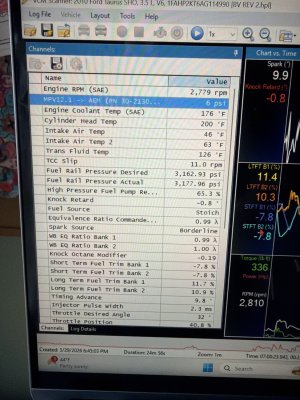
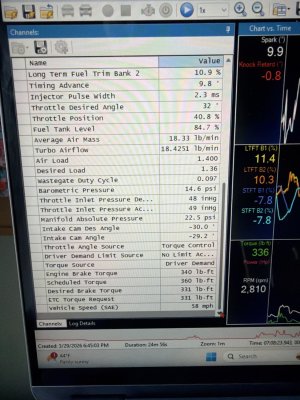
I need to get used to VCM Scanner, navigating it to separate PID’s and graph them. I was looking for EMP from the Rife sensor on my mild throttle and here’s a great snapshot.

IMG A514E9E4 9AB0 4E7D B463 5F66D0701B59IMG 24437E4E 69CC 4688 82BE 192B9F133AD5
One clean snapshot from the log:

58 mph
2779 rpm
40.8% throttle
1.40 load / 1.36 desired
MAP 22.5 psi absolute
Baro 14.6 psi
= about 7.9 psi boost

At that same moment the Rife EMP channel showed 6 psi, so the sensor is alive and giving believable data. Real load will show the truth but mid throttle that’s 0.76:1 (Drive pressure to Boost). (6) : (7.9)

High pressure fuel:
3162.93 desired
3177.96 actual

Widebands:
0.99 / 1.00 lambda

STFT:
-7.8 / -7.8

LTFT:
11.7 / 10.9

Spark:
9.8

Knock:
-0.8

That one frame says a lot.

EMP channel works.
Boost math checks out.
Fuel system is doing its job.
High side is tracking where it should.
The data actually makes sense now.

For a first useful road snapshot, that’s good.
 

802SHO

Boost > VE, MBT, Cams
Supporting Member
Joined
Oct 8, 2019
Messages
3,249
Reaction score
7,819
Location
Essex Junction Vermont
Build update. The logic war continues.:bs:

I celebrated a little too early. The bypass power feed does work. Jumping Fuse 49, on the other hand, may have been a bad idea. I’m going to leave that rabbit hole alone for a second and just stick to what I know. After work yesterday I went back out for another road test and the solenoids started buzzing again. I drove it lightly just to see what it would do. Under moderate load it hesitated, but I was able to drive it back uninterrupted and it seemed to have full power otherwise. No hard faults, no dead zones, and no need to cycle the ignition. My first thought was that the switched 12 volt I had tied into Fuse 49 might have been backfeeding something, so I removed it and let the car cool down.

The next test drive it did it again, and this time it actually got stuck in 2nd gear and I came back that way. Luckily the speed limit on my road is only 25 mph, so nothing looked too out of the ordinary from the outside, but the solenoids were buzzing loud.

At this point, when I look at the history of this car, especially the wrench light and the 0 mph limp mode events going all the way back to 2015, the common denominator is not the new parts. It is the original harness. The electrical system as a whole is stronger than it has ever been. Dual batteries, upgraded grounds, all of that. But what I think I’m actually fighting now is a logic war between the PCM and the TCM.

The biggest clue is that the behavior changes depending on the power up sequence and depending on whether that backfeed variable is in the picture. That does not scream to me that the new internal lead frame is simply broken. It looks more like it is either being starved or confused by the external feed path. In other words, I have moved from a dead on arrival situation to a struggling under load situation.

So to stop this five month rabbit hole, the next move is to isolate the transmission from the car’s weirdness entirely. I’m going to a dumb power, dumb ground isolation test so I can finally separate the car’s harness from the transmission internals.

That means a direct fused 12 gauge battery feed, bypassing the 8 gang switch and the BJB. It means a heavy jumper cable straight from the battery to the transmission case. And it means back probing pin 9 for power and pins 1 and 2 for ground at the 20 pin connector while it is actively buzzing.

The threshold is simple. If it still buzzes with a clean 13.5 plus volts and a solid ground right at the doorstep of the transmission, then the new internal lead frame and solenoid assembly moves to the top of the suspect list. New solenoid assembly #2… If it goes quiet on dumb power, then the ghost is officially living in the 14 year old harness or in the switch panel logic.

The switch panel logic is this: The logic conflict stems from the fact that modern 8-gang switch panels are typically solid-state (MOSFET) devices rather than simple mechanical relays. Unlike a "dumb" copper contact, these electronic switches use microprocessors to constantly monitor current and protect against spikes. Transmission solenoids are inductive loads that fire high-voltage "kickback" (flyback voltage) up the wire every time they cycle; a sensitive solid-state switch can mistake this electrical noise for a short circuit, causing it to trip and reset hundreds of times per second. This rapid-fire cycling creates an audible solenoid buzzing as the TCM is essentially being turned on and off in a high-speed loop, eventually leading to the "stuttering" power delivery that forced your transmission into a 2nd-gear limp mode during your last road test.

One clean test. No more guessing. This SHO is going to be nasty once the electrical gremlins are finally evicted.IMG 8828
 

802SHO

Boost > VE, MBT, Cams
Supporting Member
Joined
Oct 8, 2019
Messages
3,249
Reaction score
7,819
Location
Essex Junction Vermont
Shit. I pulled up my exact switch panel and it is indeed a suspect: from Gemini Pro

Your MaySpare 8-Gang Switch Panel is an electronic relay system that uses solid-state MOSFETs rather than traditional mechanical contacts to distribute power. Because transmission solenoids are inductive loads, they send high-voltage electrical "noise" back up the wire that can confuse the MaySpare's sensitive internal protection logic. This causes the panel to rapidly trip and reset, creating the audible buzzing and the stuttering power delivery that eventually forced your 6F55 into a 2nd-gear limp mode. The next tests will determine if my switch panel is fighting the TCM under load or if the modules have latched, and the fix would be to use the switch panel as a trigger and add a 40-amp mechanical relay to provide the "dumb," stable power the transmission actually needs.
 

802SHO

Boost > VE, MBT, Cams
Supporting Member
Joined
Oct 8, 2019
Messages
3,249
Reaction score
7,819
Location
Essex Junction Vermont
My Brain is getting swole fighting this LOL this idea is accepted by ChatGPT and Gemini Pro.

What I’m dealing with right now is this. Fuse 49’s load path is not directly powering the transmission the way I think it is. My switch panel has become the middle man, and that switch panel is fighting a war it was never designed for. It’s an electronic relay system, not a dumb copper path. A transmission solenoid circuit is a noisy inductive load. It creates electrical noise, kickback, and current demands that are a lot uglier than lights, fans, or accessories. So instead of the transmission getting a simple hard feed, the switch panel is stuck in the middle trying to manage a load path that is far more violent and sensitive than what that box was really built to handle.

On top of that, the car’s history matters. This is the same car that has had wrench light, limp mode, and TCM related weirdness going back to 2015. So the original PCM to TCM load path is suspect by default. At that point, continuing to just feed that same old path better is still a marginal strategy. You are still asking a questionable factory wire and connector path, buried in a 14 year old harness, to carry a critical load after years of heat, vibration, and intermittent failure history. Even if that wire looks fine outside, the inside of that path can still be compromised.

So the clean fix is not to let the switch panel carry the transmission load. The clean fix is to let the switch panel become nothing more than a trigger. Use it to energize a 40 amp mechanical relay, then send real battery power through that relay directly to the transmission power feed at pin 9 on the 20 pin connector, with a proper re-pin if needed. Give the transmission a real 1/0 ground to the chassis so the return path is just as serious as the feed path. That way the PCM still controls the logic and the shift strategy, but the TCM gets powered directly with a stable supply that bypasses the BJB and bypasses the old questionable PCM to TCM load path. In other words, keep the factory brain, but stop forcing the transmission to drink through a straw.
 

802SHO

Boost > VE, MBT, Cams
Supporting Member
Joined
Oct 8, 2019
Messages
3,249
Reaction score
7,819
Location
Essex Junction Vermont
I have a plan. Yesterday I had nothing.

Ok I choose the Nuclear option.

No games no curiosity side quests.

Fuse49’s load path beyond what I can see is suspect. PCM/TCM load path bc of the car’s weird history is suspect. We eliminate those variables off the board! Switch panel gets demoted to relay switch.

1) de-pin pin9

2) 14g power wire from battery, close to battery inline fuse (15amp) to start, to 75amp relay, to pin 9 stepped down at Pin

3) connect switch panel to relay

Use my 24 count terminal kit for once

4) start the car and listen for solenoids buzzing. If quiet, silent victory and road test when roads dry up again. Then maybe side quest checking ground pins.

5) if still buzzing, backpin the ground pins of the connector pin 1&2. If bad go nuclear and ground to the battery negative. If good see step 6

6) remove solenoid assembly and replace

The poor new assembly has been through War and may be gravely wounded at this point. Remove and perform burial ritual. Valhalla just got another real one. Liquor poured.
 

802SHO

Boost > VE, MBT, Cams
Supporting Member
Joined
Oct 8, 2019
Messages
3,249
Reaction score
7,819
Location
Essex Junction Vermont
I bought the 14g wire, the mechanical relay and I already have the rest. I started to get ready to de-pin pin 9 and averted to hold fast.
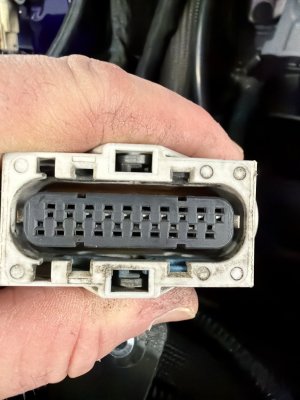
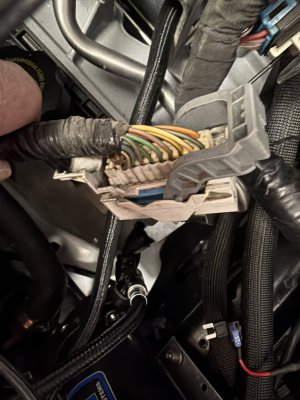
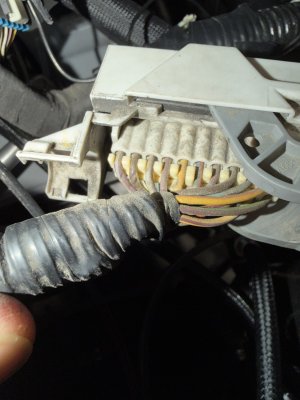
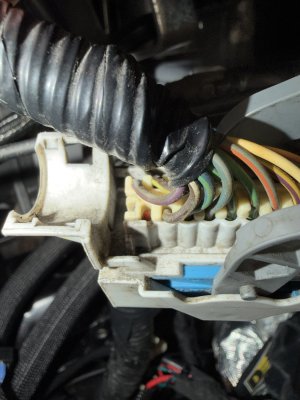
IMG 96CF3FE3 1839 4103 B5A8 8A972EA79092IMG 679C4E94 1D11 4BB9 9109 3D2D5405E789IMG 8853IMG 8856
Facing the connector
Top row left to right is pin 10-1
Bottom row left to right 20-11.
My build date is October 2009. Legacy shit

Power probe 3 KOEO
Top row

10 = no beep, 4.9 V — OSS sensor signal
9 = beep, 0.0 V — TSS/OSS sensor ground
8 = beep, 0.0 V — TR sensor ground
7 = no beep, 11.4 V — TR4
6 = beep, 12.0 V — TR3
5 = beep, 12.0 V — TR2
4 = beep, 12.0 V — TR1
3 = beep, 0.0 V — TFT signal return
2 = no beep, 4.4 V — TFT sensor supply
1 = beep, 0.0 V — Shift Solenoid E (SSE)

Bottom row

20 = beep, 12.1 V — TSS/OSS sensor power supply
19 = no beep, 4.9 V — TSS sensor signal
18 = flickering beep/light, 1.2–1.6 V cycling — Line Pressure Control (LPC)
17 = no beep, 2.0 V — Shift Solenoid C (SSC)
16 = going crazy like 13 did — Shift Solenoid B (SSB)
15 = beep, 12.3 V — Transaxle solenoid power control voltage
14 = no beep, 2.0 V — TCC solenoid
13 = no beep, 2.0 V — Shift Solenoid A (SSA)
12 = going crazy like 15 and 13 did — Shift Solenoid D (SSD)
11 = no wire / unused cavity — Not Used

Hold fast is MF right. Pin 9 was not correct info.

Let’s take a trip back in time. Forscan memory lane I flashed GUC. IMG 8857
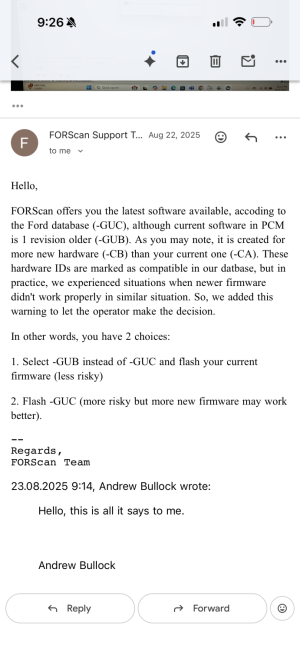
More risky, sounds fun, maybe not.

Found one body of work through Ford that if PIN 15 shows more than 10 volts—change solenoid assembly. However I did not perform their exact method so to just jump to more than 10 volts — replace is not exactly correct.

Order or new operations:

1. strategy / programming mismatch on the currently installed hardware
2. external connector / harness / terminal-fit issue at C168 or nearby
3. current installed solenoid body / valvebody / trans-side hardware issue
4. early-build TSB TR-sensor issue
5. PCM

Blunt version: the TSB mostly points inside the transmission-side TR sensor circuit, but your swap/update history makes that specific early-build bulletin less likely than software mismatch or connector/harness problems on the current setup.

I have the problematic 2009 stuff and harness plugged into hardware meant for an updated firmware version that’s inside a ‘14 transmission. Flashing the new solenoid assembly back from GUC to GUB firmware my car supports is the next cleanest path. Then hard reset…and electrical checks before any Cowboy shit
 

Latest posts

Forum statistics

Threads
107,085
Messages
1,181,298
Members
16,152
Latest member
lapochkarr

Members online

Back
Top