802SHO 2010 Build

Disclaimer: Links on this page pointing to Amazon, eBay and other sites may include affiliate code. If you click them and make a purchase, we may earn a small commission.

Zpak

Es Aich Oh!
Joined
Jun 1, 2017
Messages
1,973
Reaction score
2,528
Location
The region, Indiana
That’s funny. Last winter I had some truck issue and had to drive the SHO to work one night. The roads were clear but it was like high temp of 8° that day. On my way home in the morning the ambient temp was -12°. With Easton’s desert level trans cooling the trans temp never cracked 120°.
 

802SHO

Boost > VE, MBT, Cams
Supporting Member
Joined
Oct 8, 2019
Messages
3,248
Reaction score
7,814
Location
Essex Junction Vermont
Idk if I ever raced higher than 140. I’m going to go back and check data logs. The days I would drive to the track they’d get up to 180-190 interstate on the 3 hour drive. I’ve seen 205 at the track before doing some hot laps. All of that is not bad. Just chasing ideal temps for optimal performance
 

802SHO

Boost > VE, MBT, Cams
Supporting Member
Joined
Oct 8, 2019
Messages
3,248
Reaction score
7,814
Location
Essex Junction Vermont
Attention: please anyone who has no clue what the meth debate is, what the data means please unfollow me immediately.
 

802SHO

Boost > VE, MBT, Cams
Supporting Member
Joined
Oct 8, 2019
Messages
3,248
Reaction score
7,814
Location
Essex Junction Vermont
For clarity, this isn’t about personalities or tuners. It’s about physics, methodology, and actually understanding the system.

Methanol is fuel mass with a latent heat benefit, not a cosmetic cooling trick. Any amount, at any concentration, alters combustion dynamics and must be tuned for. Treating meth as “cooling only” or recommending fixed doses without tuning isn’t a difference of opinion, it’s a misunderstanding of engine control.

Also, my car runs perfectly fine. The issue discussed was a documented TCM power fault that’s already been shared and explained. This has never been about drivability, being unable to get the car running, or being upset someone didn’t tune it. I’m with the best EcoBoost tuner there is now with software that’s not going to hold it back. The point was repeated claims of expertise paired with a refusal to actually engage the PCM, strategy, or data. Certainty from a keyboard without hands-on validation isn’t engineering.

I’d rather be in a room with three people who can read logs, understand pressure ratios, lambda behavior, and timing response than in a packed arena applauding half-taught physics. Volume doesn’t create correctness, and repetition doesn’t replace measurement.

If someone wants to engage, bring logs, pressure data, AFR behavior, timing sensitivity, or repeatable results. If not, that’s fine too. This build and this thread are moving forward based on instrumentation and data, not consensus.

The platform limit is the stock location turbines. Always has been. Drive pressure 100% affects VE and MBT. Cams before larger turbines is pointless. Like tuning suspension with a blown shock. Like installing larger doors on a 2’ hallway.

Airflow is NOT the limit. Drive pressure is. That’s why when you do downpipes you don’t gain too much. That’s why cams and heads won’t do much. If the choke is still there it’s of very little gain. Next to that is SCT. Do you think it’s a coincidence we are the EcoBoost community left behind collecting dust and we are on stock turbines and SCT software. Coincidence? This is a highly sophisticated DI platform. SCT will never fully support out system calibration
 

kryptto

The Best Thing About Cars... ones in my mirror.
Supporting Member
Joined
Mar 24, 2023
Messages
3,196
Reaction score
2,066
Location
South East, Florida
you think it’s a coincidence we are the EcoBoost community left behind collecting dust and we are on stock turbines and SCT software. Coincidence? This is a highly sophisticated DI platform. SCT will never fully support out system calibration
and why when first doing research back before. joining this forum or any others, I bought HP. it has more access to tables and scalars in the PCM, which allows for better visibility into the datalogs collected. HP priced themselves out of many tuners hands because you have to pay a license fee to unlock a new PCM. Thus SCT has been prefered by many. Buy SCT pay someone to read and tune your car. And I do know that both companies offer remote tuning devices as well.

HP has always been in my opinion the DIY device and why I switched. I didn't feel comfortable doing it myself like many. so hats off to the people who do. we are only blowing up someone's engine.

But as you can see by other forums I read and creep this debate goes on and on...

from my bookmarks;


However at the end of the day I do truly believe, maybe because I have spent 30+ years working with programming, development and managing of technology that every change matters. the more I can edit tweak or write around means I can do more with the system. so everything ultimately matters and so does adding additives to our fuel.

one time I added one of those MBT additives octane boosters... Brad tells me something about adding race fuel to my mixture I beleive and can be wrong it's been a long while maybe something around KR knock retard and he was seeing it and asked did I add something to my fuel?

so it all matters. I added some 104+ crap to the gas and my tuner saw the change in the logs and wanted before making a change to his tune should he
.. so everything matters to a computer system. every variable should be adjusted for at some level.
 
Last edited:

802SHO

Boost > VE, MBT, Cams
Supporting Member
Joined
Oct 8, 2019
Messages
3,248
Reaction score
7,814
Location
Essex Junction Vermont
Let’s separate what was real from what was misinterpreted.

On Matt’s specific SHO setup, the VE drop was real and the MBT threshold was real. Those data points absolutely existed for that configuration. What they were not was a universal engine limit. They were the moment his system hit turbine choke and drive pressure took over.

That distinction matters. VE and MBT are outcomes of a system, not fixed coordinates on a chart that every build hits at the same RPM and load. Change the exhaust flow capacity, the fuel strategy, and the combustion environment, and the plot moves.

That’s why my car did not hit the same ceiling. Running E40 with 100 percent methanol, ported GH Gen3 turbines, port-matched to gasket, ported and thermal-coated 13+ exhaust manifolds, also port-matched, pushed drive pressure down and moved the limits out. VE carried farther. MBT stayed available longer. The ceiling shifted. Matt’s ceiling was not my ceiling, even then.

That difference in system behavior is exactly why my car responded differently on the track. I tried the recommended doctrine shift strategy. It didn’t work. ET slowed. When I shifted back to 6200, the car immediately picked up time because it was still operating in a better part of the power band for my setup, not his.

This is where the bragging gets backwards. Increasing compressor flow into the same stock-location turbine doesn’t prove the engine is airflow-limited. It proves the turbine is the choke. When people celebrate that those turbos can “blow a stock motor,” what they’re really celebrating is how hard they can spike drive pressure and heat. That’s not efficiency. That’s not head flow. That’s not cams. That’s just hitting the exhaust restriction harder.

Same metaphor every time: driving into the same wall faster doesn’t mean the engine learned to flow more air. It means the brakes never improved.

The motor has never been airflow-limited. Its true intake flow ceiling has never been touched. What keeps getting hit is the platform drive-pressure limit. Big difference.

Cams are the answer is a blatant lie. The cams aren’t the problem. The interim limit, in stock location, is turbine flow capacity. Period. Until that choke is relieved with a more capable turbine, every result will look the same, better low to midrange, a flat top end, and rising danger.

This isn’t about being right. It’s about reading the data correctly and refusing to turn one configuration’s limits into a doctrine for everyone else. The sooner you understand it dry, as science, the sooner you let go of Groupthink based on one man’s view and data plots.
 

mattr66usa

Active Member
Joined
Nov 22, 2025
Messages
145
Reaction score
108
Location
Texas
Let’s separate what was real from what was misinterpreted.

That difference in system behavior is exactly why my car responded differently on the track. I tried the recommended doctrine shift strategy. It didn’t work. ET slowed. When I shifted back to 6200, the car immediately picked up time because it was still operating in a better part of the power band for my setup, not his.
Why don't we separate real from what was and still is being misrepresented? I have completely stock cars with just a tune shifting at 6200 rpms as a target, especially on the 2-3 shift. Why do you keep saying the opposite like it is true?
 

802SHO

Boost > VE, MBT, Cams
Supporting Member
Joined
Oct 8, 2019
Messages
3,248
Reaction score
7,814
Location
Essex Junction Vermont
Why don't we separate real from what was and still is being misrepresented?
Exactly so leave my build thread. Your BS has no audience here. You are a used car salesman selling airflow limits as drive pressure limits. Kick rocks dude. Expert SCT calibrator. Other real tuners aren’t impressed.
 

802SHO

Boost > VE, MBT, Cams
Supporting Member
Joined
Oct 8, 2019
Messages
3,248
Reaction score
7,814
Location
Essex Junction Vermont
Why don't we separate real from what was and still is being misrepresented? I have completely stock cars with just a tune shifting at 6200 rpms as a target, especially on the 2-3 shift. Why do you keep saying the opposite like it is true?
Your VE and MBT observations on your configuration were real.
The error is extending those limits universally without measuring drive pressure.
That distinction has already been explained in detail.

My build thread is not the place to reframe that discussion.
 

802SHO

Boost > VE, MBT, Cams
Supporting Member
Joined
Oct 8, 2019
Messages
3,248
Reaction score
7,814
Location
Essex Junction Vermont
This is a dyno discussion. The data being referenced comes from loaded pulls in higher gears. Bringing up 2–3 shift RPM has no relevance to 3–4 or 4–5 dyno behavior, VE trends, or MBT limits being discussed.

The original points were about methanol as fuel, drive pressure effects, and turbine flow constraints under load. Focusing on an unrelated shift event doesn’t address any of that.

If there’s something to add on those topics, great. Otherwise this was just a derailment.
 

802SHO

Boost > VE, MBT, Cams
Supporting Member
Joined
Oct 8, 2019
Messages
3,248
Reaction score
7,814
Location
Essex Junction Vermont
Sorry not sorry for challenging this entire false belief system everyone so easily adopted years ago. I can’t unsee it now. And won’t be quiet. But saving anyone is where I need to fall back. It’s really not worth all the Bs.
 

mattr66usa

Active Member
Joined
Nov 22, 2025
Messages
145
Reaction score
108
Location
Texas
Exactly so leave my build thread. Your BS has no audience here. You are a used car salesman selling airflow limits as drive pressure limits. Kick rocks dude. Expert SCT calibrator. Other real tuners aren’t impressed.
You can't hide in your build thread when you chose to spew your BS everywhere. Come to the technical thread and defend your points like a real man.
 

802SHO

Boost > VE, MBT, Cams
Supporting Member
Joined
Oct 8, 2019
Messages
3,248
Reaction score
7,814
Location
Essex Junction Vermont
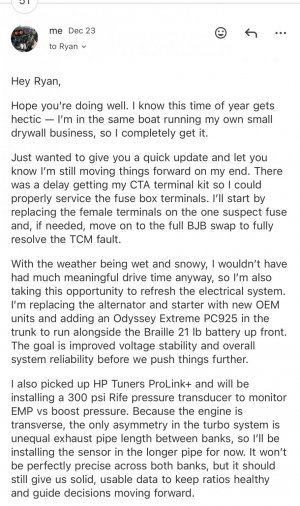
Pretty pumped for the next round of changes. HPtuners Prolink+ to monitor EMP:Boost pressure ratio. Rife 300 psi pressure sensor transducer. By monitoring drive pressure to boost pressure it will be crystal clear what healthy boost pressure is, and know exactly when the engine has had enough way before it ever becomes an issue.

Most OEM and stock-location turbo cars live with exhaust drive pressure well above boost pressure, often in the 1.6–2.0:1 range or higher, simply because of turbine and packaging limits. They work, but it’s inefficient and heat-heavy. With my setup, the hardware changes were made specifically to reduce turbine restriction and backpressure, so there’s no reason to accept OEM-level ratios anymore. For this car, a healthy window is roughly 1.1–1.3:1, 1.4:1 is still usable under harder pulls, and anything approaching 1.5:1 is a sign to stop adding boost and reassess. Tighter ratios let the engine breathe, keep temperatures under control, and allow timing and airflow to keep improving instead of hitting a wall…which is exactly why this system was built the way it was. Then it becomes easy to make informed decisions like buying larger turbines and swapping them in. No guessing. Data says what to do next.

No guessing and with the prolink+ it’ll be added to my VCM Scanner datalog parameters. I’ll be using a spare o2 bung post exhaust manifold, pre turbine. Since I already have that I’m going to use a m18x1.5 to 1/8NPT fitting, 1/8NPT 90 to -3AN. The sensor will get mounted on the firewall or near the strut tower in the engine bay with a snubber installed inline before the sensor so readings are smooth. I’ll be installing and wiring myself.

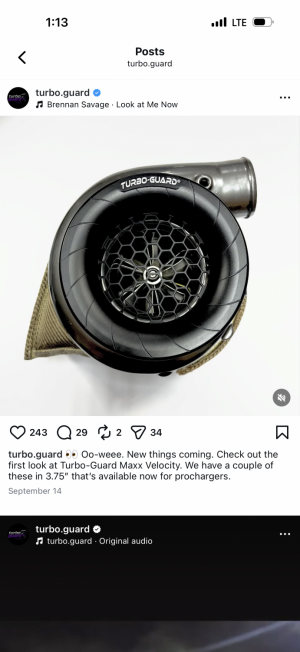
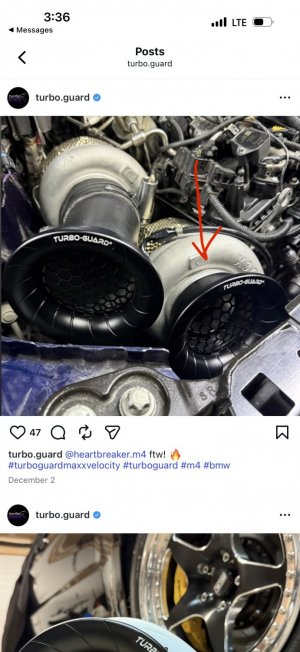
TurboGuard has a new product available for presale and I ordered (2) 3” Maxx Velocity guards to try out. My turbos eat ambient air so this will enhance spool and sound amazing. Later I can compare to my front mounted intakes with some Dragy pulls. Idea is to test them but bc of the added risk of debris I might hold them for track days only as part of a no limit prep. IMG 6990IMG 6991
Once I receive them in another week or so I’m going to send them to BPC Restoration in NY to powder coat them Illusion Purple like my motor.

I’m also stepping up my electrical system by adding an Odyssey Extreme PC925 battery in the trunk in conjunction with my Braille 21 pound battery remaining in the engine bay. My 16 year old (car was built in 09) alternator and starter are getting replaced with new units.

The dual-battery setup is for voltage stability, not just cranking. The rear Odyssey provides reserve capacity for high electrical demand while the front Braille keeps starting response immediate. Combined with a new alternator and starter, this removes voltage drop and electrical noise from the equation as loads increase, which helps sensor accuracy, ECU consistency, and overall reliability.

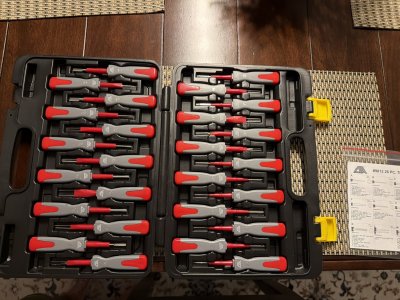
I’m getting ready to play with my CTA kit and get power restored to the TCM. At first I’ll just attempt to examine the female terminals and hopefully I can just replace those otherwise I’ll move on to the full BJB swap.

This car started out as a plan to build a really serious EcoBoost SHO… same basic mold, just stronger and capable of more. But the deeper it went, the clearer it became that it wasn’t playing by those rules anymore. Every time we tried to force it back into a familiar calibration, adding power only made things worse. It was like trying to jam an octagon into a round hole…no matter how hard you push, it’s never going to fit. At that point, the only smart move was to stop forcing it and hit reset. Now it’s in a phase where the data leads and the car tells us what it actually wants instead of us guessing. That’s why it evolved past surface-level tuning with SCT, and into HP Tuners….. because once the car went full-frame turbos moved out of the engine bay, a return-style fuel system with a dedicated fuel cell, and a fundamentally different airflow and pressure model, SCT simply doesn’t have the system-level access required to recalibrate something like this.

This isn’t about making it louder or faster right away… it’s about understanding it first. Because once you stop trying to make a car be what it isn’t, you can finally build it into what it’s meant to become.
IMG 5861
The real beginning has begun
 

802SHO

Boost > VE, MBT, Cams
Supporting Member
Joined
Oct 8, 2019
Messages
3,248
Reaction score
7,814
Location
Essex Junction Vermont
I genuinely hope the progression of this build is easy to follow. A few ppl had me second guessing if it was easy for everyone to follow. I think most of you get it. No mechanical failures here….just bad assumptions getting exposed once power showed up. For those waiting on me to be stuck, this is actually the point where progress accelerates.

For the record, I’m obsessed with reality and making the system honest. I’m not brand-loyal, so the brand-parade arguments don’t land. There’s more than one vendor on this platform, and none of them require worship.
 

DadMobile

Worlds 3rd least slowest Ecoboost SHO
Joined
Nov 4, 2020
Messages
679
Reaction score
1,122
Location
Texas
Pretty pumped for the next round of changes. HPtuners Prolink+ to monitor EMP:Boost pressure ratio. Rife 300 psi pressure sensor transducer. By monitoring drive pressure to boost pressure it will be crystal clear what healthy boost pressure is, and know exactly when the engine has had enough way before it ever becomes an issue.

Most OEM and stock-location turbo cars live with exhaust drive pressure well above boost pressure, often in the 1.6–2.0:1 range or higher, simply because of turbine and packaging limits. They work, but it’s inefficient and heat-heavy. With my setup, the hardware changes were made specifically to reduce turbine restriction and backpressure, so there’s no reason to accept OEM-level ratios anymore. For this car, a healthy window is roughly 1.1–1.3:1, 1.4:1 is still usable under harder pulls, and anything approaching 1.5:1 is a sign to stop adding boost and reassess. Tighter ratios let the engine breathe, keep temperatures under control, and allow timing and airflow to keep improving instead of hitting a wall…which is exactly why this system was built the way it was. Then it becomes easy to make informed decisions like buying larger turbines and swapping them in. No guessing. Data says what to do next.

No guessing and with the prolink+ it’ll be added to my VCM Scanner datalog parameters. I’ll be using a spare o2 bung post exhaust manifold, pre turbine. Since I already have that I’m going to use a m18x1.5 to 1/8NPT fitting, 1/8NPT 90 to -3AN. The sensor will get mounted on the firewall or near the strut tower in the engine bay with a snubber installed inline before the sensor so readings are smooth. I’ll be installing and wiring myself.

TurboGuard has a new product available for presale and I ordered (2) 3” Maxx Velocity guards to try out. My turbos eat ambient air so this will enhance spool and sound amazing. Later I can compare to my front mounted intakes with some Dragy pulls. Idea is to test them but bc of the added risk of debris I might hold them for track days only as part of a no limit prep. View attachment 96208View attachment 96209
Once I receive them in another week or so I’m going to send them to BPC Restoration in NY to powder coat them Illusion Purple like my motor.

I’m also stepping up my electrical system by adding an Odyssey Extreme PC925 battery in the trunk in conjunction with my Braille 21 pound battery remaining in the engine bay. My 16 year old (car was built in 09) alternator and starter are getting replaced with new units.

The dual-battery setup is for voltage stability, not just cranking. The rear Odyssey provides reserve capacity for high electrical demand while the front Braille keeps starting response immediate. Combined with a new alternator and starter, this removes voltage drop and electrical noise from the equation as loads increase, which helps sensor accuracy, ECU consistency, and overall reliability.

I’m getting ready to play with my CTA kit and get power restored to the TCM. At first I’ll just attempt to examine the female terminals and hopefully I can just replace those otherwise I’ll move on to the full BJB swap.

This car started out as a plan to build a really serious EcoBoost SHO… same basic mold, just stronger and capable of more. But the deeper it went, the clearer it became that it wasn’t playing by those rules anymore. Every time we tried to force it back into a familiar calibration, adding power only made things worse. It was like trying to jam an octagon into a round hole…no matter how hard you push, it’s never going to fit. At that point, the only smart move was to stop forcing it and hit reset. Now it’s in a phase where the data leads and the car tells us what it actually wants instead of us guessing. That’s why it evolved past surface-level tuning with SCT, and into HP Tuners….. because once the car went full-frame turbos moved out of the engine bay, a return-style fuel system with a dedicated fuel cell, and a fundamentally different airflow and pressure model, SCT simply doesn’t have the system-level access required to recalibrate something like this.

This isn’t about making it louder or faster right away… it’s about understanding it first. Because once you stop trying to make a car be what it isn’t, you can finally build it into what it’s meant to become.
View attachment 96211
The real beginning has begun
After 99 pages, let the build begin!
HPT tuners offered less for the SHO than SCT.

*edit
I used to be excited about this build maybe 4 years ago. Then about 2 years ago I realized it will never run down the track if it ever gets done at all.

Now I’m absolutely certain this build is nothing more than a forum post.
 
Last edited:

802SHO

Boost > VE, MBT, Cams
Supporting Member
Joined
Oct 8, 2019
Messages
3,248
Reaction score
7,814
Location
Essex Junction Vermont
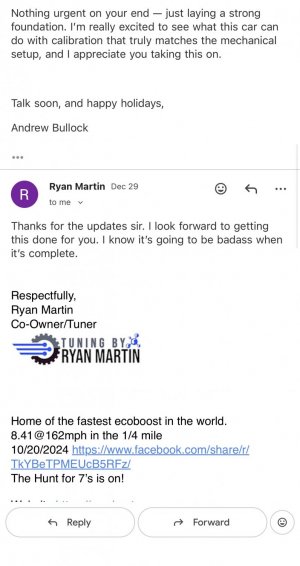
Update to share from Ryan Martin. I sent him an update and I heard back today. IMG 7217IMG 7218
Data driven ….data guarded. No assumptions, no vibes, no guessing. When the mechanical and software and tuning philosophy come together as one. Letting this Hybrid EcoBoost SHO reveal to Ryan what it is and what it wants. Truly exciting is an understatement.

The tool a lot of ppl like to dismiss bc they can’t argue technically, bc they can’t dismantle physics and fluid dynamics…AI. Such a valuable tool to use. Like whining someone used a calculator instead of count with their hands. Like saying online certificates and degrees earned don’t count bc they weren’t earned in a classroom. All that matters is if the information is correct yes or no. When a person(s) resort to attacking a tool they have already lost the debate. That’s the weakest angle to come from.

I’m using AI to upgrade my car to Motorsport spec. I used it to plan and execute EMP monitoring. Using it as a collaborator to spec out HPTuners prolink +, The Rife 300 psi I chose is bc 300 psi will capture spikes…adding a snubber before the sensor to keep readings smooth…I asked AI to help me buy every part. Same as my dual battery setup. I’m using 1/0 welding cable, class T 300amp fuse 6-12” away from the trunk power. 1/0 ground to chassis, 1/0 ground to rear subframe. Motorsport spec. No compromises.

While others debate hypotheticals, I’m getting my electrical system upgraded for serious voltage stability, signal clarity and overall reliability. Monitoring EMP, game changer. Car is getting back to 100%+upgraded health. No blind paths, no guessing.

My turbos system can evolve in place. I can swap out turbines and compressor cartridges. Data decides. I’m going up against maxed out whips with evolution options that require 0 pipe iterations.

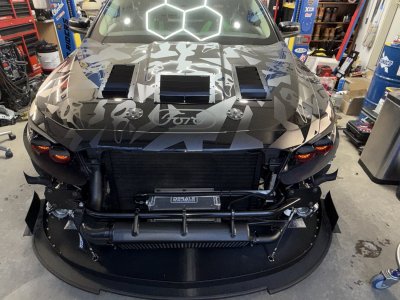
Waiting for my Maxx Velocity TurboGuards to show up. IMG 7199
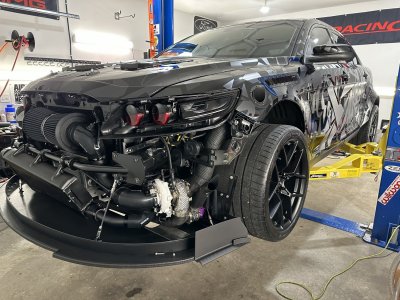
Looks different with the intakes gone for now IMG 7194
 
Last edited:

Forum statistics

Threads
107,084
Messages
1,181,279
Members
16,152
Latest member
Satchmoz

Members online

Back
Top