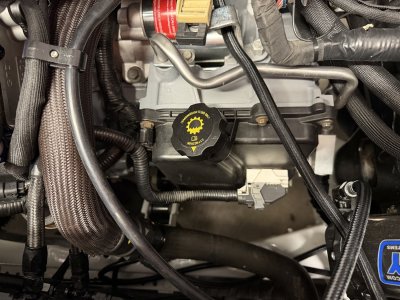
I flashed my transmission to GUB with the new body ID last night and it was successful and that change broke the communication language barrier with MAP in my custom tune. Looks to have changed my operating system ID.
The transmission worked fine with no buzzing at least while in GUC alone for about 500+ miles of the roughly 700 total.
I’m programming it back to GUC after work. Then I am going to drain the car with battery terminals removed and touching them and holding them together for 15 min.
I have a strong theory that flips the whole situation on its head. That gets tested tonight.
Ready? I’m thick in the weeds here but this is not a clean test sample in a classroom with every perfect tool at my disposal.
It’s in my garage with very little tools, just my God-given pattern recognition, intuition, what I’ve observed and lived and what I’ve learned all put into focus that looks clear only now.
What I think finally happened here is actually pretty insane, and last night a couple major pieces finally snapped into place.
Over the last 700 miles, especially during repeated heavy single-gear WOT pulls, my original 2009 Relay 53 and some oxidized grounds were slowly getting cooked. The first real warning was a P0689 limp event. Then after I beefed up the PCV setup, I made another WOT pull close to home and that was basically the death blow. The trans hung in 3rd, and the car conveniently died right as I rolled into my driveway.
I found and repaired some ugly green grounds, and I also corrected a missing EMI foil issue at the crank sensor. Even after that, the transmission kept dropping out. At the time, the hardware side still wasn’t fully making sense, so I kept chasing power delivery.
Once I got into it with HP Tuners, I found a P1602 and a completely dead BJB Fuse 49. At that point, I did not know Fuse 49 was for heated mirrors. I thought I had found a direct TCM power path problem, so I powered Fuse 49 thinking I was feeding something transmission-critical.
And that is where things started getting weird.
As soon as I powered Fuse 49, the behavior changed. It looked like I had found something real, because the trans would survive a no-load lift test. But it still failed under actual road load. Later on, once I learned Fuse 49 is heated mirrors and shares the bus bar with Relay 53, that changed the entire way I looked at what happened. I was never directly powering the TCM the way I thought I was. I was backfeeding a shared power path just enough to fake progress.
Then it got even more interesting.
I spliced my MaySpare switch panel into that same load path thinking I was directly helping the TCM. But then the car would not even start unless I hit that switch. That changed everything. At that point, it became obvious I wasn’t just helping the TCM…I had actually hotwired the master Relay 53 ignition path without realizing it.
Last night was when the bigger picture finally came together. That was also when I learned about Ford’s latch logic. So now the sequence makes a lot more sense. I likely had an original hardware failure involving Relay 53, voltage drop, grounds, or all of the above. I fixed parts of the hardware, but the system may have already latched the failure and continued holding that state even after the physical issue changed.
Then comes the part that really ties the timeline together. While I was building all of this and finishing the dual battery setup, the car sat completely powerless for about a month. That long drain likely wiped the original software latch. So when I fired it back up with my manual switch taking over the load path, the solenoids were dead silent and the car was happy again. Not because the original issue never happened, but because the car had finally been forced to let go of it.
Of course, that still was not the end of it. My switch panel uses smart solid-state logic and at the time only had a 10-amp fuse on that button. Under real heat and load, the trans appears to want more like 11–12+ amps. So the circuit started choking, voltage dropped, and while the trans was trying to relearn its adaptive tables, it likely saw unstable voltage, panicked, and latched a fresh failure. That lines up way too well with the buzzing coming back.
So tonight’s plan is simple. Flash back to the known-good GUC firmware, do a hard battery drain to wipe any fresh latches, and start it with the switch panel powering that path. It should be dead silent. Then comes the real test: with the engine running, pull Relay 53 straight out of the box.
Why? Because I already cut that wire about 6 inches out of the BJB and manually took over the load path. At this point, Relay 53 should basically be a phantom relay clicking into nothing. If I pull it and the engine keeps running, that proves my bypass is carrying 100% of the load and that the factory electrical bottleneck is officially out of the equation.
That would be the moment this whole electrical ghost stops being a ghost. That would mean what looked like a transmission mystery was really a power path problem, mixed with latch logic, and a whole lot of Ford nonsense layered on top of it with me stuck trying to think my way out of it.
Stay tuned. This one has some serious bite. Only one way to find out. But this is hot on its heels
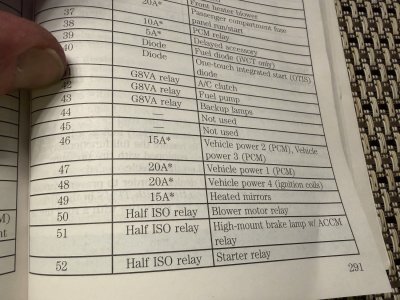
I seriously questioned reality when I found fuse 49 is heated F mirrors. F me.