Ecoboost_xsport
SHO Member
OK, real quick (I'll elaborate more later, it's Thanksgiving right now and Turkey is in the oven, LOL), but I'm pretty excited about the results so far.
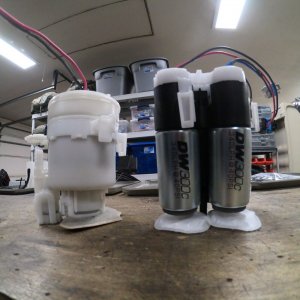
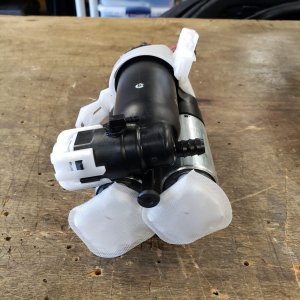
I've always felt the LPFP was inadequate to make serious HP. Even with injectors and a HPFP we are forgetting to address the source of fuel. With those larger injectors and HPFP, you basically have a fire hose connected to a garden hose bib. You'll never be able to utilize them to their full potential when pushing the limits of the platform. Well, the problem really manifested when switching to e85. Brad (AJP Turbo) noticed in the data log as we were tuning that the low pressure side was dipping pretty low and the HPFP would follow with a dip. Even with a DW300c in the fuel module, it was faltering. It's just not enough to make serious power, especially on corn...
As some of you know, I've been trying for quite some time to address this issue and decided to implement old school solution to increase flow for now. Enter the boost-a-pump (usually referring to the Kenne Bell version) from JMS. There are a few versions from other manufacturers out there, but the JMS has the reputation of having the cleanest output signal.
Those of you who are trying to make serious power, it may be worth entertaining the idea of installing one. It's relatively easy and I'll be doing a write-up on it in my build thread shortly. Just wanted to share my preliminary findings.
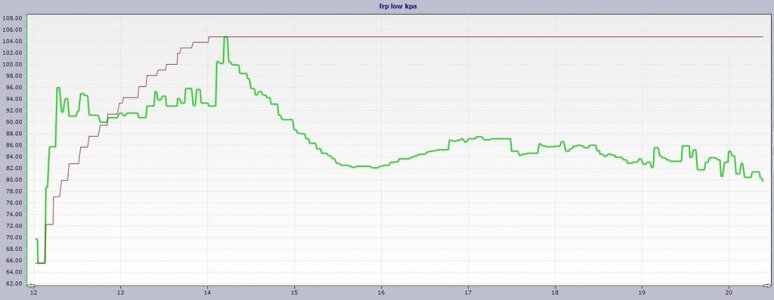
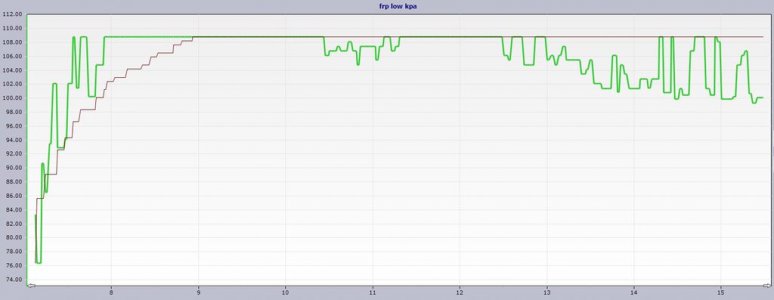
Brad is still tuning but he's super happy about the pressure staying way more stable and here is a log to illustrate, everything is 100% equal except for the BAP. The tune is the same before and after, so it's easy to see the improvement:
Charts are isolated to a 3rd gear run from 2k RPM to 6k RPM. Showing:
- LP Pressure DSD (Brown)
- LP Actual (Green)
Without BAP, you can see how it just can't keep up with the requested pressure:
With BAP, it can still use some help at the end, but way better:
Stock, the fuel pump driver module never puts more than 14.10v to the pump (actually higher than I was anticipating). The DW300c is stable up to 18.00v, leaving almost 4.0v on the table. Right now, I am using a 0-5v trigger input from the pedal position sensor and have it ramping from 14.5v to a max of 17.0v at WOT.
Anyway, wanted to pass this on so that those who are on the cutting edge ( @bpd1151 @Jordan_R @802SHO and I may be forgetting some of you) can possibly use this as a very viable solution to get that HPFP the fuel it needs.
Anyway, I have ANOTHER LPFP solution on the way that may blow the doors open for our platform and maybe even change the game...stay tuned...
I've always felt the LPFP was inadequate to make serious HP. Even with injectors and a HPFP we are forgetting to address the source of fuel. With those larger injectors and HPFP, you basically have a fire hose connected to a garden hose bib. You'll never be able to utilize them to their full potential when pushing the limits of the platform. Well, the problem really manifested when switching to e85. Brad (AJP Turbo) noticed in the data log as we were tuning that the low pressure side was dipping pretty low and the HPFP would follow with a dip. Even with a DW300c in the fuel module, it was faltering. It's just not enough to make serious power, especially on corn...
As some of you know, I've been trying for quite some time to address this issue and decided to implement old school solution to increase flow for now. Enter the boost-a-pump (usually referring to the Kenne Bell version) from JMS. There are a few versions from other manufacturers out there, but the JMS has the reputation of having the cleanest output signal.
Those of you who are trying to make serious power, it may be worth entertaining the idea of installing one. It's relatively easy and I'll be doing a write-up on it in my build thread shortly. Just wanted to share my preliminary findings.
Brad is still tuning but he's super happy about the pressure staying way more stable and here is a log to illustrate, everything is 100% equal except for the BAP. The tune is the same before and after, so it's easy to see the improvement:
Charts are isolated to a 3rd gear run from 2k RPM to 6k RPM. Showing:
- LP Pressure DSD (Brown)
- LP Actual (Green)
Without BAP, you can see how it just can't keep up with the requested pressure:
With BAP, it can still use some help at the end, but way better:
Stock, the fuel pump driver module never puts more than 14.10v to the pump (actually higher than I was anticipating). The DW300c is stable up to 18.00v, leaving almost 4.0v on the table. Right now, I am using a 0-5v trigger input from the pedal position sensor and have it ramping from 14.5v to a max of 17.0v at WOT.
Anyway, wanted to pass this on so that those who are on the cutting edge ( @bpd1151 @Jordan_R @802SHO and I may be forgetting some of you) can possibly use this as a very viable solution to get that HPFP the fuel it needs.
Anyway, I have ANOTHER LPFP solution on the way that may blow the doors open for our platform and maybe even change the game...stay tuned...
Last edited: