

You are using an out of date browser. It may not display this or other websites correctly.
You should upgrade or use an alternative browser.
You should upgrade or use an alternative browser.
Effectiveness of Fuel Pump Voltage Booster (Boost-A-Pump)
- Thread starter Ecoboost_xsport
- Start date
Disclaimer: Links on this page pointing to Amazon, eBay and other sites may include affiliate code. If you click them and make a purchase, we may earn a small commission.

SM105K
Streetlight Grand Prix Champ/ IG @fafomotorsports
I’ve seen 3/8 line support 6-700 up on e-85 fwiw so I doubt line size will be a large consideration for most people
We did it on both of my twin turbo camaros.......

Sharpcoolman
SHO Member
Is this set up made to interface with the stock tank? Will you be using an MSD boost a pump or similar to get more volts at higher boost? I want to make my sho run off of pure E85 pump gas everyone keeps saying it can’t be done I refuse to believe that. Plenty of E85 in my area and it is cheap performance fuel.sssssshhhhhhhhh! here's my "other" LPFP project that is ongoing...but don't tell anyone yet ok, LOL (whisper):
Not even sure it will work yet, but here's a sneak peak:
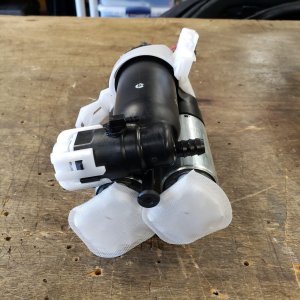
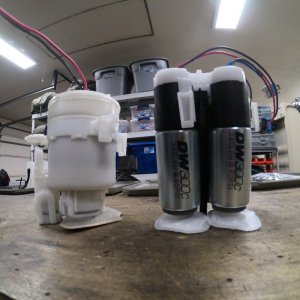

The way I look at it the 3 most important variables when it comes to flow of a fuel system are mass, mass and mass. Everything else is secondary information. By definition of a positive displacement pump, The HPFP displaces a fixed volume of fluid for each stroke or cycle. Mass = volume x density, so achieving greater mass flow through it requires raising the density of the fluid. Like you guys are saying, the HPFP can only flow what it's being fed. But that has absolutely nothing to do with static pressure from the LPFP.
Here's where you completely lose me- the difference in density of ethanol between 0 psig and 75 psig is nothing, like 0.02%. Ergo, the difference in mass flow should also be an inconsequential at any given operating point of the HPFP. The HPFP truly should be capable of feeding itself without a secondary pump, as has been the case for mechanical fuel pumps of various designs for many many decades. The LPFP is just there for priming and to prevent vapor lock. It's the exact same pump used in the non-ecoboosts, and according to DeatschWerks even the oem lift pump can out-flow the xdi60 at 40 psi of head (216 lph vs 200 lph).
Sorry if it sounds like I'm arguing with you. I just feel like there's something being missed, and that any significant performance boost from raising the pressure at the inlet of the HPFP means there must be a significant change in density, which means somewhere between your gas tank and your HPFP there must be cavitation or vaporization of some kind. Who knows, maybe it happens right within the HPFP itself and there's nothing else that can be done about it. But you're not giving much to look at; your screenshots highlight commanded gear but hide rail pressure altogether?? Are you logging injector pulsewidth at all? Load and lambda to calculate fuel flow?
As you continue fighting to increase the velocity through the fuel line and fittings, the probability of cavitation in your pump or flashing in your lines becomes more and more real. In a project that has thousands upon thousands of dollars devoted to a fuel system upgrade yet still struggles to run e85 even at modest power levels, I would think something so basic as a larger fuel line would make good sense for making your life easier. I'm just armchair quarterbacking and maybe I'm way off base. But I know drinking through a slurpee straw requires a lot less effort than drinking through a coffee stirrer. To **** with "what's been done before". If I listened to practical wisdom at every turn I'd be either a lot slower or a lot poorer, or both.
The sound quality sucks but this video series has some good information and concepts that don't get talked about a lot, so it's worth a watch:
Here's where you completely lose me- the difference in density of ethanol between 0 psig and 75 psig is nothing, like 0.02%. Ergo, the difference in mass flow should also be an inconsequential at any given operating point of the HPFP. The HPFP truly should be capable of feeding itself without a secondary pump, as has been the case for mechanical fuel pumps of various designs for many many decades. The LPFP is just there for priming and to prevent vapor lock. It's the exact same pump used in the non-ecoboosts, and according to DeatschWerks even the oem lift pump can out-flow the xdi60 at 40 psi of head (216 lph vs 200 lph).
Sorry if it sounds like I'm arguing with you. I just feel like there's something being missed, and that any significant performance boost from raising the pressure at the inlet of the HPFP means there must be a significant change in density, which means somewhere between your gas tank and your HPFP there must be cavitation or vaporization of some kind. Who knows, maybe it happens right within the HPFP itself and there's nothing else that can be done about it. But you're not giving much to look at; your screenshots highlight commanded gear but hide rail pressure altogether?? Are you logging injector pulsewidth at all? Load and lambda to calculate fuel flow?
As you continue fighting to increase the velocity through the fuel line and fittings, the probability of cavitation in your pump or flashing in your lines becomes more and more real. In a project that has thousands upon thousands of dollars devoted to a fuel system upgrade yet still struggles to run e85 even at modest power levels, I would think something so basic as a larger fuel line would make good sense for making your life easier. I'm just armchair quarterbacking and maybe I'm way off base. But I know drinking through a slurpee straw requires a lot less effort than drinking through a coffee stirrer. To **** with "what's been done before". If I listened to practical wisdom at every turn I'd be either a lot slower or a lot poorer, or both.
The sound quality sucks but this video series has some good information and concepts that don't get talked about a lot, so it's worth a watch:
Sharpcoolman
SHO Member
So larger fuel lines would help but won’t the constricting and limiting factor be when you have to neck it down. The xdi from what I understand still uses stock diameter connections so it wouldn’t help get enough fuel? I am more inclined to believe that the hpfp design itself maybe the problem because if I am not mistaken early SHO’s (2010-2011) we’re having issues with cavitation in the hpfp if it got too hot like taking the car to the track or under hard driving. It may have been bandaided by the blue oval in the 2013 refresh but E85’s properties may be exasperating the issues. Are the XDI hpfp exactly the same design internally as fords or slightly different? Same design but larger passage way for fuel flow? And finally are the XDI pumps better or worse than Livernois Motorsports? Livernois claims they have an E85 only tuned SHO.The way I look at it the 3 most important variables when it comes to flow of a fuel system are mass, mass and mass. Everything else is secondary information. By definition of a positive displacement pump, The HPFP displaces a fixed volume of fluid for each stroke or cycle. Mass = volume x density, so achieving greater mass flow through it requires raising the density of the fluid. Like you guys are saying, the HPFP can only flow what it's being fed. But that has absolutely nothing to do with static pressure from the LPFP.
Here's where you completely lose me- the difference in density of ethanol between 0 psig and 75 psig is nothing, like 0.02%. Ergo, the difference in mass flow should also be an inconsequential at any given operating point of the HPFP. The HPFP truly should be capable of feeding itself without a secondary pump, as has been the case for mechanical fuel pumps of various designs for many many decades. The LPFP is just there for priming and to prevent vapor lock. It's the exact same pump used in the non-ecoboosts, and according to DeatschWerks even the oem lift pump can out-flow the xdi60 at 40 psi of head (216 lph vs 200 lph).
Sorry if it sounds like I'm arguing with you. I just feel like there's something being missed, and that any significant performance boost from raising the pressure at the inlet of the HPFP means there must be a significant change in density, which means somewhere between your gas tank and your HPFP there must be cavitation or vaporization of some kind. Who knows, maybe it happens right within the HPFP itself and there's nothing else that can be done about it. But you're not giving much to look at; your screenshots highlight commanded gear but hide rail pressure altogether?? Are you logging injector pulsewidth at all? Load and lambda to calculate fuel flow?
As you continue fighting to increase the velocity through the fuel line and fittings, the probability of cavitation in your pump or flashing in your lines becomes more and more real. In a project that has thousands upon thousands of dollars devoted to a fuel system upgrade yet still struggles to run e85 even at modest power levels, I would think something so basic as a larger fuel line would make good sense for making your life easier. I'm just armchair quarterbacking and maybe I'm way off base. But I know drinking through a slurpee straw requires a lot less effort than drinking through a coffee stirrer. To **** with "what's been done before". If I listened to practical wisdom at every turn I'd be either a lot slower or a lot poorer, or both.
The sound quality sucks but this video series has some good information and concepts that don't get talked about a lot, so it's worth a watch:
Last edited:

Jordan_R
Stock Block Ready To Knock...er..Rock
Lms e85 tuned sho is using a dw300c with a kenne bell boost a pump. There is been several e85 tuned sho just none actually abusing the fuel for max power. No clue why people say it can't be done. It has been done several times just smaller ethanol blends get you MBT timing anyways and there isn't much point

Ecoboost_xsport
SHO Member
I'm currently on full e85, but the current system cannot keep up when trying to maximize the potential the fuel has. So yes, this will hopefully improve rhat situationIs this set up made to interface with the stock tank? Will you be using an MSD boost a pump or similar to get more volts at higher boost? I want to make my sho run off of pure E85 pump gas everyone keeps saying it can’t be done I refuse to believe that. Plenty of E85 in my area and it is cheap performance fuel.
Ecoboost_xsport
SHO Member
Lms e85 tuned sho is using a dw300c with a kenne bell boost a pump. There is been several e85 tuned sho just none actually abusing the fuel for max power. No clue why people say it can't be done. It has been done several times just smaller ethanol blends get you MBT timing anyways and there isn't much point
Yes, until we can crack the secret to feeding this motor the amount of e85 it needs, the current blends/tunes out there can get you pretty far...
Ecoboost_xsport
SHO Member
The way I look at it the 3 most important variables when it comes to flow of a fuel system are mass, mass and mass. Everything else is secondary information. By definition of a positive displacement pump, The HPFP displaces a fixed volume of fluid for each stroke or cycle. Mass = volume x density, so achieving greater mass flow through it requires raising the density of the fluid. Like you guys are saying, the HPFP can only flow what it's being fed. But that has absolutely nothing to do with static pressure from the LPFP.
Here's where you completely lose me- the difference in density of ethanol between 0 psig and 75 psig is nothing, like 0.02%. Ergo, the difference in mass flow should also be an inconsequential at any given operating point of the HPFP. The HPFP truly should be capable of feeding itself without a secondary pump, as has been the case for mechanical fuel pumps of various designs for many many decades. The LPFP is just there for priming and to prevent vapor lock. It's the exact same pump used in the non-ecoboosts, and according to DeatschWerks even the oem lift pump can out-flow the xdi60 at 40 psi of head (216 lph vs 200 lph).
Sorry if it sounds like I'm arguing with you. I just feel like there's something being missed, and that any significant performance boost from raising the pressure at the inlet of the HPFP means there must be a significant change in density, which means somewhere between your gas tank and your HPFP there must be cavitation or vaporization of some kind. Who knows, maybe it happens right within the HPFP itself and there's nothing else that can be done about it. But you're not giving much to look at; your screenshots highlight commanded gear but hide rail pressure altogether?? Are you logging injector pulsewidth at all? Load and lambda to calculate fuel flow?
As you continue fighting to increase the velocity through the fuel line and fittings, the probability of cavitation in your pump or flashing in your lines becomes more and more real. In a project that has thousands upon thousands of dollars devoted to a fuel system upgrade yet still struggles to run e85 even at modest power levels, I would think something so basic as a larger fuel line would make good sense for making your life easier. I'm just armchair quarterbacking and maybe I'm way off base. But I know drinking through a slurpee straw requires a lot less effort than drinking through a coffee stirrer. To **** with "what's been done before". If I listened to practical wisdom at every turn I'd be either a lot slower or a lot poorer, or both.
The sound quality sucks but this video series has some good information and concepts that don't get talked about a lot, so it's worth a watch:
First and foremost I want to say that I absolutely appreciate your input on this. I don’t believe you're being argumentative at all as this is the kind of input I look forward to receiving from a forum versus simply saying things suck, lol.
That being said, I wanted to say I'm coming at this problem from a layman's perspective. I'm definitely no engineer so my knowledge of fluid dynamics is likely limited. Sounds like you have a good grasp of it. I still don't believe we've reached the point where mass is the operative variable.
As for the log I posted, yes, I will agree they were very minimal. I was attempting to give a brief update on what I've found so far and minimize how crowded some of these logs can be. But yes, all those other parameters are important and are being logged. Maybe when I get the tune dialed in, I'll post my logs up for those of you smarter than me can pick it apart...I'd love that sort of feedback.
As I'm no engineer and have no access to extensive research tools and capabilities, I'm relegated to experimenting through trial and error. I'm blessed to be in a position where I can spend the amount of money I am spending to do this. Plus, it's fun for me to try and tackle these kinds of problems through experimentation. I'm completely cognizant of the fact that I may be participating in an exercise in futility...and I'll gladly report back if that's the case.
However, I firmly believe this will help in pushing the platform forward and maybe open some doors (other limiting components notwithstanding) for making more power. I've been talking with some pretty smart people in the aftermarket fueling business and the feedback I've been getting is pretty positive, so I'll keep pushing my angle that improving the LPFP (via voltage boosting and/or increasing size of the pump) as a part of the fueling equation...
...oh and though your example of sucking through a straw vs a coffee stirrer is valid, flip that around and tell me how difficult it is to suck through a fire hose vs a straw...using your same lung capacity. It won't work and the concept is the same. The trick is finding that balance on fuel line sizing...I don't have the answer, but as I said, for the time being, the stock line is adequate....
Anyway, I appreciate your input and keep asking those questions...I think they help us all stay honest with ourselves.
Last edited:

Sgtmeatsauce1
2013 SHO +pp
Subscribe
Sgtmeatsauce1
2013 SHO +pp
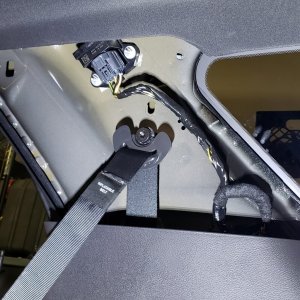
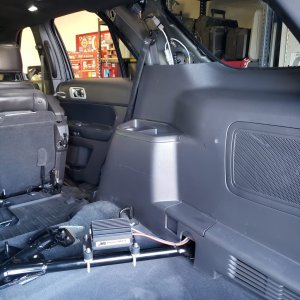
Where is the relay on a 2013 SHO PP+ to install the boost a pump?
Ecoboost_xsport
SHO Member
Where is the relay on a 2013 SHO PP+ to install the boost a pump?
That's where I can be of no help...apologies. But it's up high on the passenger side c-pillar on the XSport...
Sgtmeatsauce1
2013 SHO +pp
Cool thats a start, I'll look through forums, on preliminary search i saw many installments on YouTube, none fir a SHO though yet...

Cool thats a start, I'll look through forums, on preliminary search i saw many installments on YouTube, none fir a SHO though yet...
On the Taurus and MKS its on the passenger side C-pillar. Fold the seat back down and pull the pillar carpeting back.
Sgtmeatsauce1
2013 SHO +pp
Thank you!
We did it on both of my twin turbo camaros.......
that was my point. It HAS supported those power levels. So it would take a **** of a build for a 3/8 line to be an issue or need to be upgraded
I've said my peace about the fuel line. If you all feel dropping bookoo bucks on pumps and boosters is super important but some pocket change to reduce frictional losses and therefore the demand on that pump is stupid, then more power to you all!
I've said my peace about the fuel line. If you all feel dropping bookoo bucks on pumps and boosters is super important but some pocket change to reduce frictional losses and therefore the demand on that pump is stupid, then more power to you all!
I don’t want you to take my quote as directed at you, it was at my buddy who I believed was missing the intent of my post. As far as line sizing, I know it to be true that on a non direct injected motor the 3/8 line is not and issue until a fairly large power is made. In the example of the LS engines it’s not even really the 3/8 line that becomes the issue it’s the fuel rail crossover and the return less fuel system that ultimately create the bottleneck.
Now this is a different fuel system and is direct injected so there are some different variables.
SM105K
Streetlight Grand Prix Champ/ IG @fafomotorsports
I don’t want you to take my quote as directed at you, it was at my buddy who I believed was missing the intent of my post. As far as line sizing, I know it to be true that on a non direct injected motor the 3/8 line is not and issue until a fairly large power is made. In the example of the LS engines it’s not even really the 3/8 line that becomes the issue it’s the fuel rail crossover and the return less fuel system that ultimately create the bottleneck.
Now this is a different fuel system and is direct injected so there are some different variables.
I was agreeing with you buddy.
Fair enoughI was agreeing with you buddy.
Similar threads

- Replies
- 8
- Views
- 2K


- Replies
- 9
- Views
- 1K

- Replies
- 1
- Views
- 557

- Replies
- 0
- Views
- 802

Latest posts
-
-

-
Rich backfire with Loss of Power
- Latest: Irish Pride
-

Forum statistics
Members online
Total: 925 (members: 5, guests: 920)