DeepPower
Searchng4Truth
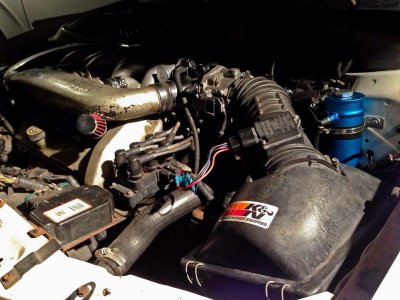
Passive venting the way @broke1 has the advantage of relieving excess crankcase pressure and keeps the intake manifold clean, but it is not effective at removing contaminated air from the crankcase.
The crankcase ventilation system on the SHO provides vacuum at low RPMs, but that's when blow-by is minimal.
Blow-by pressure is the highest during acceleration, but that's when vacuum is minimal.
So the stock crankcase ventilation system on the SHO - really sucks.
Passive venting like @broke1 might be better than stock because it provides venting at WOT. But according to rumor, it has the disadvantage of letting unmetered (non-MAF) air into the system because the ECU takes this into account. @broke1 you might want to run the codes and see if you get O2 sensor codes saying you're running lean and get back to us.
In all cases it's crucial on our engines to change the oil either every 3K miles or whenever it's black on the dipstick, whichever comes first.
@broke1 I strongly suggest you replace your green filters with white ones so you can easily see when they are muddied with oil. Replace often, but a catch-can is really better.
Electric vacuum pumps with a catch can have the advantage of drawing away contaminated air, and a crankcase vacuum minimizes blow-by while lowering oil loss, and can provide some extra horsepower. The disadvantage is that vacuum pumps often draw 12A or more so if the system is not designed properly (the pump can't be always on) it can neutralize the performance advantage.
So I'm looking at designing my own system. To start, I'm looking for the biggest catch-can that can fit (I'd like one with a clear bottom), because with a check valve on the outlet, I can get a large catch-can to act as a vacuum reservoir (check valve because PCV valves are too slow). So the catch-can stores vacuum while cruising, and then during acceleration the stored vacuum would suck some air out of the crankcase - this is a huge improvement over stock. I can also later add a vacuum pump to this setup which would only turn on when needed. For the vacuum pump, I'm looking at brushless motors (most reliable), new models (most efficient). This guy did something similar: http://grannys.tripod.com/evac.html .
This thread is also very good as it has info from an automotive engineer the designs PCV vale systems:
http://www.northamericanmotoring.co...her-legitimate-oil-catch-can-question-10.html
Warning - this is all according to my own personal research. I've done little testing on my own.
The crankcase ventilation system on the SHO provides vacuum at low RPMs, but that's when blow-by is minimal.
Blow-by pressure is the highest during acceleration, but that's when vacuum is minimal.
So the stock crankcase ventilation system on the SHO - really sucks.
Passive venting like @broke1 might be better than stock because it provides venting at WOT. But according to rumor, it has the disadvantage of letting unmetered (non-MAF) air into the system because the ECU takes this into account. @broke1 you might want to run the codes and see if you get O2 sensor codes saying you're running lean and get back to us.
In all cases it's crucial on our engines to change the oil either every 3K miles or whenever it's black on the dipstick, whichever comes first.
@broke1 I strongly suggest you replace your green filters with white ones so you can easily see when they are muddied with oil. Replace often, but a catch-can is really better.
Electric vacuum pumps with a catch can have the advantage of drawing away contaminated air, and a crankcase vacuum minimizes blow-by while lowering oil loss, and can provide some extra horsepower. The disadvantage is that vacuum pumps often draw 12A or more so if the system is not designed properly (the pump can't be always on) it can neutralize the performance advantage.
So I'm looking at designing my own system. To start, I'm looking for the biggest catch-can that can fit (I'd like one with a clear bottom), because with a check valve on the outlet, I can get a large catch-can to act as a vacuum reservoir (check valve because PCV valves are too slow). So the catch-can stores vacuum while cruising, and then during acceleration the stored vacuum would suck some air out of the crankcase - this is a huge improvement over stock. I can also later add a vacuum pump to this setup which would only turn on when needed. For the vacuum pump, I'm looking at brushless motors (most reliable), new models (most efficient). This guy did something similar: http://grannys.tripod.com/evac.html .
This thread is also very good as it has info from an automotive engineer the designs PCV vale systems:
http://www.northamericanmotoring.co...her-legitimate-oil-catch-can-question-10.html
Warning - this is all according to my own personal research. I've done little testing on my own.