
Don't know if you are close to any of these locations:Connecticut.
https://afdc.energy.gov/fuels/ethanol_locations.html#/find/nearest?fuel=E85&location=connecticut

Disclaimer: Links on this page pointing to Amazon, eBay and other sites may include affiliate code. If you click them and make a purchase, we may earn a small commission.
Don't know if you are close to any of these locations:Connecticut.

E85 would be easier, but methanol is plentiful and E85 is not where I'm at. Car still put down 400hp so I have no complaints.Without Ethanol, there's always the option of going full ****** with METHANOL!
WOOOOOOOOOOO BOY!
REEEEEEEEEEEEEE!!
I LOVE METH!

E85 would be easier, but methanol is plentiful and E85 is not where I'm at. Car still put down 400hp so I have no complaints.
Nope. They're both a solid 80 miles or more away.Don't know if you are close to any of these locations:
https://afdc.energy.gov/fuels/ethanol_locations.html#/find/nearest?fuel=E85&location=connecticut

The GH intercooler actually makes a huge difference.

Not on my car......mine had really bad boost taper in the high rpms, WGDC had to be maxed to make up the difference, and it make less power with significantly colder IAT's.
Put my stock IC back in with my Ice Water DIY sprayer. My car is going .3 tenths faster in the same ambient air with more boost, less WGDC, and hotter IAT's.
Okay.... have you ever seen an ecoboost with lightly ported heads and reground cams all else being equal? Once you see how much duration we don't have you will realize the truth.The difference in VE from 5000 RPM to 6000 RPM is maybe 5%, nowhere near an explanation for the amount of freefall exhibited with the GH turbos. So no it's not the cams. Since I have to guess the real answer I'll say excessive exhaust manifold pressure causing exhaust valve float.
ATP's have made upwards of 450 lb-ft all the way at 6500 RPM, meaning you can make 550 hp with hardly any more torque than a basic tune. I don't know why you guys have started rating a turbos performance based on its ability to break an engine. Stock turbos can do that too if that's what you're after.
interesting.


C'mon @mattr66, drop those cams already! LOL....Okay.... have you ever seen an ecoboost with lightly ported heads and reground cams all else being equal? Once you see how much duration we don't have you will realize the truth.
Okay....Okay.... have you ever seen an ecoboost with lightly ported heads and reground cams all else being equal? Once you see how much duration we don't have you will realize the truth.

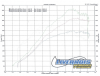


CR only upgrades compressor side so you have the huge turbine restriction. 40.6mm compressor is the same size as the GH gen3 turbos except GH matches the turbine side so you have a more efficient turbo. I've seen a car rod the motor with the CR stage 3 though so they do put out some steam just for the price you can get a more effective overall turbo from GH and be less prone to turbine housing cracks from a turbine that can move the exhaust more efficiently. A lot of cost from CR for half the machine workDoesn’t cr also offer a stage 3 now? Wondering if it is comparable to the GH turbos?
https://crpengineering.com/product/3-035-310/
I could extract a little more power at higher rpms, but there is a reason the factory tapers boost off slightly before the shift the same way that I do.Okay....
Yeah. 248 degrees total, right? Have you ever seen an NA 3.5l with THE EXACT SAME DURATION rev to 6800 rpm from the factory?
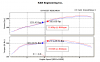
Here's what the power band of these engines looks like when not choked by an almost 3:1 backpressure ratio:
View attachment 16772
(https://www.knfilters.com/dynocharts/69-3528TS_dyno.pdf)
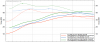
Here's the ECU torque model from my 93 tune only losing 12 hp between 5k and 6k rpm despite a 2 psi boost loss:
View attachment 16773
Now virtual dyno from 3 different tunes showing flat horsepower between 5k and 6k despite that same 2 psi boost loss:
View attachment 16774
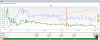
The inherent volumetric efficiency of the engine seems pretty simple to estimate from a log as long as the speed density is accurate. VE = Load x (barometric pressure/manifold pressure), no? Here's an example with this 4th gear 4600-5864 rpm data from a run. 3.7% drop from 5000 to 5864 rpm; only 2.5% from 5500-5864 rpm.
View attachment 16776
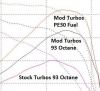
So I hope you can understand why I find it so peculiar and interesting that dyno runs featuring your turbos are uniquely shaped like this:
View attachment 16778
whereas the competition can carry power to 6500 rpm, like this:
View attachment 16779
Losing 20-25% torque in this span of 500 rpm is definitely not characteristic of the cams. All evidence is to the contrary. That 7 at the end of your tach wasn't just put there for good luck. So let me translate my harebrained theory into a question: what exhaust manifold pressure should be expected with your turbos at 20 psi and 5500 rpm?
The NA engines also have the advantage of twin VCT. We can't phase our exhaust camsOkay....
Yeah. 248 degrees total, right? Have you ever seen an NA 3.5l with THE EXACT SAME DURATION rev to 6800 rpm from the factory?
Here's what the power band of these engines looks like when not choked by an almost 3:1 backpressure ratio:
View attachment 16772
(https://www.knfilters.com/dynocharts/69-3528TS_dyno.pdf)
Here's the ECU torque model from my 93 tune only losing 12 hp between 5k and 6k rpm despite a 2 psi boost loss:
View attachment 16773
Now virtual dyno from 3 different tunes showing flat horsepower between 5k and 6k despite that same 2 psi boost loss:
View attachment 16774
The inherent volumetric efficiency of the engine seems pretty simple to estimate from a log as long as the speed density is accurate. VE = Load x (barometric pressure/manifold pressure), no? Here's an example with this 4th gear 4600-5864 rpm data from a run. 3.7% drop from 5000 to 5864 rpm; only 2.5% from 5500-5864 rpm.
View attachment 16776
So I hope you can understand why I find it so peculiar and interesting that dyno runs featuring your turbos are uniquely shaped like this:
View attachment 16778
whereas the competition can carry power to 6500 rpm, like this:
View attachment 16779
Losing 20-25% torque in this span of 500 rpm is definitely not characteristic of the cams. All evidence is to the contrary. That 7 at the end of your tach wasn't just put there for good luck. So let me translate my harebrained theory into a question: what exhaust manifold pressure should be expected with your turbos at 20 psi and 5500 rpm?


