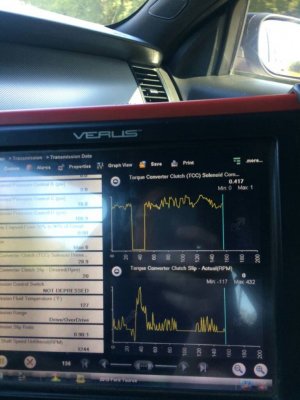
So ford has two great Pics for diagnosing a torque converter. TC_SLIPDSD (The commanded converter slip by the pcm) and TC_SLIPACT (the calculated difference between engine RPM and turbine shaft speed). The turbine shaft is the input shaft of the transmission. When TC_SLIPDSD reads 1020 the converter is off. When it reads less than 1020 the com is modulating the converter. When the desired is near 0 rpm, TC_SLIPACT should be following within 10-15 rpm.
The torque converter solenoid needs power to provide converter clutch application. More power more clutch. So the picture shows the converter solenoid on, but the converter is never locking up and staying locked up.
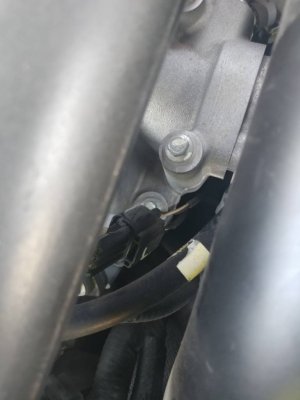
Another little fun fact. If you disconnect the transmission bulk head connector you will have max line pressure, park, neutral, reverse and one forward gear to limp you home. That forward gear is usually 5th. This will happen for most all Ford automatic transmissions that use hudrolic fluid to function.
There is also PIDs GEAR_RAT and TRAN_RAT that can be monitored for a forward gear slip. GEAR_RAT the commanded ratio and Tran_rat the measured ratio using the turbine shaft speed and Outputshaft speed sensors. TRAN_RAT won't work at a stop because there is no T.S.S. and O.S.S. sensor data to make a calculation on. For a slip in first or reverse one must monitor T.S.S. data in gear, stoped. If there is turbine shaft speed 8n gear wheels stoped, a clutch is slipping.
A harsh shift is the way the p.C.M. accounts for a slip. The PCM does not know what a harsh shift is. It only knows that when I demand a say 2-3 shift is should occur in x time. If that does not occurs it ramps up pressure to make sure the shift happens in x time. The driver feels this as a harsh shift. PID data won't show a slip because the P.C.M. has already accounted for the slip. This is where a PID called GEAR helps. It tells one if the transmission in in 1st through 6th gear.
Be aware that all harsh shifts may not be due to a transmission fault. The PCM will do what it thinks the driver commands and reads accordingly. It just wants to make sure it's clutches don't slip too much and become damaged.
Also there is really only 5 things that go wrong in a transmission. The brain box, a wire, a solenoid, a valve, or a clutch fault. The clutch fault includes a hudrolic or medical failure.
There some good old ford trans diag 101 at free.99. Good night.