

You are using an out of date browser. It may not display this or other websites correctly.
You should upgrade or use an alternative browser.
You should upgrade or use an alternative browser.
Acid Ported Intake today.....
- Thread starter mgreen1872
- Start date
Disclaimer: Links on this page pointing to Amazon, eBay and other sites may include affiliate code. If you click them and make a purchase, we may earn a small commission.

mgreen1872
New Member
I want to try this.
well I give up... here are some pics that I was able to put together... the camera that I have is a wal-mart special and I was not able to get a close up of the ports very well.... so I used my cell phone to get the port shot and its still blurry, best I can do.
First pic is what happens when you pour the acid into the intake (I used the cross-over only for example purposes because it will stand up on its own and easier to shoot (keep in mind I only poured in a little splash to show and as you can see before I could get the shot I already have a mess... USE COMPLETE CAUTION!)
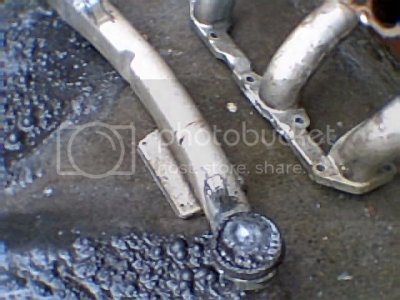
And here is the port after clean, Lye and Acid... again sorry for the blurriness had to shoot this one with the cell phone.. sorry you can't make out much

The acid leaves a black film that I found comes out easy with acetone and follow up with a dremel extension and buff pad it looks fairly nice.
Best pics I could get given what I have, good luck hope everything works out for anyone interested..bye.....
Last edited:

kevinspann
Don't take my advice.
I wonder if this can be done on the outside to make the surfaces smoother for polishing...
mgreen1872
New Member
as you can see, it boiled over but did not react, I suppose the paint protects it?? I just wiped the spill over off and the exterior is fine...I suppose if you removed the paint? but it would still require hand work, the ports are nicely smooth but far from polished. Kind of neat though, dangerous but neat!
Last edited:
pjtoledo
'ol man in the SHO
well, the air is really heavy in Atlanta.....
for the rest of us, the volume of air in a 1.81 diameter by about 6" long runner is around 15 cubic inches or about .010 cubic feet. the mass of air is around .075 lb/cu ft, so that .010 cubic feet of air has about .0075 pounds mass. the 5% increase in air mass from the increased diameter is about .0004 lbm per runner or less than 0.1 ounces total.
pounds mass????
Perry
FastAndFurious
SHO Member
I will do everything in SI units.I don't claim to be a math expert but using this formula, I assumed I was pretty close....
The density of air is approximately 1.19g/L
1L is defined to be exactly 1 dm^3 (one cubic decimeter), so
1L = 0.1m * 0.1m * 0.1m = 0.001 m^3
1.19 g/L = 1.19 / (0.001 m^3) = 1190 g/m^3
Remember that 1kg = 1000g, so
1190 g/m^3 = 1.19 kg/m^3
the volume of a space is W*L*H (1.73inch circle diameter * 12 inch runner)
and Mass= volume*density
so basically figuring the volume of each runner and multiplying the approximate density of air gave me the air mass?
that multiplied by 12 runners equals to 13.68kg/m^3 or roughly converted to 30.16lb/m^3 of air mass now.... not be confused with CFM, simply more air mass...
Correct me if I am wrong... math is not one of my favorite things?
1.73 in = 0.043942m
1.81 in = 0.045974m
12 in = 0.3048m
Volume:
1.73 in (0.043942m) diameter runner
V = pi*r^2*length = pi/4*dia^2*length = 4.6224e-4 m^3 or 0.00046224 m^3 per runner
1.81 in (0.045974m) diameter runner
V = pi*r^2*length = pi/4*dia^2*length = 5.0598e-4 m^3 or 0.00050598 m^3 per runner
Mass
I'm going to assume density of air is 1.19g/L or 1190g/m^3 (I know air density changes a lot, but for this calculation, I am going to assume the density does not change).
Like you said Mass = Density*Volume
1.73 in (0.043942m) diameter runner
M = density*volume = 1190g/m^3 * 4.6224e-4 m^3 = 0.5501g per runner
1.81 in (0.045974m) diameter runner
M = density*volume = 1190g/m^3 * 5.0598e-4 m^3 = 0.6021g per runner
The mass difference between two different diameters of runners is 0.052 g of air per runner.
I think the more important part about acid porting or extrude honing is making the walls of runners smooth. This way head loss can be reduced.
mgreen1872
New Member
I will do everything in SI units.
1.73 in = 0.043942m
1.81 in = 0.045974m
12 in = 0.3048m
Volume:
1.73 in (0.043942m) diameter runner
V = pi*r^2*length = pi/4*dia^2*length = 4.6224e-4 m^3 or 0.00046224 m^3 per runner
1.81 in (0.045974m) diameter runner
V = pi*r^2*length = pi/4*dia^2*length = 5.0598e-4 m^3 or 0.00050598 m^3 per runner
Mass
I'm going to assume density of air is 1.19g/L or 1190g/m^3 (I know air density changes a lot, but for this calculation, I am going to assume the density does not change).
Like you said Mass = Density*Volume
1.73 in (0.043942m) diameter runner
M = density*volume = 1190g/m^3 * 4.6224e-4 m^3 = 0.5501g per runner
1.81 in (0.045974m) diameter runner
M = density*volume = 1190g/m^3 * 5.0598e-4 m^3 = 0.6021g per runner
The mass difference between two different diameters of runners is 0.052 g of air per runner.
I think the more important part about acid porting or extrude honing is making the walls of runners smooth. This way head loss can be reduced.
thanks..

SeanMc
NoMoSHO
Look what I started with the numbers, 

mcrowe3797
New Member
What type of acid do you use? Would i need that lye? Where can i get everything chemical wise for this and what is the mix ratio?

mgreen1872
New Member
What type of acid do you use? Would i need that lye? Where can i get everything chemical wise for this and what is the mix ratio?
I don't know the reasons for the lye, but I believe that it has something to do with removing flash/cast material that the acid does not interact with.
Caustic soda lye is sold in most hardware stores (Ask for Lye), muriatic acid is the acid you will need and it too is sold at hardware stores (cost $6.98 at lowes)
First, the intake needs to be VERY clean. I used a gallon of Acetone (also bought at Lowes) and some small brushes and cleaned the intake very well, basically the Acid has to contact the inside metal, if there is a ton of oil and grease in there it can't.
Lye was mixed 50/50 water to lye, pour it in and WAIT, it takes a few minutes but it will start to get hot and slightly boil. After 15 minutes of working pour it out and rinse well.
Acid was also mixed 50/50 to start, the acid is 31.45% straight from the bottle so I cut it by 50% to get started, pour it in and WAIT. DO NOT HOLD THE INTAKE IT WILL GET SCREAMING HOT--- Put the intake in a safe place, keep plenty of paper towels, gloves and a water source close by... do not breath the fumes, blah blah (Just read the acid label VERY WELL- I take no responsibility for your getting hurt!!)
You may have to do a couple of soaks to get the results you want, but when you are satisfied clean the intake again with the brushes and acetone to remove the black film -- if you have a dremel tool with an extension the ports will buff out nicely with very little effort..... good luck

as I recall the story told by a guy I know, muriatic acid is used by people making meth, and is not legal to buy in many places. he stopped at the hardware store and innocently asked to buy some, and the next thing he knew he was being interrogated by the local detective.....
mgreen1872
New Member
as I recall the story told by a guy I know, muriatic acid is used by people making meth, and is not legal to buy in many places. he stopped at the hardware store and innocently asked to buy some, and the next thing he knew he was being interrogated by the local detective.....
Muriatic acid is sold by the truck load every day. Used in concrete cleaning, brick laying, pool chemicals, some plumbers use it, the stuff is very common. Just buying a gallon will not get you interrogated. Don't worry.

Eric VerValin
PiMPSKiLLET
I like doing new things.... I feel like this is something I'll try one of these days when I get bored. I have an extra set of runners I was going to have sent off to get cleaned up, and opened up a bit. I might just have em cleaned, and melt that aluminum out of there.
I made "works bombs" back in the day. I'm very well aware of how aluminum and hydrochloric acid don't like each other. lol
I made "works bombs" back in the day. I'm very well aware of how aluminum and hydrochloric acid don't like each other. lol
Last edited:

ShadetreeSHOguy
Postwhore
I'd like to see what this looks like in person.
mgreen1872
New Member
I'd like to see what this looks like in person.
this same exact service is offered by numerous performance shops.... it not a hack job or anything, its a legitimate method of porting head and intakes.. see links below.. (Good reading on the whole process not just the service), However I am sure that they have better equipment, space, time and methods to do it in a more professional manner

http://www.highflowacidporting.com/
http://www.castheads.com/acid_porting.php
http://www.flatlanderracing.com/machine.html
http://racingenginetechnologies.com/
http://www.trimarkperformance.com/ServicesCylinderManifoldPorting.htm
kevinspann
Don't take my advice.
Update on this thing? Any pictures of the inside of it without all the acid in it?
Off Road SHO
Moderator
well, the air is really heavy in Atlanta.....
for the rest of us, the volume of air in a 1.81 diameter by about 6" long runner is around 15 cubic inches or about .010 cubic feet. the mass of air is around .075 lb/cu ft, so that .010 cubic feet of air has about .0075 pounds mass. the 5% increase in air mass from the increased diameter is about .0004 lbm per runner or less than 0.1 ounces total.
That math even looks wrong.
Tom
gmail
Well-Known Member
i did a bit of acid porting before... after your done with your porting make sure you oil the inside... since aluminum has much of the same effect of steel it will be like rusting.
i did some crazy porting on a set of runners and i was gonna do surge tanks... now i lost my good intake in my move.
i did a 5 to 1 mix 15 times for the short and long runners.
also i recommend the lye bath in between the porting and it will clean away the excess powdery residue . the surface i was left with was smoother then stock. granted it wasent smooth as extrude hone but it removed much more material then EH does and its a lot cheaper then EH
also i used a piece of plexi glass and petrolium jelly... the acid and lye do not eat the PJ gasket. make sure you dont fill to the top either or it will damage the gasket area where it seats to the head and you will have a usless intake.
also be sure to follow up with hand porting afterwards to get the parts the acid cant touch.
i was also gonna try this on a set of heads. take a old set of valves and block them off with PJ then port away.
this all was probley over **** and more needed for a stroker setup
just remember anything you dont want the acid to eat will need to be covered in PJ... you been warned...
also a side note. to stop the lye reaction vingar works well... baking soda kills acid also... the fumes will be toxic and lye will destroy skin on contact.... be careful
i did some crazy porting on a set of runners and i was gonna do surge tanks... now i lost my good intake in my move.
i did a 5 to 1 mix 15 times for the short and long runners.
also i recommend the lye bath in between the porting and it will clean away the excess powdery residue . the surface i was left with was smoother then stock. granted it wasent smooth as extrude hone but it removed much more material then EH does and its a lot cheaper then EH
also i used a piece of plexi glass and petrolium jelly... the acid and lye do not eat the PJ gasket. make sure you dont fill to the top either or it will damage the gasket area where it seats to the head and you will have a usless intake.
also be sure to follow up with hand porting afterwards to get the parts the acid cant touch.
i was also gonna try this on a set of heads. take a old set of valves and block them off with PJ then port away.
this all was probley over **** and more needed for a stroker setup
just remember anything you dont want the acid to eat will need to be covered in PJ... you been warned...
also a side note. to stop the lye reaction vingar works well... baking soda kills acid also... the fumes will be toxic and lye will destroy skin on contact.... be careful
Last edited:
Similar threads
- Replies
- 5
- Views
- 801


- Replies
- 30
- Views
- 3K


