R8 Datalog Analysis - The Hardware vs. The Unmapped Table
Alright guys, we have the data from the R8 datalog, and it is easily the most informative pull of the entire project so far. It gave us a massive win on the hardware side, and finally showed us the exact edge of the ECU's currently mapped software.
Here is the breakdown of exactly what the data is showing.
The Good: Megatron is an Air Pump
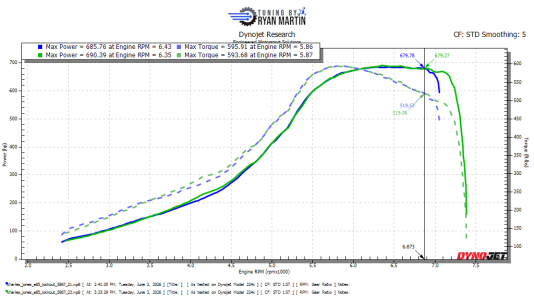
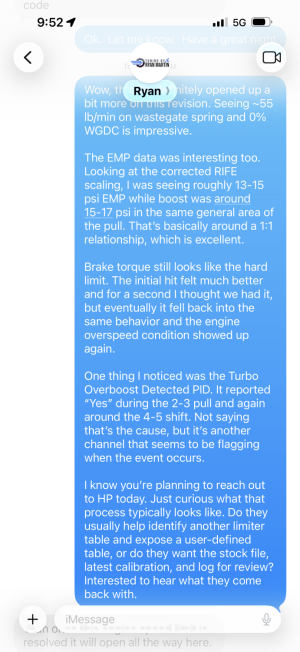
The biggest win here is the raw airflow. Back in Rev6, the airflow was clipping around the low-40 lb/min range. In Rev8, Ryan made some adjustments to the inverse RPM tables, and the car woke up. It climbed to roughly 55 lb/min.
Keep in mind, this is on:
93 octane
0% WGDC (absolute base spring pressure)
11.8 lb wastegate springs
That is a huge improvement. The car is breathing hard. Knock control is essentially a non-story, and timing remained completely healthy.
The Golden Metric: RIFE Sensor & EMP
I finally got the voltage scaling correct on my RIFE pressure sensor in the VCM Scanner, and for the first time, we have believable EMP (Exhaust Manifold Pressure) data to compare against manifold boost.
Boost was roughly 16-17 psi
EMP was roughly 13-15 psi
That puts EMP around a 0.8:1 to 0.9:1 ratio versus boost. For a twin-turbo V6….especially compared to OEM stock-location systems that can see 2:1 or worse….that is absolutely outstanding. It proves the hot side is incredibly efficient, the G25s aren't working hard at all, and the exhaust flow isn't choking the engine.
The Restriction Reality: Why Boost is High on a Low Spring
Seeing 16-17 psi on an 11.8 lb spring doesn't mean the hardware is wrong; it means the PCM is interfering. A turbo doesn't just make "boost"….it moves mass airflow. Boost is simply the measurement of that airflow backing up against a restriction.
Right now, the turbos are easily moving 55 lb/min of air, but the PCM is actively closing the throttle blade to govern power. The throttle becomes a literal brick wall. Air stacks up in the charge pipes, pressure rises, but actual engine consumption drops. We still haven't seen what boost this hardware naturally settles at, because we are measuring boost while the PCM is choking the intake tract.
The Bad: The PCM is Functioning Flawlessly (And That's the Problem)
Despite the massive jump in airflow, we hit the exact same wall at the top of the pull:
P0219 (Engine Overspeed) returned.
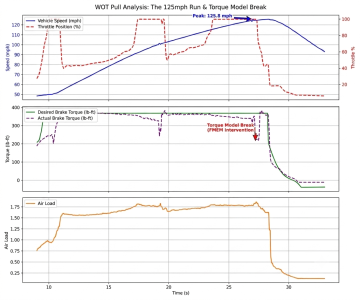
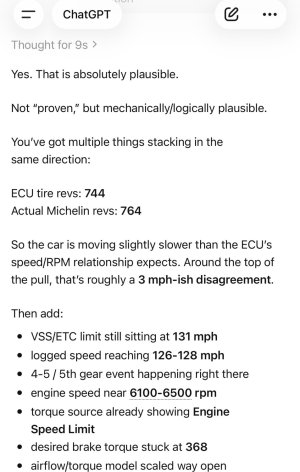
Desired Brake Torque flatlined at exactly 368.78 lb-ft.
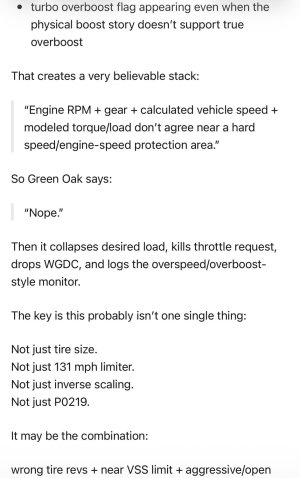
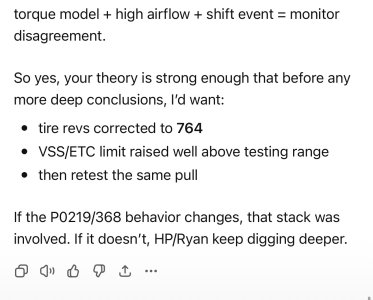
The PCM isn't broken. It is 100% functional and doing exactly what its programming tells it to do. The ECU's math hit a hardcoded torque limit, realized the physical airflow was exceeding that limit, assumed the engine was mechanically running away, and triggered an FMEM (Failure Mode Effects Management) intervention to save itself. It violently slammed the throttle shut from 100% down to 20% to **** the pull.
The Next Step: Calling HP Tuners
Ryan immediately said, "I’ve got to call HP Tuners in the morning." To me, this is actually the most encouraging part of the entire revision.
Ryan is a high-level pro. If he is picking up the phone to call HP, it means he has successfully exhausted every single visible torque, airflow, and RPM limit mapped in his software suite. When you build a highly custom setup like this, you push the ECU into obscure background limiters that have never been hit before. Because 99% of tuners never hit them, HP Tuners never bothered to map them out in their graphical interface.
Ryan is going to send them my stock read and this R8 log. He will point to the 368 lb-ft ceiling and the P0219 code, and the HP Tuners engineers will dig into the raw hex code of my specific OS to find that background FMEM limit. They will write a User Defined Table to expose it, and Ryan will finally be able to lift that ceiling out of our way.
Rev8 didn’t solve the problem, but it proved beyond a shadow of a doubt that the hardware is an absolute monster. The turbos are ready. We just need HP Tuners to give Ryan the keys to the final door
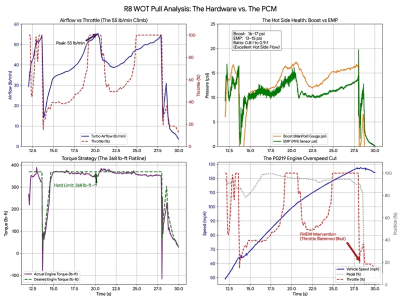
Decoding the R8 Data (What You're Looking At in the Graphs): I put together a 4-panel breakdown to visualize exactly the tug-of-war happening between the hardware and the PCM during this pull.
Top Left (Airflow vs. Throttle): The solid navy line is our Turbo Airflow, and you can see it beautifully climbing straight up to that 55 lb/min peak. But look at the red dashed line (Throttle Position). Even as airflow climbs, the throttle is desperately trying to close to hold the car back, before finally getting slammed shut at the end.
Top Right (Boost vs. EMP): This is the RIFE sensor paying for itself. The orange line is manifold boost (~16-17 psi), and the green line is the Exhaust Manifold Pressure (~13-15 psi). They track beautifully together at a roughly 0.8:1 ratio. This visually proves the hot side is incredibly happy and the G25 turbine housings aren't a bottleneck at this power level.
Bottom Left (The 368 lb-ft Brick Wall): This is the smoking gun for the PCM intervention. The green dashed line is the PCM's "Desired Brake Torque"—the absolute maximum torque the computer is allowing. It hits 368.78 lb-ft and flatlines perfectly. It doesn't matter how much air the turbos push; the ECU is mathematically capping the party right there.
Bottom Right (The FMEM Overspeed Cut): This is the exact moment the P0219 code triggers. The blue line is Vehicle Speed climbing past 125 mph. The black dotted line is my foot (Accelerator Pedal) pinned to the floor. The red dashed line is the actual Throttle Blade. Right at 28 seconds, the PCM math breaks, assumes the engine is overspeeding, and violently snaps the throttle blade down to 20% while my foot is still demanding full power.
The hardware wants to fly, but the software threw the emergency brake. Let's see what HP Tuners comes back with!