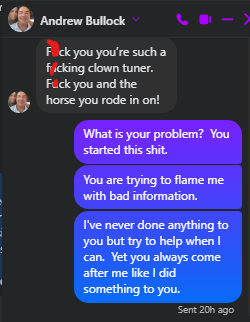
Matt Robinson from GearHead Tuning keeps pushing this strange idea that methanol injection doesn’t need to be tuned for, or that it should only be used for cooling. It’s the kind of statement that sounds safe on the surface, but it defies basic physics and every practical reality of how meth actually works inside a combustion chamber. When you add 100% meth through a proper system, you’re introducing a real, measurable mass of additional fuel, and you’re raising the octane to the equivalent of race gas. That’s not a “minor cooling effect,” that’s a full-blown change in the fuel energy balance. To pretend that isn’t happening or to let the PCM “sort it out” is the mechanical version of closing your eyes and hoping the engine magically adjusts. Engines don’t run on hope. They run on fuel, timing, airflow, and pressure.
What’s even funnier is the claim that people shouldn’t tune for meth because “if the meth fails, the car will blow up.” That’s backwards. You tune meth in stages, you verify the system, you datalog, you build in fallbacks, and you choose a high-quality kit from a brand that has real engineering behind it. You don’t dumb down the tuning, cripple the gains, and lie to customers about how much meth they should use just to protect yourself from liability. If you’re that worried, just say you don’t tune for meth. Don’t rewrite the laws of physics to make it sound like no one should. The real liability isn’t tuning for meth — the real liability is pretending meth is “just cooling” and letting customers drive around rich enough to wash cylinders for tens of thousands of miles.
And then there’s the false-knock circus. For seven years in this platform there was no “false knock epidemic.” Then suddenly there is — but only from one tuning philosophy. Funny how that works. If you run auto octane and build a universal tune that tries to cater to every possible fuel quality from 87 to E30, of course timing strategy gets weird. Of course borderline tables get abused. Of course the PCM will start thinking random noise is detonation. A universal tune is always weaker than a fuel-specific tune — it has to be. You can’t optimize for every condition at once. You can’t get perfect spark control and perfect torque logic when you refuse to commit to a specific fuel. So customers chase ghosts, add E85 because the tune can’t stabilize itself, and convince themselves something is wrong with their engine instead of looking at the philosophy behind the calibration.
Meth gains “without tuning” are the biggest joke of all. People feel something because IAT2 drops like a rock, but they only get the cooling benefit — not the real power. They get half the gains a proper meth tune delivers. And they get all the long-term side effects: over-rich mixtures, diluted oil, extra blow-by, unnecessary ring and bore wear, and sensors seeing a fuel curve that was never corrected. The whole reason meth is such a powerful mod on the SHO is because it replaces 10–20% of your fuel mass under boost and raises octane so you can run more timing and more boost safely. If you don’t tune for it, you’re literally running the worst possible version of meth — all the extra fuel with none of the optimization.
The part that makes me shake my head is how confidently all this gets preached to the community. Half the platform now repeats this “cooling only” logic like gospel. Meanwhile the people who actually understand meth, people like Juan from Alky Control or anyone who built a fast SHO in the last decade, know exactly how much meth volume is required for a meaningful effect. Five hundred cc isn’t doing anything special on a 4,000-pound twin-turbo V6. Fifteen hundred cc is where the physics say the system starts to matter. That’s not opinion; that’s empirical. That’s experience. That’s what people who actually go fast do.
And the irony is thick. The whole “no meth tuning” stance is supposed to avoid liability, but it actually creates a different kind of liability — a quieter, slower, more destructive one. Because if you actively tell people not to tune for a huge shift in effective fuel and octane, you’re not protecting the engine. You’re just protecting yourself. Customers aren’t paying for padded safety; they’re paying for results. They’re paying for truth. They’re paying for accuracy. And instead they get a universal tune, a watered-down strategy, and a platform-wide misunderstanding about what meth actually does.
That’s the part that bothers me. Not the philosophy, not the risk avoidance — it’s the misinformation. Let people make an informed decision. Tell them you won’t tune meth if that’s your stance. Don’t redefine thermodynamics to justify a shortcut. Don’t pretend “cooling only” is real tuning. And definitely don’t act shocked when someone who has actually run meth for years points out the holes in the logic. If anyone should understand the consequences of running an engine too rich for too long, it’s an engineer.
What’s even funnier is the claim that people shouldn’t tune for meth because “if the meth fails, the car will blow up.” That’s backwards. You tune meth in stages, you verify the system, you datalog, you build in fallbacks, and you choose a high-quality kit from a brand that has real engineering behind it. You don’t dumb down the tuning, cripple the gains, and lie to customers about how much meth they should use just to protect yourself from liability. If you’re that worried, just say you don’t tune for meth. Don’t rewrite the laws of physics to make it sound like no one should. The real liability isn’t tuning for meth — the real liability is pretending meth is “just cooling” and letting customers drive around rich enough to wash cylinders for tens of thousands of miles.
And then there’s the false-knock circus. For seven years in this platform there was no “false knock epidemic.” Then suddenly there is — but only from one tuning philosophy. Funny how that works. If you run auto octane and build a universal tune that tries to cater to every possible fuel quality from 87 to E30, of course timing strategy gets weird. Of course borderline tables get abused. Of course the PCM will start thinking random noise is detonation. A universal tune is always weaker than a fuel-specific tune — it has to be. You can’t optimize for every condition at once. You can’t get perfect spark control and perfect torque logic when you refuse to commit to a specific fuel. So customers chase ghosts, add E85 because the tune can’t stabilize itself, and convince themselves something is wrong with their engine instead of looking at the philosophy behind the calibration.
Meth gains “without tuning” are the biggest joke of all. People feel something because IAT2 drops like a rock, but they only get the cooling benefit — not the real power. They get half the gains a proper meth tune delivers. And they get all the long-term side effects: over-rich mixtures, diluted oil, extra blow-by, unnecessary ring and bore wear, and sensors seeing a fuel curve that was never corrected. The whole reason meth is such a powerful mod on the SHO is because it replaces 10–20% of your fuel mass under boost and raises octane so you can run more timing and more boost safely. If you don’t tune for it, you’re literally running the worst possible version of meth — all the extra fuel with none of the optimization.
The part that makes me shake my head is how confidently all this gets preached to the community. Half the platform now repeats this “cooling only” logic like gospel. Meanwhile the people who actually understand meth, people like Juan from Alky Control or anyone who built a fast SHO in the last decade, know exactly how much meth volume is required for a meaningful effect. Five hundred cc isn’t doing anything special on a 4,000-pound twin-turbo V6. Fifteen hundred cc is where the physics say the system starts to matter. That’s not opinion; that’s empirical. That’s experience. That’s what people who actually go fast do.
And the irony is thick. The whole “no meth tuning” stance is supposed to avoid liability, but it actually creates a different kind of liability — a quieter, slower, more destructive one. Because if you actively tell people not to tune for a huge shift in effective fuel and octane, you’re not protecting the engine. You’re just protecting yourself. Customers aren’t paying for padded safety; they’re paying for results. They’re paying for truth. They’re paying for accuracy. And instead they get a universal tune, a watered-down strategy, and a platform-wide misunderstanding about what meth actually does.
That’s the part that bothers me. Not the philosophy, not the risk avoidance — it’s the misinformation. Let people make an informed decision. Tell them you won’t tune meth if that’s your stance. Don’t redefine thermodynamics to justify a shortcut. Don’t pretend “cooling only” is real tuning. And definitely don’t act shocked when someone who has actually run meth for years points out the holes in the logic. If anyone should understand the consequences of running an engine too rich for too long, it’s an engineer.