Gen 1 Oil Catch Can - Where?

Disclaimer: Links on this page pointing to Amazon, eBay and other sites may include affiliate code. If you click them and make a purchase, we may earn a small commission.

DeepPower

Searchng4Truth
Joined
Sep 6, 2007
Messages
403
Reaction score
76
Location
Texas since 2013
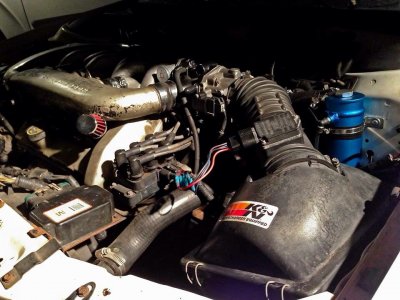
I'd like to put an oil catch can on my Gen 1. But I can't tell for certain which is the hose from the oil separator coming out of the V of the engine. Can anyone tell me exactly where it is and where it connects to, or post a photo?

I understand that the valve cover ****** next to the #6 cylinder is the air intake for the PCV system. Any advantage to putting one of those PCV vent filters on that, with or without the catch can? Thanks!
 

Irish Pride

Irish Inside
Staff member
Super Moderators
Joined
Dec 23, 2007
Messages
3,714
Reaction score
4,765
Location
MusicCityUSA
I have been running my 89 like this for a few years now with no issues. I just have to remember to empty the catch can at every oil change or else it does build up sludge. The amount of oil kept from going back into the intake manifold is incredible.

The hose connecting to the bottom of the throttle body is the one coming out from the V of the block. In order to install a catch can you will need to remove the intake manifold. There is no way to reach that hose with the intake in place and the existing hose will not be long enough or flexible enough to use with the catch can.

18684130891 a9b3b8d9f2 bimage
 

broke1

Member
Joined
Jul 19, 2014
Messages
181
Reaction score
23
Location
Alabama
I wouldn't run a catch can,I'd go ahead and install a clamp on/push in breather where your oil fill cap is.....block off the valve cover vent to your intake at the valve cover ****** and at the intake.

I will try to post a pic for you on the crankcase vent hose but it is the large hose that runs to the bottom of your throttle body. I would install a clamp on filter to that hose as we'll.

This is what I did on my 95 ATX along with deleting my EGR and the bypassing the TB coolant lines(simply looped).

As soon as I read about blown cam seals and seeing that most 89-95 SHO's don't run breathers,I knew it was an easy improvement I'd be making.

It's all for emissions anyways(no matter what some folks think). So if you don't have to worry about emissions,I think it's a no brainier.

Oil into intake tract=detonation and higher octane requirements
 

DeepPower

Searchng4Truth
Joined
Sep 6, 2007
Messages
403
Reaction score
76
Location
Texas since 2013
I wouldn't run a catch can,I'd go ahead and install a clamp on/push in breather where your oil fill cap is.....block off the valve cover vent to your intake at the valve cover ****** and at the intake.
Really? I hadn't heard of this. Do you have a part number for the oil fill cap breather? And why not also add a breather to the valve cover ******, too?
 
Last edited:

broke1

Member
Joined
Jul 19, 2014
Messages
181
Reaction score
23
Location
Alabama
I have no idea on part #'s but I could prob find out.....both are clamp on filters,the one in the valve cover just happened to fit the oil fill and it had a slight angle to it.I bought Green USA filters(made in PA). I've found them to hold up the best for crankcase vents and still very reasonably priced.Superior to K&N....

They also have a lip at the bottom that allowed me to basically screw it into the valve cover. My tb to crankcase hose was rock hard and i tore it getting it off so I cut maybe 1" off and was able to Just clamp my filter on. It barely clears my intake w/ ShoSource 1/4" spacers but it does clear. Once the intake is on,it pretty much disappears.
 

DeepPower

Searchng4Truth
Joined
Sep 6, 2007
Messages
403
Reaction score
76
Location
Texas since 2013
Thanks for the photos. The p/n I'm looking for is, well, what parts did you use to put the breather filter on the oil filler cap? I already have breather filters, I'm asking how you did the cap.
 

Irish Pride

Irish Inside
Staff member
Super Moderators
Joined
Dec 23, 2007
Messages
3,714
Reaction score
4,765
Location
MusicCityUSA
How long have you been running these filters like this? I would like to see a pic after they have several thousand miles on them. I get about a quarter quart of oil in my catch can every oil change. If i removed the catch can and just added a filter to the hose coming from the crank case like what you have it would quickly get saturated with oil and then be dripping all over the hoses, harness, and trans before making it down to the pavement. The Blow-by needs to go somewhere, whether into the intake, into a catch can, or on the pavement. Adding a filter doesnt stop this from happening. 95% of the oil/sludge that gets into the intake comes from this hose.

The port coming off the valve cover has baffling under the valve cover to prevent oil from splashing up and out of it and saturating the filter. The oil filler hole does not have any baffling. Unless you get an actual Oil Filler Filter Cap with built in screens and a check valve i can see that filter getting saturated and dripping oil all over the exhaust. This setup does not seem like a good idea at all.
 

DeepPower

Searchng4Truth
Joined
Sep 6, 2007
Messages
403
Reaction score
76
Location
Texas since 2013
@Irish Pride, if I understand you correctly, to summarize, it is necessary for there to be a vacuum in order to suck out the blow-by?

Because I'm also wondering if, like the @broke1 setup, venting itself is good enough, and if it is not sucked out by vacuum, then vapors would be expelled by the force of it's own pressure, without much oil. Or am I mistaken?
 

Irish Pride

Irish Inside
Staff member
Super Moderators
Joined
Dec 23, 2007
Messages
3,714
Reaction score
4,765
Location
MusicCityUSA
@Irish Pride, if I understand you correctly, to summarize, it is necessary for there to be a vacuum in order to suck out the blow-by?

Because I'm also wondering if, like the @broke1 setup, venting itself is good enough, and if it is not sucked out by vacuum, then vapors would be expelled by the force of it's own pressure, without much oil. Or am I mistaken?
You read way more into my post than is actually there. What i am basically saying is the Catch Can serves a purpose. To catch the blow-by(engine oil/unburned fuel) leaving the engine. These would normally be directed back into the intake via the hose connected to the underside of the throttle body. The intake manifold is essentially a catch can already. When you remove the intake and see all the pooled up oil, that is what i mean. If you remove the hose from the bottom of the throttle body you will prevent all that oil from being directed back inside but it still needs to be directed somewhere. Just adding a filter to the end of that hose will not prevent the blow-by. That filter will start dripping oil in no time and where he has it placed it will start to coat all those hoses and wires in oil and leave a nasty oil stain where you nomally park. My catch can is connected directly to that hose and like i said before, i drain about a quarter or a quart of oil every oil change. That oil would normally be going back into my intake if i didnt have the catch can.
 

broke1

Member
Joined
Jul 19, 2014
Messages
181
Reaction score
23
Location
Alabama
I've run open filters on other engines,both NA and forced induction(over 35psi on Buick v6's and over 100psi on diesels),ZERO problems....Only time I've ever seen it as a problem is when the rings were on the way out. Then it's usually blowing the dipstick out as well.
 

DeepPower

Searchng4Truth
Joined
Sep 6, 2007
Messages
403
Reaction score
76
Location
Texas since 2013
Someone correct me if I'm wrong, but if I understand positive crankcase ventilation correctly, "positive" means that there needs to be fresh air pushed or pulled into the system, correct?

So only venting to the atmosphere with all open filters doesn't do the job, berause there needs to be a vacuum on the manifold that pulls fresh air into the crankcase. I'm guessing that without that vacuum, air is expelled only by air pressure in valve cover, which does not necessarily remove unburned fuel.

So a catch-can removes the oil while letting unburned fuel get sucked back into the intake manifold for another shot at combustion. Correct?
 

DeepPower

Searchng4Truth
Joined
Sep 6, 2007
Messages
403
Reaction score
76
Location
Texas since 2013
I've been doing some reading, and I've seen claims that running an electric vacuum pump creates a vacuum also sucks out air from the valve covers. Claims are the vacuum increases horsepower and is also easier on the piston rings which lessens oil consumption. This is what Ford did on the '01 to '06 Mustangs.

Just running breathers lets the blowby escape from its own pressure, but does not provide the benefit of a vacuum.
 

broke1

Member
Joined
Jul 19, 2014
Messages
181
Reaction score
23
Location
Alabama
The only "Benifit" of pulling vacuum on a crankcase is cleaner emissions.

If you don't have to worry about emissions and want a clean,crud free intake and don't want to worry about mounting a catch can or having to spend the $$$(and possibly save a cam seal),run open element breathers like I did.....
 

broke1

Member
Joined
Jul 19, 2014
Messages
181
Reaction score
23
Location
Alabama
You aren't getting any better ring seal by intake vacuum.

It takes a dedicated belt driven pump to pull enough crankcase vacuum to give you 5-10hp on a 600hp engine.

You'd play **** mounting it on a fwd SHO.

The electric vacuum pumps sold are mostly for vacuum brakes but I do run an electric vacuum pump on my Buick race car. Cuts down on oil leaks....
 

zak

Supporting Member
Supporting Member
Joined
May 15, 2002
Messages
1,770
Reaction score
497
Location
east of Hartford
I think a neat solution to this problem, without venting crankcase to air (ever been behind a pre-mid 60s car in traffic? That's what you are smelling) is to adapt one of the cyclone separators from the E39 BMW application, aftermarket version is like $12 on Evilbay and could mount to the side of, or below the throttle body.

Finding the best point to drain the device back into the engine (drain point is the bottom of the cone, entrance and gas exit to throttlebody are on top) is the only part to be figured out - while it seems simple to T into the dipstick, you then have a line full of oil running right above the exhaust manifold (fire risk and possibly coking the oil). Where do the supercharger guys flow their bearing oil back into the SHO engine?

Kudos to JEM for suggesting this years ago (when E39 PVC parts were dealer only and very expensive).
 

DeepPower

Searchng4Truth
Joined
Sep 6, 2007
Messages
403
Reaction score
76
Location
Texas since 2013
You aren't getting any better ring seal by intake vacuum.
I suggest you do your research. You get less blow-by with a crankcase vacuum (I never said intake) because the piston has less resistance on the downstroke. Also minimizes oil leaks which is important to me. The challenge is finding a pump that can withstand the heat and also pull enough vacuum.

@zak, I like the idea of the E39 cyclone separator.
 

Devin

3.Slow
Supporting Member
Joined
Jan 15, 2003
Messages
3,542
Reaction score
932
Location
Pacific Northwest
I think a neat solution to this problem, without venting crankcase to air (ever been behind a pre-mid 60s car in traffic? That's what you are smelling) is to adapt one of the cyclone separators from the E39 BMW application, aftermarket version is like $12 on Evilbay and could mount to the side of, or below the throttle body.

Finding the best point to drain the device back into the engine (drain point is the bottom of the cone, entrance and gas exit to throttlebody are on top) is the only part to be figured out - while it seems simple to T into the dipstick, you then have a line full of oil running right above the exhaust manifold (fire risk and possibly coking the oil). Where do the supercharger guys flow their bearing oil back into the SHO engine?

Kudos to JEM for suggesting this years ago (when E39 PVC parts were dealer only and very expensive).
If you run the blow-by products back into the crankcase, you'll foul the oil faster due to the extra gasoline in the oil.

How much does the blow-by actually affect engine performance? The system was designed to eliminate these products this way. Yeah, it gunks up the intake, but so what?
 

zak

Supporting Member
Supporting Member
Joined
May 15, 2002
Messages
1,770
Reaction score
497
Location
east of Hartford
Devin, the cyclone separator works by taking the PCV flow (coming in through a nominal 3/4 inch port merging into the side of the cyclone, see link) and causing a spiral flow or vortex against the walls of the cyclone. Suspended oil droplets will be flung on the walls of the cyclone (by centrifugal action) run down them and drain back to the crankcase. There is a second nominal 3/4 inch port that comes in the top of the cyclone. It is this port that will connect back to the large (14 mm I think) PCV port at the bottom of the throttle body. Because its in the center of the cyclone it will not extract any oil, just actual crankcase gases that will be much less likely to condense inside the snakes. Many automakers are now insulating their rubber PCV lines to keep the gases hot and prevent condensation.

Oil drains from the bottom of the cyclone at the smallest port at the center of the cone shape. It is unfortunate that the evilbay pics don't show the cyclone in its proper orientation.

BTW, I said E39 but the actual application seems to be the BMW X5 4.4l (which uses two of these)
http://www.ebay.com/itm/BMW-Crankcase-Vent-Valve-PCV-Oil-Separator-Premium-Quality-05237-/252478654636?fits=Make:BMW&hash=item3ac8e688ac:g:pWUAAMXQyFFTkfSU&vxp=mtr
 
Last edited:
Back
Top