The knock sensor is located under the intake and fuel rails, adjacent to the PCV crankcase cover plate.
The sensor is, to the best of my recollection and inference, a piezo contact microphone, actually listening for the octane knock, and will compensate for octane accordingly under current conditions. No output is interpreted as no knocking, the only failure mode I could imagine.
Pulling the "spout" connector will set timing constant.
----
Edit: Didn't see this was G3 with sleepy eyes. G3 has
two knock sensors - under the intake, there's one on either side of the PCV plate at the center of the engine.
How and why are you checking timing? To get actual timing, you have to acquire the falling edge, the off signal, of the coil signal wire, not something your average clamp-on timing light would do.
---
More V8 info
Failure Mode Effect Management
During some electronic ignition system faults, the failure mode effects management portion of the PCM will maintain vehicle operation:
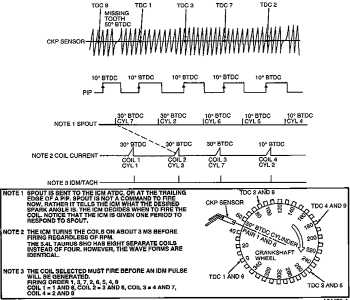
- If the spark output signal is interrupted, the PCM will turn the ignition coils on and off using the crank sensor signal. This will result in fixed spark timing (10 degrees BTDC) and fixed dwell time (no CCD).
...
The PCM uses information from the cam position sensor to generate an internal PIP (profile ignition pickup) signal. Once the PIP signal is generated, fuel and spark are enabled (otherwise random-start fallback mode). The calculated spark target is used internally by the PCM as a PWM digital signal called SPOUT (spark output). The PCM decodes the SPOUT signal and fires the next spark at the commanded spark target. The PIP signal is also used to for the tachometer.
So - basically no cam signal or no computed "spout" from that, and it is in fallback mode. There is also the "octane adjust shorting bar" with unclear function. That is, if you are actually testing correctly.