New Clutch Testing

Disclaimer: Links on this page pointing to Amazon, eBay and other sites may include affiliate code. If you click them and make a purchase, we may earn a small commission.

Art5

Active Member
Joined
Sep 5, 2009
Messages
730
Reaction score
40
Location
white plains, NY
has/does anybody actually MAKE a bigger spring for the valeo plate? SHO Shop used to just double them up, and Centerforce just changed the fulcrum point.

I agree with gary, straps look stock. I think most of the failures were in the rivets (least the ones I saw) not the straps, but you almost have to go to a bigger strap with a bigger rivet (or cap screw like gary used to do), as there ain't much "strap" left on the ends with a bigger fastner going through the center.

I've always said all SHO clutches suck, some just suck a little less than others :rofl:

I would have to call them back and ask them about Presure Plate to see if they did anything to it. thanks for the flywheel, by the way. I missed that rightaway wheel power.
 

Racer X

SHO Pilot, Retired
Joined
Oct 27, 2002
Messages
3,446
Reaction score
1,572
Location
Connecticut
A question, do you mean the higher spring forces (not weight) cause bending of the flywheel and thus alter the stack height/release?

And to add to your snow comments which are quite valid - the slip then stick phenomena when fooling around in the snow (wheels spinning, then suddenly grabing on wet as opposed to slick pavement) could well be expected to cause liberation of a disc spring due to the sudden contraction as the load train through axles, differential and gearbox snaps the opposite direction. It can also snap axles (more like ice onto dry pavement in that case).

zak
To clarify, when I say weight, I meant the higher force exerted on the flywheel by pushing against the spring to disengage the clutch from the FW and PP. From what I understand, that increased force is enough to deflect the flywheel, allowing for partial engagement (and causing funky shifting issues).

And on the snow drifting, now that you mention it, the shock loading due to catching traction at a high wheel speed can absolutely eject a spring from the clutch disc.
 

gmorrell

Never been a noob...
Joined
Nov 28, 2000
Messages
806
Reaction score
540
Location
Colorado Springs, CO
has/does anybody actually MAKE a bigger spring for the valeo plate? SHO Shop used to just double them up, and Centerforce just changed the fulcrum point.

I agree with gary, straps look stock. I think most of the failures were in the rivets (least the ones I saw) not the straps, but you almost have to go to a bigger strap with a bigger rivet (or cap screw like gary used to do), as there ain't much "strap" left on the ends with a bigger fastner going through the center.

I've always said all SHO clutches suck, some just suck a little less than others :rofl:
To my knowledge, there is no compatible stronger diaphragm spring that will fit the SHO/Valeo cover rivet pattern. Doubling up the springs (Double Diaphragm) nearly doubles the plate clamp load, but also doubles the release force, and this is what causes the deflection issues in the Aluminum flywheels. This is why I recommend using a steel billet FW for the DD clutch covers, the release is much nicer.

The other issue is that the Valeo diaphragm pivot rivet is a one-off design, it holds the diaphragm and also provides the diaphragm pivot, or fulcrum point. I've never found it in the clutch parts aftermarket.

When SS made their double-diaphragm clutches, they used standard round-head diaphragm rivets and added a wire pivot ring as a fulcrum for the diaphragm. Problem here was SS used soft steel wire for the pivot ring, which eventually deformed and gave the clutch crappy release characteristics. I re-built a few of the DD clutches with hard wire pivot ring, they worked far better. (Edit: SS didn't make these clutches, whoever was their supplier did this.)

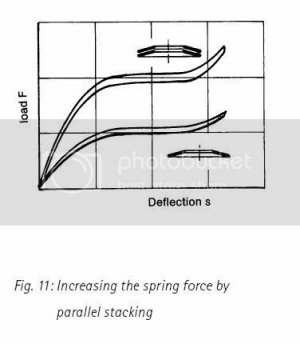
Here's the graphics behind spring stacking, or double diaphragm. You want the clutch to operate in the area where Load F is flat over deflection.
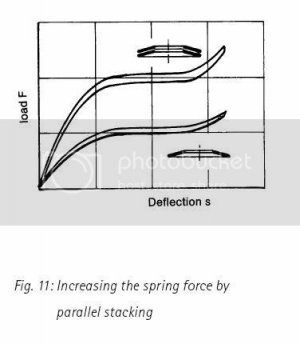
Spring stacking

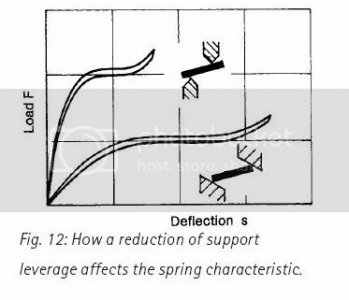
Centerforce did indeed change the diaphragm pivot points, but there is no free lunch here, because the total force -vs- travel envelope for a diaphragm spring is limited. If the pivots are optimized for lower total force, the amount of pressure plate travel is increased for that force (the pressure plate load). OTOH, if you optimize the pivot points for higher pressure plate load, that higher force will be available for a shorter amount of PP travel.

Here's the graphics behind what happens when you change the diaphragm spring pivot points. OEM Valeo is the bottom curve, note the long flat Load F -vs- deflection. CenterForce is the top curve: Higher load, but reduced deflection, and when the lining wears, you're on the left side of the graph, and plate load drops.
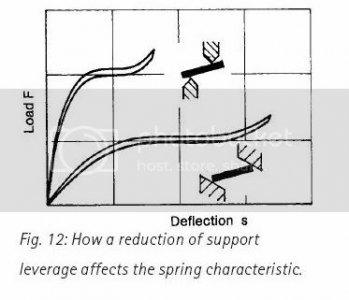
Fulcrum changes

What you trade-off here is pressure plate load for lining thickness wear. You can make a low-load pressure plate work for a wide range of lining thicknesses, IOW, the pressure plate load will remain fairly constant as the lining goes from (new) full thickness to (thin) and fully worn out. But... if the pressure plate fulcrum is moved and optimized for high load, it's not very tolerant of lining wear, and as the lining wears, plate load drops in a hurry.

The strap problem on the stock Valeo covers is well known, actually, it's just weak rivets that can't take the shear load. The rivet shank for the straps is only 3/16" diameter.

SHOShop's re-strapped covers used 1/4" shank rivets and wider, thicker straps with 1/4" holes.

My covers also used wider, thicker straps with 1/4" holes, and instead of rivets, I used 160,000 psi tensile close tolerance NAS (National Aerospace Grade) bolts with 0.188" unthreaded shanks where they passed through the straps. To my knowledge, nobody ever de-strapped one of my clutches.
 
Last edited:

Art5

Active Member
Joined
Sep 5, 2009
Messages
730
Reaction score
40
Location
white plains, NY
To clarify, when I say weight, I meant the higher force exerted on the flywheel by pushing against the spring to disengage the clutch from the FW and PP. From what I understand, that increased force is enough to deflect the flywheel, allowing for partial engagement (and causing funky shifting issues).

And on the snow drifting, now that you mention it, the shock loading due to catching traction at a high wheel speed can absolutely eject a spring from the clutch disc.

ok, let me get that clear for myself: when i had clatchmasters clutch and steel flywheel, i was drifting in the snow, there was nothing but deep snow and no dry surface anywhere, drifting in 2nd and third gear barely pass 4000 rpm, could cause a spring pop out of the disc?
 

geomarathoner

New Member
Joined
Jul 29, 2009
Messages
38
Reaction score
5
Location
WV
The most common failure mode of the original 89 clutches and the early upgraded ones from the factory was that one of the disk springs would fall out....happened to me on the Denver freeway in slow rush hour traffic back in about 92. Apparently the disk and the 4 springs had different resonant frequencies, when the disk was released from the pp during a shift. Sometimes this was audible at shifts above about 4000 rpm....a buzz or fluttering sound. At any rate the springs and the disk would vibrate against each other, and the harder spring would wear out the softer disk material that held it in. When one spring fell out...goodbye. I still have some closeup pics from back then showing the wear points between the disk and the spring that fell out. Ford engineers told me that high speed shifting was the cause.....but both yours and mine failed at very low speed. I'm an old guy....that's the only clutch failure I've ever had....and I've never owned an atx. FWIW
 

Art5

Active Member
Joined
Sep 5, 2009
Messages
730
Reaction score
40
Location
white plains, NY
The most common failure mode of the original 89 clutches and the early upgraded ones from the factory was that one of the disk springs would fall out....happened to me on the Denver freeway in slow rush hour traffic back in about 92. Apparently the disk and the 4 springs had different resonant frequencies, when the disk was released from the pp during a shift. Sometimes this was audible at shifts above about 4000 rpm....a buzz or fluttering sound. At any rate the springs and the disk would vibrate against each other, and the harder spring would wear out the softer disk material that held it in. When one spring fell out...goodbye. I still have some closeup pics from back then showing the wear points between the disk and the spring that fell out. Ford engineers told me that high speed shifting was the cause.....but both yours and mine failed at very low speed. I'm an old guy....that's the only clutch failure I've ever had....and I've never owned an atx. FWIW

but you see in that picture of the bad disk , it looks pretty good and not that old at all. even material is barely touched, but spring ccame out so clean, like it was never there. I had one clutch few years back where springs were bouncing making rattling noise, but i was driving that car very hard and burning out a lot and still they didn't come out. Besides clutch in pictures is Clutchmaster stage I, i belive and they claim it to be 70% better than stock. Another CM i had was on another car didn't even last 3000 miles. was slipping in 5th sometimes and finally burnt. But anyways, i haven't hear anyone telling me a spring story about the clutch that had more than 4 springs though, so maybe this is where the problem really is?
 

Art5

Active Member
Joined
Sep 5, 2009
Messages
730
Reaction score
40
Location
white plains, NY
To my knowledge, there is no compatible stronger diaphragm spring that will fit the SHO/Valeo cover rivet pattern. Doubling up the springs (Double Diaphragm) nearly doubles the plate clamp load, but also doubles the release force, and this is what causes the deflection issues in the Aluminum flywheels. This is why I recommend using a steel billet FW for the DD clutch covers, the release is much nicer.

The other issue is that the Valeo diaphragm pivot rivet is a one-off design, it holds the diaphragm and also provides the diaphragm pivot, or fulcrum point. I've never found it in the clutch parts aftermarket.

When SS made their double-diaphragm clutches, they used standard round-head diaphragm rivets and added a wire pivot ring as a fulcrum for the diaphragm. Problem here was SS used soft steel wire for the pivot ring, which eventually deformed and gave the clutch crappy release characteristics. I re-built a few of the DD clutches with hard wire pivot ring, they worked far better. (Edit: SS didn't make these clutches, whoever was their supplier did this.)

Here's the graphics behind spring stacking, or double diaphragm. You want the clutch to operate in the area where Load F is flat over deflection.
Spring stacking

Centerforce did indeed change the diaphragm pivot points, but there is no free lunch here, because the total force -vs- travel envelope for a diaphragm spring is limited. If the pivots are optimized for lower total force, the amount of pressure plate travel is increased for that force (the pressure plate load). OTOH, if you optimize the pivot points for higher pressure plate load, that higher force will be available for a shorter amount of PP travel.

Here's the graphics behind what happens when you change the diaphragm spring pivot points. OEM Valeo is the bottom curve, note the long flat Load F -vs- deflection. CenterForce is the top curve: Higher load, but reduced deflection, and when the lining wears, you're on the left side of the graph, and plate load drops.
Fulcrum changes

What you trade-off here is pressure plate load for lining thickness wear. You can make a low-load pressure plate work for a wide range of lining thicknesses, IOW, the pressure plate load will remain fairly constant as the lining goes from (new) full thickness to (thin) and fully worn out. But... if the pressure plate fulcrum is moved and optimized for high load, it's not very tolerant of lining wear, and as the lining wears, plate load drops in a hurry.

The strap problem on the stock Valeo covers is well known, actually, it's just weak rivets that can't take the shear load. The rivet shank for the straps is only 3/16" diameter.

SHOShop's re-strapped covers used 1/4" shank rivets and wider, thicker straps with 1/4" holes.

My covers also used wider, thicker straps with 1/4" holes, and instead of rivets, I used 160,000 psi tensile close tolerance NAS (National Aerospace Grade) bolts with 0.188" unthreaded shanks where they passed through the straps. To my knowledge, nobody ever de-strapped one of my clutches.

so , if you know better how to make clutches for this specific application, why didn't you say anything in the begining, damn it!!! I could've ordered one from you then.
However , i like how with aluminium flywheel car would launch almost right away and feels like wheels get that extra power right away.
 

Art5

Active Member
Joined
Sep 5, 2009
Messages
730
Reaction score
40
Location
white plains, NY
I don't understand what it is and if it is because of this clutch that i have in this car now, but now when I am backing up something starting hitting hard as if engine wants to jump out and run away. When I'm taking of in first gear it is not as bad, but it seems like doing that when I am about to let the pedal go. I have subframe connectors and reinforced motor mounts, but no torque dumpers at all. Maybe it is because i have no dumpers or is it the way this clutch is? What do you guys think?
 

Racer X

SHO Pilot, Retired
Joined
Oct 27, 2002
Messages
3,446
Reaction score
1,572
Location
Connecticut
Welcome to the world of "chatter".

It tends to be more pronounced in reverse. Dampers help reduce it; I'd put them back in for now.
 

kikkinasphalt

Wrrrrrrrr
Staff member
Club Mod
Joined
Apr 14, 2008
Messages
1,297
Reaction score
548
Location
Missouri
I don't understand what it is and if it is because of this clutch that i have in this car now, but now when I am backing up something starting hitting hard as if engine wants to jump out and run away. When I'm taking of in first gear it is not as bad, but it seems like doing that when I am about to let the pedal go. I have subframe connectors and reinforced motor mounts, but no torque dumpers at all. Maybe it is because i have no dumpers or is it the way this clutch is? What do you guys think?

wait, you installed a pucked clutch and did no research on them?
 

Art5

Active Member
Joined
Sep 5, 2009
Messages
730
Reaction score
40
Location
white plains, NY
I didn't know specifically what kind of clutch were they sending to me. It was a custom clutch, they made it from what i was telling them about my car, but if you guys say that dumpers help, I would have to get them, because car came without them. I don't know why would anyone pull them off this car.
 

Art5

Active Member
Joined
Sep 5, 2009
Messages
730
Reaction score
40
Location
white plains, NY
Ok, new problems now I have! I don't know what I did, or what happened, but now I feel that my tranny moves a little, but a little more than before and when I drive and let the foot of gas it kinda hits back. Since I just found out i have reinforced mounts by NESHO, maybe something went wrong with transmission mount. Did any of you have that problem with performance clutch? I just realized that engine should be turning as slow as possible when going in reverse with the kind of clutch that I have, but before it would shake all devils out of me. Maybe something broke?
 

SHO92

New Member
Joined
May 4, 2001
Messages
1,618
Reaction score
33
Location
Upper Freehold, NJ
If the drive train is moving around a lot and you already have reinforced motor mounts, your trans mount is going to take a beating.

I installed a stock clutch and had severe clutch chatter in reverse. It turned out that the flywheel was not resurfaced properly. That could also be part of your problem, but the bigger contributor is the 4-puck clutch.
 

Art5

Active Member
Joined
Sep 5, 2009
Messages
730
Reaction score
40
Location
white plains, NY
If the drive train is moving around a lot and you already have reinforced motor mounts, your trans mount is going to take a beating.

I installed a stock clutch and had severe clutch chatter in reverse. It turned out that the flywheel was not resurfaced properly. That could also be part of your problem, but the bigger contributor is the 4-puck clutch.

I had my friends help me check motor and it doesn't move, but pedal and shifter does, when i let gas pedal go after acceleration. I have a feeling that it could be tranny mount, I may be wrong too. Flywheel has new insert, and it is 3 puck clutch. it did chatter in the beginning too, but now i think it did something.

Is it possible, that this way i could brake reinforced tranny mount?
 

Art5

Active Member
Joined
Sep 5, 2009
Messages
730
Reaction score
40
Location
white plains, NY
Brought my car to my buddy's shop today, got it on the lift and found that my front motor mount is missing top bolt and nut. Now this explains why i can't back up in this thing. I have to find a bolt for it and then I'll see how does that clutch really feels.
 

Latest posts

Forum statistics

Threads
107,080
Messages
1,181,221
Members
16,144
Latest member
14blkbeauty

Members online

Back
Top