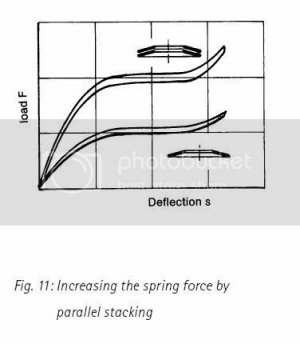
To my knowledge, there is no compatible stronger diaphragm spring that will fit the SHO/Valeo cover rivet pattern. Doubling up the springs (Double Diaphragm) nearly doubles the plate clamp load, but also doubles the release force, and this is what causes the deflection issues in the Aluminum flywheels. This is why I recommend using a steel billet FW for the DD clutch covers, the release is much nicer.
The other issue is that the Valeo diaphragm pivot rivet is a one-off design, it holds the diaphragm and also provides the diaphragm pivot, or fulcrum point. I've never found it in the clutch parts aftermarket.
When SS made their double-diaphragm clutches, they used standard round-head diaphragm rivets and added a wire pivot ring as a fulcrum for the diaphragm. Problem here was SS used soft steel wire for the pivot ring, which eventually deformed and gave the clutch crappy release characteristics. I re-built a few of the DD clutches with hard wire pivot ring, they worked far better. (Edit: SS didn't make these clutches, whoever was their supplier did this.)
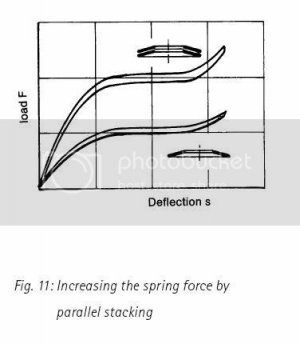
Here's the graphics behind spring stacking, or double diaphragm. You want the clutch to operate in the area where Load F is flat over deflection.
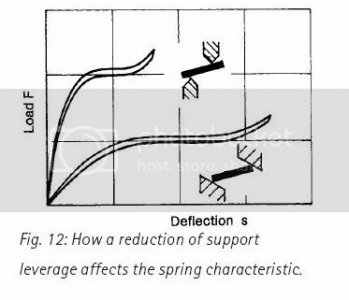
Centerforce did indeed change the diaphragm pivot points, but there is no free lunch here, because the total force -vs- travel envelope for a diaphragm spring is limited. If the pivots are optimized for lower total force, the amount of pressure plate travel is increased for that force (the pressure plate load). OTOH, if you optimize the pivot points for higher pressure plate load, that higher force will be available for a shorter amount of PP travel.
Here's the graphics behind what happens when you change the diaphragm spring pivot points. OEM Valeo is the bottom curve, note the long flat Load F -vs- deflection. CenterForce is the top curve: Higher load, but reduced deflection, and when the lining wears, you're on the left side of the graph, and plate load drops.
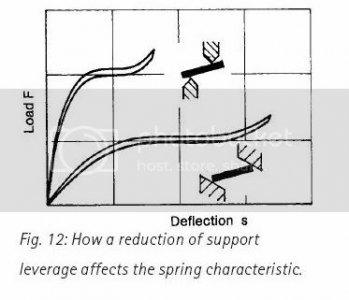
What you trade-off here is pressure plate load for lining thickness wear. You can make a low-load pressure plate work for a wide range of lining thicknesses, IOW, the pressure plate load will remain fairly constant as the lining goes from (new) full thickness to (thin) and fully worn out. But... if the pressure plate fulcrum is moved and optimized for high load, it's not very tolerant of lining wear, and as the lining wears, plate load drops in a hurry.
The strap problem on the stock Valeo covers is well known, actually, it's just weak rivets that can't take the shear load. The rivet shank for the straps is only 3/16" diameter.
SHOShop's re-strapped covers used 1/4" shank rivets and wider, thicker straps with 1/4" holes.
My covers also used wider, thicker straps with 1/4" holes, and instead of rivets, I used 160,000 psi tensile close tolerance NAS (National Aerospace Grade) bolts with 0.188" unthreaded shanks where they passed through the straps. To my knowledge,
nobody ever de-strapped one of my clutches.