MTX stall...O2 codes redux

Disclaimer: Links on this page pointing to Amazon, eBay and other sites may include affiliate code. If you click them and make a purchase, we may earn a small commission.

Storm-Chaser

New Member
Joined
Jan 26, 2005
Messages
2,786
Reaction score
258
Location
Shit Louis
shorty - you mentioned in your previous post that after the car stalled the first time, ".... I waited about five minutes, wiggled some connections and she started. I got about 100 yards and she stalled again. I did get her to run for about 3 minutes but she died again....".

See the common items the pinpoint tests above are designed to test?

I was just curious, what kind of road conditions were you driving on prior to this happening? Any good chuck-holes, spped-bumps, etc.,?

What wire/harness/harnesses did you "wiggle"?


SASHO91

Zoom Zoom
Joined
Feb 3, 2004
Messages
6,990
Reaction score
141
Location
San Antonio,TX
Well, we know that someone can copy and paste... and worthless info at that.

:rolleyes:

Anywho...
Im sure its been stated, but give the MAF a cleaning, as well as the IAB. Then check for a vacuum leak.
 

shorty

New Member
Joined
Nov 30, 2006
Messages
21
Reaction score
0
Location
Virginia
Storm-Chaser said:
shorty - you mentioned in your previous post that after the car stalled the first time, ".... I waited about five minutes, wiggled some connections and she started. I got about 100 yards and she stalled again. I did get her to run for about 3 minutes but she died again....".

See the common items the pinpoint tests above are designed to test?

I was just curious, what kind of road conditions were you driving on prior to this happening? Any good chuck-holes, spped-bumps, etc.,?

What wire/harness/harnesses did you "wiggle"?


smooth road, no bumps. I wiggled both sides of the harness on the right hand side of the intake. After I restarted it, wiggling that harness did not seem to affect things.
 

Markus

SHO Member
Joined
Feb 2, 2001
Messages
634
Reaction score
28
Location
Ottawa, Ontario, Canada
Storm-Chaser said:
This is the primary reason I don't recommend pulling codes using a paper clip. The paper clip trick does not distinguish between retained CM codes and the KOEO and KOER codes generated during their respective tests - you’re only getting half the fault code information.


Ummm. The CM codes are given after the KOEO codes EVEN WHEN USING A PAPERCLIP. After the KOEO codes are given there is a single flash of the check-engine light and 6-9 second thereafter the CM CODES ARE GIVEN. It's as simple as that - no scanner required. I have used both a scanner and a paperclip and guess what? There is no difference in the codes and the sequence in which they are given whether a scanner or a paperclip is used.
 
Last edited:

Markus

SHO Member
Joined
Feb 2, 2001
Messages
634
Reaction score
28
Location
Ottawa, Ontario, Canada
Storm-Chaser said:
DTC 542

Constant Control Relay Module


Remember


This Pinpoint Test is intended to diagnose only the following:
  • Constant Control Relay Module (CCRM)
    - EEC Power Relay
    - LFC Relay
    - HFC Relay
    - WAC Relay
    - FP Relay
  • Pusher Fan Control Relay
  • Harness circuits: B+, KPWR, PWR GND, FP, LFP, HFP, LFC, HFC, PFC, A/C, ACCS, ACPSW, WAC
  • Powertrain Control Module (PCM) (12A650)


Description

Constant Control Relay Module (CCRM)
The Constant Control Relay Module (CCRM) interfaces with the EEC-IV system to provide control for the cooling
fan, A/C clutch and the fuel pump. The CCRM may also contain the EEC power relay which provides vehicle
battery power (VPWR) to the Powertrain Control Module (PCM) and EEC-IV system. Refer to the following
schematics for specific CCRM relay control.

Pusher Fan (Thunderbird SC)
The Thunderbird SC has ….

Dual and Single Function A/C Pressure Switch (ACPSW) (also known as Refrigerant
Containment Switch)

The ACPSW is used for additional A/C system pressure control and is also known as the refrigerant containment
Switch. The normally open medium pressure contacts close at a predetermined A/C head pressure. This
Grounds the input to PCM indicating that the high speed cooling fan is required. For the 3.0L SHO and Taurus
Flex Fuel, the medium pressure ACPSW circuit is not wired to the PCM, but is wired directly to the CCRM for high
speed cooling fan control. The normally closed high pressure contacts open at a predetermined A/C head
pressure. This turns off the A/C by opening the A/C demand circuit preventing the A/C pressure from rising to a
level that would open the A/C high pressure relief valve. For additional information, refer to the
Ventilation / Climate Control group of the service manual.

[deleted]


Here's an example of why the diagnostic routines are not always accurate. A 542 can be caused by a bad O2 sensor. I've proven this by clearing all the codes, unplugging an O2 sensor are driving for 1/2 hr. Guess what? I had a 542 code. Please show me in the cut and paste job you just made where it says an O2 sensor can trigger 542? You can't, can you?
 

Storm-Chaser

New Member
Joined
Jan 26, 2005
Messages
2,786
Reaction score
258
Location
Shit Louis
shorty said:
smooth road, no bumps. I wiggled both sides of the harness on the right hand side of the intake. After I restarted it, wiggling that harness did not seem to affect things.


Are you talking about the DIS harness? You'll also want to trace (and then wiggle) the harness from the PCM (it contains the VPWR - Vehicle Power harness wire), as well as the harness for the front HEGO sensor and the positive battery power (B+) harness wires from the battery.


You can get highly legible wiring diagrams via AutoZone's online Vehicle Repair Guides (click on the Chassis Electrical link, then Wiring Diagrams).


For example:


0900823d800d30b4.gif


In the illustration above, look just above the word "POWERTRAIN" for VPWR circuits # 57 and 37 - and note how they tie directly via the VPWR Harness into the other following items:

- CONSTANT CONTROL RELAY MODULE (directly powers fuel pump relay)
- Mass Air Flow Sensor (opposite circuit #09)
- Canister Purge Solenoid (opposite circuit #31)
- Intake Manfld Runner Control (opposite circuit #32)
- EGR Vac. Reg. Sol. (opposite circuit #33)
- Inj 1 (opposite circuit #58)
- Inj 2 (opposite circuit #59)
- Inj 3 (opposite circuit #12)
- Inj 4 (opposite circuit #13)
- Inj 5 (opposite circuit #14)
- Inj 6 (opposite circuit #15)
- Idle Air Cntrl Sol. (opposite circuit #21)
 

Storm-Chaser

New Member
Joined
Jan 26, 2005
Messages
2,786
Reaction score
258
Location
Shit Louis
SASHO91 said:
Well, we know that someone can copy and paste... and worthless info at that.

:rolleyes:
Opinion noted. The information was taken directly from the Ford PCED Manual, and typed and formatted in a Word document, then posted here, for the OP’s benefit.

Btw, since the factory manuals [IYHO] are worthless, do you have a better manual for forum members that want to learn how to work on their SHO?


SASHO91 said:
Anywho...
Im sure its been stated, but give the MAF a cleaning, as well as the IAB. Then check for a vacuum leak.

Read the thread.
 

SASHO91

Zoom Zoom
Joined
Feb 3, 2004
Messages
6,990
Reaction score
141
Location
San Antonio,TX
I did not mean that the manual was worthless... just some of the info you "brought over" from there was "worthless" to the OP's issue's.

I relize now, that worthless was not the correct term... I did not mean for it to sound that way.
FWIW, I use those manuals as well... (for some issues)

Ah, and yes... Chris allready stated what I said...
 

Storm-Chaser

New Member
Joined
Jan 26, 2005
Messages
2,786
Reaction score
258
Location
Shit Louis
Markus said:
Ummm. The CM codes are given after the KOEO codes EVEN WHEN USING A PAPERCLIP. After the KOEO codes are given there is a single flash of the check-engine light and 6-9 second thereafter the CM CODES ARE GIVEN. It's as simple as that - no scanner required. I have used both a scanner and a paperclip and guess what? There is no difference in the codes and the sequence in which they are given whether a scanner or a paperclip is used.

I know the order the codes are given. However, simply using a paper clip does not distinguish between the codes unless the individual knows the above information. They're simply going to record the codes flashed not realizing the difference. I see this in post after post here where it is clear people don't understand this. The latest example someone was asking what a code "33" was for (he was describing the 1-1-1 KOEO Self-Test "pass" code).

And I guess shorty's suppose to have some great epiphany in his dreams and figure this out, since the SHO PP information he used to pull codes glosses right over this:

Posted on the SHO Phoenix Project website

"It can be a little confusing at first, but the car will display the codes twice. Then it will flash once, and then move on to the stored codes. These are the codes that have been stored by the computer but may or may not have found when testing."​

Actually, it's a 6-9 second delay after the KOEO codes are complete, then a separator "10" code (the CEL only displays a single flash) and then another 6-9 second delay before the CM codes. The information incorrectly describes the delay-separator-delay sequence and only makes a brief statement that uses non-standard terminology. There's no mention of the what the "stored" codes are for, why they're stored, how long they're stored, or how they are significant. It’s apparent in many threads here that people don't understand this despite the available online information.

The PCED fully discusses the CM codes, their significance, and the order that the codes should be addressed (ie. serviced). The manual that came with both code readers I've used include this information, as well as a complete listing of the codes, that can be kept in the glove compartment or center console compartment. And we all know that SHOs never break down, on the road away from home.... :ohreally:
 

Storm-Chaser

New Member
Joined
Jan 26, 2005
Messages
2,786
Reaction score
258
Location
Shit Louis
Markus said:
Here's an example of why the diagnostic routines are not always accurate. A 542 can be caused by a bad O2 sensor. I've proven this by clearing all the codes, unplugging an O2 sensor are driving for 1/2 hr. Guess what? I had a 542 code. Please show me in the cut and paste job you just made where it says an O2 sensor can trigger 542? You can't, can you?

First, I did not post the information to prove whether a 542 code can be triggered by an O2 sensor fault. This is purposely being taken out-of-context, as it was not the intent of the series of posts above. I posted the introductory page from the FIVE DTCs to show the two common areas in the seven DTCs covered by the Pinpoint Test routines (VPWR harness and PCM issues).

Second, this was already discussed.

Third, if you have a PCED, it is included in the Diagnostic routine.

It's about 30-pages into the CCRM 52-page test routine and I figured most here didn't care to read that many pages (if any of it). Oh, and most of the test on the O2 sensors is looking for signal faults between the sensor and the PCM (harness shorts). Read the PCED.
 

Markus

SHO Member
Joined
Feb 2, 2001
Messages
634
Reaction score
28
Location
Ottawa, Ontario, Canada
Storm-Chaser said:
I know the order the codes are given. However, simply using a paper clip does not distinguish between the codes unless the individual knows the above information.

Now you're changing you tune. You must have finally learned something from the rubes here at SHOForum. Or perhaps you've just learned to express yourself in a more meaningful manner? You made 2 prior posts that adamantly say the paperclip trick DOES NOT distinguish CM codes:

1:
Storm-Chaser said:
And I'm sure *ALL* those paper clips come with readouts that will tell shorty whether he has a KOEO, KOER, or CM code.....

I didn't think so.................
That worthless $30 code reader does....

2:
Storm-Chaser said:
This is the primary reason I don't recommend pulling codes using a paper clip. The paper clip trick does not distinguish between retained CM codes and the KOEO and KOER codes generated during their respective tests - you’re only getting half the fault code information.

You're very welcome, by the way. Glad we could be of assistance to you. And, of course an individual won't get proper results from a test if he doesn't know all the anciallary information. The same is true, of course, of the code reader products.

Storm-Chaser said:
The manual that came with both code readers I've used include this information, as well as a complete listing of the codes, that can be kept in the glove compartment or center console compartment. And we all know that SHOs never break down, on the road away from home.... :ohreally:


Some of the manuals that come with code readers are, well, not complete in terms if the codes given. Some of the codes in the Equus manuals are simply wrong. Hmmm... I wonder where that leaves the poor sap who relys solely on the code book in his glove compartment ...

I keep a list of error codes in my glove compartment that I obtained via various sources - no need to purchase a code reader just to get that list ...

It should be noted, for the sake of other forum users, that while a code reader may be handy, once it gives you the codes you are no better off than the person who retrieves the codes via a paperclip. This is because neither method provides you with steps to further diagnose the problems. At this point you still need either the factory service publications or information found on the internet to help diagnose the problems.
 
Last edited:

Storm-Chaser

New Member
Joined
Jan 26, 2005
Messages
2,786
Reaction score
258
Location
Shit Louis
No, I did not "change my tune". You're taking individual comments from different posts in different sections of the thread out-of-context to prove a point.

And I don't consider anyone here to "be a rube". This is suppose to be a forum for discussion and information exchange; sometimes it is, sometimes it isn't. Lately it seems to be the latter.

Can the paper clip method be used effectively - sure, but not without considerable supplemental information. Sure, but it requires the information and interpretation that the code reader automates. I don't have to count "flashes", the time between "flashes", or organize the pattern of flashes to decode the flashes into actual numbers.

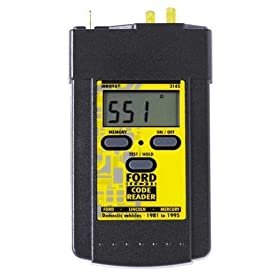
I simply plug the Equus code reader (see below) into the EEC ports, turn the ignition key on, press the reader ON / OFF button, press the TEST / HOLD button, and let it run the test.

The reader retrieves the codes, it classifies the codes (O, C, R), it displays the codes, and it stores the codes in memory for later reference.


Btw, the above link is to Amazon.com, where you can buy the reader for $24.99 ! For $49.98 you get the reader with the 6' extension harness and free shipping.
 

Storm-Chaser

New Member
Joined
Jan 26, 2005
Messages
2,786
Reaction score
258
Location
Shit Louis
Back to shorty's problem....


Hey Rob - how did you clear the codes? Did you disconnect the battery for 10 minutes as recommended on the SHO PP website?


shorty said:
No code reader here, I used the paper clip self diagnostic a la "Phoenix Project".

I must admit that while I do have some engine experience it is primarily with older (read: "no dang computer") vehicles. I find chasing codes on the SHO interesting but frustrating. Probably because I'm shooting in the dark. Hopefully I will get the hang of it.

By the way, after checking some other threads I also check for vaccum leaks by spraying WD40 on the rubber intake connectors - no change in idle speed.

Other food for thought that occured to me after the discussion of possible connection issues: The previous owner mentioned having his mechanic replace the subframe bushings. Would this require pulling the engine or otherwise disconnecting much of the harness? The reason I ask is that portions of the harness appear to not be properly attached to clips etc.

Thanks for the input, I only get to work on this car on the weekends (if I'm lucky) and sometimes go for 2-3 weeks without being able to touch it (I work in one town, my garage is in another - this is not according to my master plan, but it is what I have right now).

Rob
 

shorty

New Member
Joined
Nov 30, 2006
Messages
21
Reaction score
0
Location
Virginia
To clear the codes I disconnected the negative battery cable and held the brake for 60 seconds. I was told once upon a time that the brake light connection was a good way to "drain" the system. The stored codes changed during my tests; I took this as an indication that the brake light approach worked.
Rob

p.s. I have not been able to work on the car for a bit. It just sits in front of my house waiting for a good hot day for me to try to repeat the problem. I only miss it when it rains.
 

Storm-Chaser

New Member
Joined
Jan 26, 2005
Messages
2,786
Reaction score
258
Location
Shit Louis
That likely explains both the 512 (KAM Power)(KAPWR) codes.


Diagnostic Trouble Code (DTC) 512 includes the following note in the first troubling-shooting step:

"Continuous Memory DTC 512 indicates the PCM
has experienced a power interrupt in its Keep
Alive Memory (KAM) circuit.

NOTE: If KAPWR is interrupted to the PCM, for
Example when installing a breakout box, or
when battery is disconnected, DTC 512 may be
stored in Continuous Memory.
"​


Realize that disconnecting the battery not only clears the OBD codes and the KAM, this also clears the idle strategy used by the PCM to control the Idle Air Control solenoid - which requires allowing the engine to idle for 15-20 minutes to "re-learn" the idle strategies. Given the prior 542 code, you'll want to avoid this until it becomes clear whether this is a prior-condition code, or an intermittent code that has not reoccurred since the stalling incident.

Btw, the code reader will allow you to clear the codes directly using the reader, without disconnecting power and clearing other system memory codes.
 

Forum statistics

Threads
107,084
Messages
1,181,252
Members
16,148
Latest member
thatSHOguy101

Members online

No members online now.
Back
Top