Mating a T56 to a SHO V6

Disclaimer: Links on this page pointing to Amazon, eBay and other sites may include affiliate code. If you click them and make a purchase, we may earn a small commission.

MerkXRTurbo

New Member
Joined
Feb 28, 2005
Messages
229
Reaction score
60
Location
Vancouver, WA
Between over half a year out of work, and time spent playing with other toys, I have been away from my Merkur/SHO project for a bit. I've refocused and I'm back at it again, and acquiring my T56 was probably the biggest single financial hurdle and I am now over it. After all, it's a heck of a lot easier to spend $200 10x than it is to spend $2000 once!

Anyway, onto what you all have been waiting for: information and pics! I chose a '98-'02 Camaro/Firebird T56 for several reasons. The F-Body shifter location is very good for the Merkur, and there are some GREAT clutch options. The '94-'97 F-Body T56 can be had cheaper, but with a pull style clutch and less clutch options to boot I believe the end cost would be the same or higher with a lot more headache.

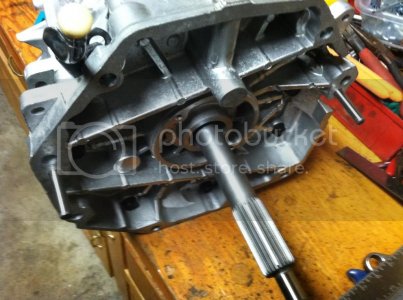
My first problem was that the T56 input shaft sticks about 1" beyond the bellhousing. For the SHO engine, I need to bring it back approximately 1" so that it's about flush with the mounting surface of the bellhousing. This is a good thing in many ways, as I need some room to take account for the thickness of the bellhousing adapter (I would have preferred more like 3/8" to 1/2", but no biggy). So my initial thought was to build my adapter out of 1" plate, although after pricing out material I decided to go another route. I made a 1/2" spacer between the bellhousing and the transmission, and then I will use a 1/2" transmission adapter.

The bellhousing is located and aligned to the transmission by two dowel pins, which were much too short to be of any use after the spacer was installed, so longer ones were required.

The old:
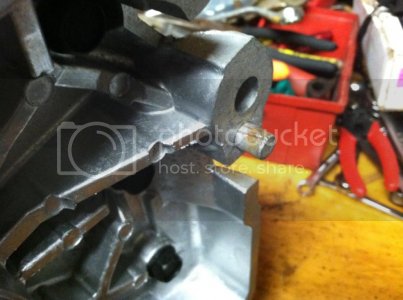
IMG 0030

The new:

IMG 0031

A little longer than they need to be, but there shouldn't be any interference with anything. If there is, I can always trim them.

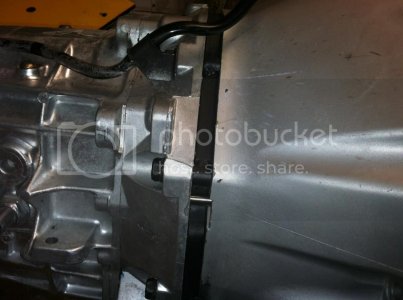
I made the spacer out of 1/2" wide flat bar and tubing for the bolts. I cut and bent the flat bar into shape and welded it all together. I then made sure it was flat using my bench top belt sander. If it's not perfectly flat that's okay, that's one of the nice things about the bellhousing being located by the dowel pins. It's a VERY tight fit and cannot be skewed even a thousandth. Here it is after primer and paint:
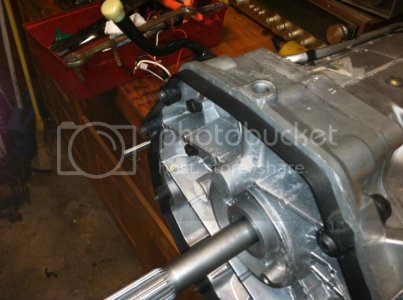
IMG 0035

IMG 0034

Bellhousing installed:

IMG 0036

From Inside:

IMG 0041

Excess length of the dowel pin (as you can see I need longer bolts):
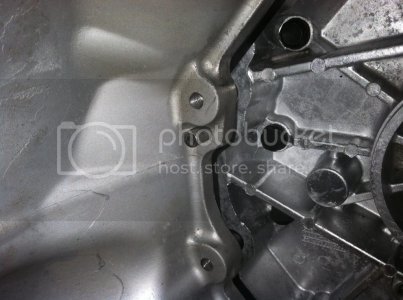
IMG 0039

After doing much research I was able to determine that the portion of the T56 input shaft that goes inside the pilot bearing is only .001" larger than the 2.3 Ford, and the SHO crank accepts the 2.3 pilot bearing as if it were factory equipment! The pilot bearing may end up being the only OEM item on the car... hey, is there a racing class that only requires a stock pilot bearing? :nut:

2.3 Pilot bearing on the T56 input shaft:
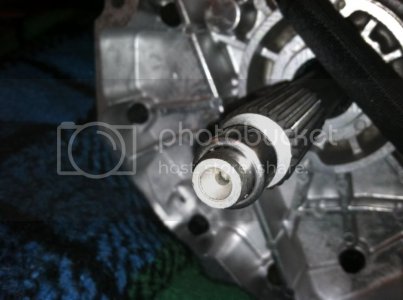
IMG 0033

2.3 Pilot bearing against the SHO crank. With a bit of force (but no more than typical for such) it would press in beautifully:
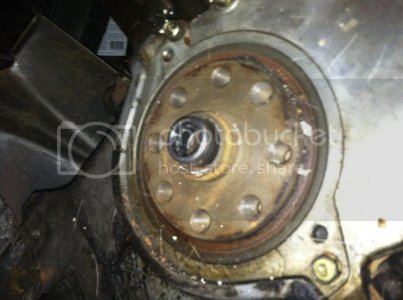
IMG 0040

Next thing I have to do is build a transmission adapter and figure out a method of aligning the bellhousing so that the input shaft is within .005" of being perfectly centered in the crank.
 

rubydist

SHO Master
Staff member
Super Moderators
Joined
Jun 25, 2007
Messages
7,521
Reaction score
3,399
Location
Denver
make sure your spacer between bell housing and trans is the exact same width all the way around - strap is typically not that consistent in width, and a .005" difference from side to side will create problems. it might be worth having a machine shop just plane it for you to make sure its the same all the way around.
 

mcrowe3797

New Member
Joined
Sep 29, 2011
Messages
87
Reaction score
8
Location
Illinois
Very impressed!!!! Keep up the great work and updates!

Shoot me the dimensions if possible..... I have access to my buddies machine shop and a waterjet that can cut up to 1 1/2" steel :)
 
Last edited:

MerkXRTurbo

New Member
Joined
Feb 28, 2005
Messages
229
Reaction score
60
Location
Vancouver, WA
make sure your spacer between bell housing and trans is the exact same width all the way around - strap is typically not that consistent in width, and a .005" difference from side to side will create problems. it might be worth having a machine shop just plane it for you to make sure its the same all the way around.

Actually this isn't that critical with this transmission, as the dowel pins that align the bellhousing are so tight that I actually have to massage the bell into place with a rubber mallet. There is no way that it can be installed skewed.
 

MerkXRTurbo

New Member
Joined
Feb 28, 2005
Messages
229
Reaction score
60
Location
Vancouver, WA
Kudos, nice work.
I'm using a weak T5 for my RX7 project.

T5 isn't a bad transmission, especially in a car that's as light as an RX7 with limited tire width. A T5 would be an excellent choice behind a N/A (or lightly boosted) Yamaha.

My pistons are 8.0:1 and I plan to be cranking boost up 25+ psi. I was originally going to use a T5, but then realized that I would put so much money in it to get it up to spec that I might as well have a sweet double overdrive to go with it! :swing:
 

DrivinhardLLC

New Member
Joined
Feb 26, 2011
Messages
81
Reaction score
100
Location
GA
Actually this isn't that critical with this transmission, as the dowel pins that align the bellhousing are so tight that I actually have to massage the bell into place with a rubber mallet. There is no way that it can be installed skewed.

I have seen (personally) clutch release/engagement issues with an LS/T56 from simply a fissure crack form on the bellhousing. So yes, you do want that thing as square as you can get it on the block.
 

intimdatr

Got Cams?
Joined
Mar 13, 2011
Messages
1,206
Reaction score
453
Location
Jefferson City, Missouri
This is awesome, Ive been tossing around the idea for a RWD SHO build but ive been thinking on what and this is a big help! Sweet thread!
 

vortex2450

Buying Parts...
Joined
Jun 10, 2010
Messages
680
Reaction score
87
Location
North Carolina
YES! I've been brainstorming hard about how this would be done and this post made my day! Awesome work, once you're have it figured out are you going to share the adapter print or will that require $$? :angelnot:

Also, I would try to aim close that 5 thou for centering the input shaft but i realize that's easier said than done.

Good work, I can't wait to see the final result.

T5 isn't a bad transmission, especially in a car that's as light as an RX7 with limited tire width. A T5 would be an excellent choice behind a N/A (or lightly boosted) Yamaha.

My pistons are 8.0:1 and I plan to be cranking boost up 25+ psi. I was originally going to use a T5, but then realized that I would put so much money in it to get it up to spec that I might as well have a sweet double overdrive to go with it! :swing:


BOOST IT! I'm so jealous of your ambitions. I wanna do something very similiar in a few years once my finances are better, are you planning on a BIG single turbo or twins? I'd suggest twins!


-Josh
 
Last edited:

MerkXRTurbo

New Member
Joined
Feb 28, 2005
Messages
229
Reaction score
60
Location
Vancouver, WA
As I no longer have VIP access to a machine shop most of my work is going to be "old school". I plan to fabricate the adapter in my garage with ordinary tools (plus various precision measuring tools to make sure everything is perfectly aligned), so there probably won't be a CAD file or anything like that. I could probably spend the hours to draw one up, but then I'd still be making it by hand in the end, so it would be wasted effort. I will check it for flatness and have it machined accordingly if I need, but that should be the extent of the outsourced work.

I was going to go with twins (and still wish I could), but I can't find a compressor that will produce the pressures I want while still pushing a small enough amount of air for 3 cylinders of the SHO engine. Just about every compressor map that I plot my points on I find that my projected result will be to the left of (or too close to) the surge line. A large single that's designed to push BIG PSI isn't too bad of compromise, after all they are abundant and cheap from the diesel truck crowd.
 
Last edited:

Shovert

Active Member
Joined
Jul 25, 2011
Messages
420
Reaction score
93
Location
ky
Hopefully in the future variable geometry turbo's and their controls [non-oem standalone] will into play in the future. Plus if they get better built for gasoline vehicle application. Maurice
 

vortex2450

Buying Parts...
Joined
Jun 10, 2010
Messages
680
Reaction score
87
Location
North Carolina
As I no longer have VIP access to a machine shop most of my work is going to be "old school". I plan to fabricate the adapter in my garage with ordinary tools (plus various precision measuring tools to make sure everything is perfectly aligned), so there probably won't be a CAD file or anything like that. I could probably spend the hours to draw one up, but then I'd still be making it by hand in the end, so it would be wasted effort. I will check it for flatness and have it machined accordingly if I need, but that should be the extent of the outsourced work.

I was going to go with twins (and still wish I could), but I can't find a compressor that will produce the pressures I want while still pushing a small enough amount of air for 3 cylinders of the SHO engine. Just about every compressor map that I plot my points on I find that my projected result will be to the left of (or too close to) the surge line. A large single that's designed to push BIG PSI isn't too bad of compromise, after all they are abundant and cheap from the diesel truck crowd.


I understand that. It's cool that you're still going to be able to do it without much outsourcing.


I don't think I've spent as much time really getting into the numbers as you've have but I think twin anything from gt2871r's to gt3076r's would be great for big power. The gt2871r turbos are run a lot on similar applications. (fwiw: audi 2.7l bi-turbo, 300zx tt, porsche's)

If I could do it right now twin gt30r all the way, check out the compressor map and tell me what you think?
You wanna be a tad left of the highest efficiency island so as you spool up you spool into it.

gt30rcompress.gif


It's really a battle of retaining to engine's nice tq band, just to retain to fun factor of the Yamaha.

I'm tired now but I'd love to discuss it further tomorrow. Here's a video I tend to view a lot that brings me inspiration.
[YOUTUBE]O2vnaGHp5PU[/YOUTUBE]


-josh
 
Last edited:

MerkXRTurbo

New Member
Joined
Feb 28, 2005
Messages
229
Reaction score
60
Location
Vancouver, WA
Hopefully in the future variable geometry turbo's and their controls [non-oem standalone] will into play in the future. Plus if they get better built for gasoline vehicle application. Maurice

I've already got one setup on my non-computer controlled 12 valve Cummins diesel, so the thought has crossed my mind. I don't think that the Holset VGT is as susceptible to issues with gasoline engine EGTs as the Garrett VNT system is. With Holset's design you only have one moving part, while Garrett's has dozens!

I don't think I've spent as much time really getting into the numbers as you've have but I think twin anything from gt2871r's to gt3076r's would be great for big power. The gt2871r turbos are run a lot on similar applications. (fwiw: audi 2.7l bi-turbo, 300zx tt, porsche's)

If I could do it right now twin gt30r all the way, check out the compressor map and tell me what you think?
You wanna be a tad left of the highest efficiency island so as you spool up you spool into it.

gt30rcompress.gif

Conservatively estimating (and I like to be conservative in my speculations) I can expect to see 25-28 lb/min of air required. 25psi manifold pressure is a 2.7 pressure ratio (assuming we're at sea level - the pressure ratio to get 25psi manifold pressure at high altitude would be even higher). That puts us awfully close to the surge line for comfort. The thing is about those cars that you're speaking of is that it's very rare for one to be pushing the manifold pressures that I'm planning. The thing is with the cars that you've just mentioned, few of them are running 25-30psi (with some exceptions of course, like the badass one in the video you posted), because that's just stupid, and stupid is what I do best! :cheers:
 
Last edited:

rubydist

SHO Master
Staff member
Super Moderators
Joined
Jun 25, 2007
Messages
7,521
Reaction score
3,399
Location
Denver
I think if you are running 2.7 pr you will be at all of 28-30 lb/min for airflow and that turbo would be just fine.
 

vortex2450

Buying Parts...
Joined
Jun 10, 2010
Messages
680
Reaction score
87
Location
North Carolina
I've already got one setup on my non-computer controlled 12 valve Cummins diesel, so the thought has crossed my mind. I don't think that the Holset VGT is as susceptible to issues with gasoline engine EGTs as the Garrett VNT system is. With Holset's design you only have one moving part, while Garrett's has dozens!

It may be me but aren't but of these technologies geared at commercial use? A quality wastegate allows much more precise control as I see it versus relying on parts in a turbine moving @ 28,000rpm+ to change geometry.


Conservatively estimating (and I like to be conservative in my speculations) I can expect to see 25-28 lb/min of air required. 25psi manifold pressure is a 2.7 pressure ratio (assuming we're at sea level - the pressure ratio to get 25psi manifold pressure at high altitude would be even higher). That puts us awfully close to the surge line for comfort. The thing is about those cars that you're speaking of is that it's very rare for one to be pushing the manifold pressures that I'm planning. The thing is with the cars that you've just mentioned, few of them are running 25-30psi (with some exceptions of course, like the badass one in the video you posted), because that's just stupid, and stupid is what I do best! :cheers:

I think you underestimate the ability of the engine to flow; in stock form it flows excellent, with a light port and polish, +1mm valves, more lift and duration and a bump in rev limit I'm confident that with 25psi and up you'll be seeing airflow numbers well over 30lb/min.

A vague scope of this might be that Yamahasho's vortech driven SHO was seeing 438whp on pump gas @16psi ( I believe) which equates to somewhere near 50lb/min of airflow. This put a twin gt30 or similar turbo right in that range.

Granted, you might see some volumetric loss due to a lower compression, I think given the proper headwork you can more than make up for that.

Here's a gt2871r map
472560-15comp.jpg


These would run out of steam anywhere over 28psi but given your plot points would fit better.


-Josh
 

Shovert

Active Member
Joined
Jul 25, 2011
Messages
420
Reaction score
93
Location
ky
I agree controlling waste gate easy. Now from my understanding on a variable geometry. A low rpm you can have boost and as rpm keep the boost up. No big deal for waste gate. But a vgt acts like a small turbo and get boost at low rpm and large boost at high rpm without overspeeding the turbo. How they work if not informed on them. Ok now I have stepped of my conform zone on these. All I know what I read.
http://paultan.org/2006/08/16/how-does-variable-turbine-geometry-work/
sizing a turbo.
http://www.turbobygarrett.com/turbobygarrett/choosing_turbo
Good site takes you from basic turbo learning to expert. Nice site. Maurice
 

MerkXRTurbo

New Member
Joined
Feb 28, 2005
Messages
229
Reaction score
60
Location
Vancouver, WA
It may be me but aren't but of these technologies geared at commercial use? A quality wastegate allows much more precise control as I see it versus relying on parts in a turbine moving @ 28,000rpm+ to change geometry.

Not commercial at all, I believe all of the diesel pickups currently on the market are equipped with some sort of variable turbine. Also, there is nothing adjustable on the rotating mass, it's all variable housing, not the turbine wheel itself. Those who have retrofitted a variable turbine to a gasoline powered vehicle have generally still used a wastegate for controlling boost.

I agree controlling waste gate easy. Now from my understanding on a variable geometry. A low rpm you can have boost and as rpm keep the boost up. No big deal for waste gate. But a vgt acts like a small turbo and get boost at low rpm and large boost at high rpm without overspeeding the turbo. How they work if not informed on them. Ok now I have stepped of my conform zone on these. All I know what I read.

You're correct.


I may rethink my turbo choice and look toward the GT30....:)
 

vortex2450

Buying Parts...
Joined
Jun 10, 2010
Messages
680
Reaction score
87
Location
North Carolina
Not commercial at all, I believe all of the diesel pickups currently on the market are equipped with some sort of variable turbine. Also, there is nothing adjustable on the rotating mass, it's all variable housing, not the turbine wheel itself. Those who have retrofitted a variable turbine to a gasoline powered vehicle have generally still used a wastegate for controlling boost.


You're correct.


I may rethink my turbo choice and look toward the GT30....:)

Fair enough, it seems promising for retaining the low end tq curve while still allowing for plenty of flow up top; of course I am not sure how tuning that goes but i'm sure it's adjustable. And the Yamaha engine is great in stock form for having such a flat powerband so I can't blame you for wanting to retain that.

My thought was to have something that didn't really start boosting hard until right around when the secondaries open up which is about where the .64 a/r gt3076r would land in the power band. BUT that's only my feeble conjecture on something I've never done and only raed about so take what you want from it.


Ohh, and another thought, pressure ratio and flow rates are inversely proportional. So when you smooth out intake flow and increase volumetric efficiency through various headwork and intake work you can effectively flow more @ lower pressure moving you further away from the surge line (down and right) giving you more headroom to work with. At least that is what I've come to conclude from my reading.

It's your project, I can't wait to see some more progress. What's your approach for centering the input shaft with the engine crank?


-Josh
 
Last edited:

MerkXRTurbo

New Member
Joined
Feb 28, 2005
Messages
229
Reaction score
60
Location
Vancouver, WA
I've got the entire week off and I have had a bit of time to make some further headway. I've got the basic adapter plate fabricated, although it is in desperate need of further cleanup on the rough edges, and that will be coming soon. Since the bolts that attach the plate to the block are mostly underneath the Chevy bellhousing ****** I needed to countersink the bolts.

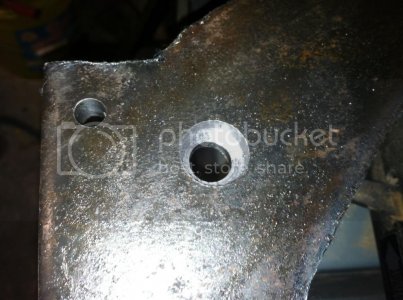
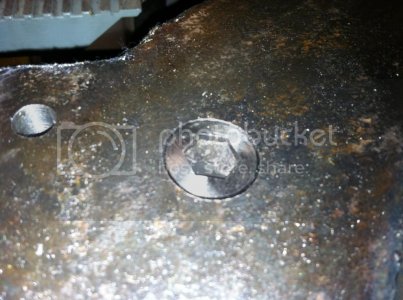
Close up of one of the counter sunk holes:
IMG 0044

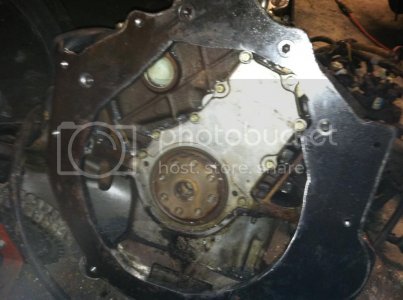
Adapter plate (those ugly edges make me cringe!):
IMG 0045

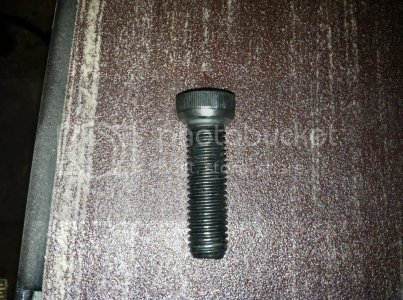
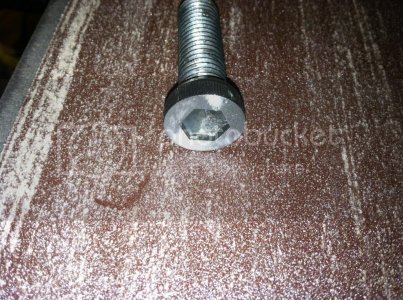
Modified Allen bolt. I put a small radius on the bottom, and shortened the height of the head. This was done with a grinder, electric drill, and a belt sander. I don't need no steenkin' lathe!
IMG 0046
IMG 0047

Countersunk:
IMG 0048

Adapter plate on the block with a couple bolts:
IMG 0051

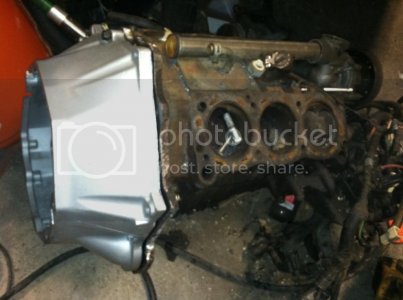
Bellhousing mocked up:
IMG 0052
IMG 0053

I was going to get the tranny bolted up but ended up breaking my tap when I was half way done tapping the holes, so I have to go exchange it tomorrow. I have a couple of ideas up my sleeve for how to align the bellhousing, but since I haven't done it yet I haven't cut the holes for any of the dowel pins at this point in time (I will be using the original SHO dowel pins to locate the plate to the block, as well as the Chevy dowel pins to locate the bell to the plate). It's REALLY close to being centered as it sits, and once I figure out which of the methods I have in mind to use I will cut the holes for the dowels and install adjustable off-center dowel pins so that I can get it exactly where I want.
 
Back
Top