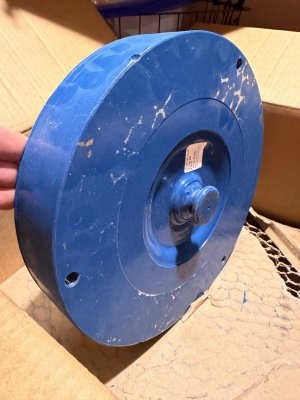
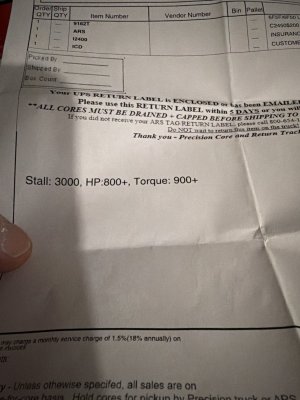
Torque Converter Evolution—Why This Became a Critical Focus
To frame this correctly, it’s important to start with where my understanding of torque converters actually was earlier in the build.
On my previous setup—stock engine and stock transmission—the car produced strong results, but not exactly all on the same run. My best sixty-foot was a 1.66, while my best eighth-mile (7.1 @ 99 mph) and best quarter-mile (11.06 @ 123 mph) occurred together on a separate pass. At the time, like most people on the platform, I believed the majority of performance lived in the engine, turbos, and tuning. The torque converter felt more like a supporting component than a defining one.
As my build progressed and I began collecting parts for what would become my new build starting in November 2020, I purchased the GearHead torque converter in late 2021 or early 2022. At that point, it seemed like a safe decision. Options were limited, technical transparency across the platform was minimal, and GearHead had an established reputation. I didn’t yet have the experience or broader drivetrain understanding to question stall characteristics, lock-up strategy, clutch capacity, or how converter design fundamentally affects how power is applied—not just how much power is made.
Why The GearHead Converter Became a Concern
As power goals increased and the scope of the build expanded, my expectations for the torque converter changed. What initially felt like a conservative choice began to raise legitimate questions—not because of opinions or forum noise, but because of real-world outcomes and the absence of hard technical information.
One of the most telling data points was Ryan Spencer’s single-turbo SHO. A single-turbo setup places significantly higher transient and sustained torque demand on the drivetrain than a comparable twin-turbo configuration, especially during launch and early gear acceleration. That converter did not survive sustained use, despite the car only recording a best quarter-mile of 11.50. The unit was later sold to Jordan, who ultimately had to have a new converter built anyway. That wasn’t a case of extreme power or abuse—it was a mismatch between converter design and torque demand.
At the same time, I began looking for actual technical documentation on the GearHead converter: stall behavior under load, clutch configuration, friction materials, lock-up strategy, torque limits, thermal considerations. None exists publicly. Not on a website, not in documentation, and not even in detailed manufacturer disclosures. Descriptions consistently rely on general statements—brazed fins, custom stator, stronger lock-up—without defined specifications or a documented performance envelope.
This isn’t about talking down on anyone or attacking a business. Technical evaluation requires technical data. If full specifications exist, I genuinely welcome them and would be happy to reassess. Until then, relying on a critical drivetrain component without documented limits or design intent becomes a real risk as torque, traction, and load increase.
That realization pushed me to stop accepting “this is what people use” as a sufficient answer.
Exploring Alternatives and Hitting Dead Ends
My next step was to look for alternatives with actual history in converter engineering. I started with Circle D, largely because of their early involvement with the platform going back to the early 2010s. Historically, higher-stall converters from that era did improve sixty-foot times, but often at the expense of trap speed—an indicator of inefficiency or excessive slip on the big end. It’s also important to remember that tuning strategies and direct-injection understanding were far more limited at the time, especially when constrained within SCT’s narrow scope, which still limits visibility today.
I filled out Circle D’s custom request form in detail. I received a generic response stating the converter wasn’t in their catalog—which is expected for a custom request. I followed up to clarify intent and application, but that follow-up went unanswered. That path ended there.
I then reached out to ATS regarding their Freeman 6F55 converter, specifically asking about performance-oriented options or stall variance. Their response was straightforward and professional: they do not currently offer performance variants or custom configurations for this transmission. Another dead end.
At that point, it became clear that the traditional answers for this platform simply no longer existed in a way that supported where this build was headed.
Precision of New Hampton—Performance Division: What They Actually Build and Why It Matters
That’s what led me to keep digging—and ultimately to Precision of New Hampton’s Performance Division.
What immediately separates Precision of New Hampton from anything previously available on this platform is that they don’t offer a single vague “performance” torque converter. They offer a scalable performance ladder, ranging from OEM-quality remanufactured units, to mild and moderate upgrades, all the way to fully custom Stage 3 EXTREME converters built for serious torque and competition-level use. That alone makes them a true one-stop shop for any level of build.
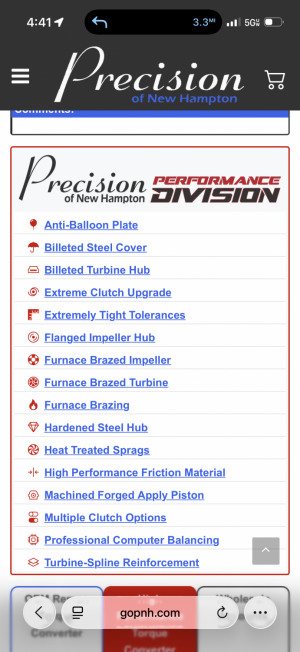
At the extreme end—where my build lives—the converter stops being a background part and becomes a load-management device. This is where PNH focuses their engineering. Furnace-brazed internals prevent fin deflection and hydraulic loss under load. Anti-ballooning protection and billet components prevent shell distortion at high boost and RPM. Reinforced spline interfaces and hardened hubs address shock loading common in AWD launches. Multi-disc lock-up clutches allow lock-up to actually hold torque instead of slipping and turning power into heat.
In real terms, this means the engine finally gets loaded the way it wants to be loaded.
Instead of rolling into boost as vehicle speed climbs, the converter allows the engine to come up on torque immediately. On the brake, the car can build boost instead of creeping forward. At launch, torque multiplication is controlled instead of chaotic. That directly translates to harder, more repeatable launches and meaningful sixty-foot improvements—not because more power was added, but because more of the existing power is now usable.
From a drivability standpoint, I’m not pretending this behaves like stock—and it shouldn’t. Light throttle and casual stop-and-go will feel a little delayed compared to an OEM converter. That’s the trade-off. But once you’re into moderate throttle, the payoff is immediate. The converter is already coupled, throttle response is instant, and the car feels locked in and connected. Mid-throttle acceleration feels on rails because the drivetrain is no longer slipping its way into motion.
That same coupling advantage carries through the gears. Instead of falling out of the powerband or bleeding energy as heat between shifts, torque stays available and usable all the way through the quarter-mile. The engine stays where it wants to be, the turbos stay lit, and the transmission stops being a limiter and starts acting like a multiplier.
Platform First — The Actual Build Process
This converter represents a platform-first application for the 6F55—not because Precision of New Hampton is new, but because this is the first time their Stage 3 EXTREME performance path is being applied intentionally and end-to-end to a high-power AWD build.
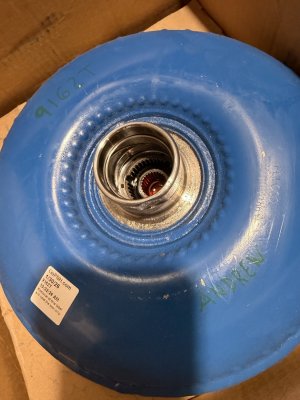
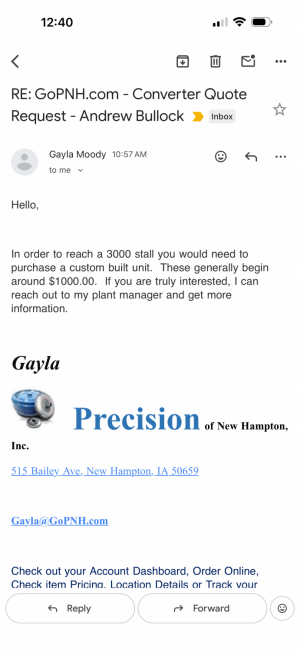
My request was explicit: a Stage 3 EXTREME, multi-disc lock-up converter with a target 3,000 RPM stall, engineered around a high-torque, boosted AWD application. I outlined approximate horsepower and torque goals, along with ET targets—deep into the 10s on 93 octane and into the 9s on E85 with supplemental methanol.
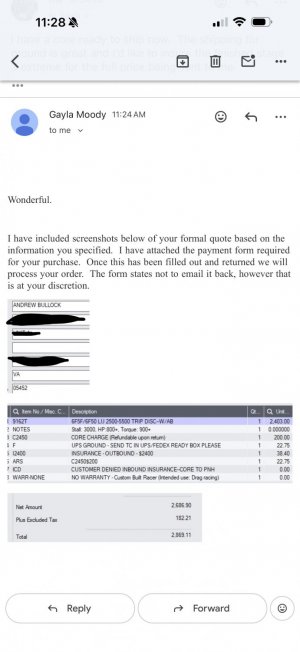
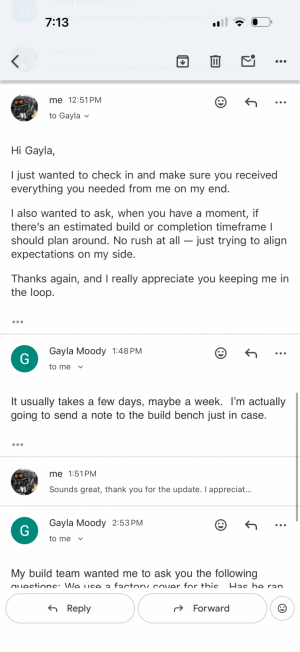
Before anything moved forward, they verified I was serious and not tire-kicking. An initial $1,000 commitment was required before escalation. Once accepted, the request was sent directly to the plant manager. From there, a firm $2,400 total was issued for a fully custom build, internally classified as SSAX—their designation for extreme, application-specific converters beyond standard performance offerings.
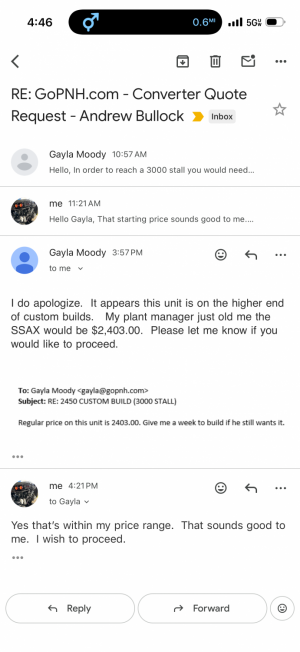
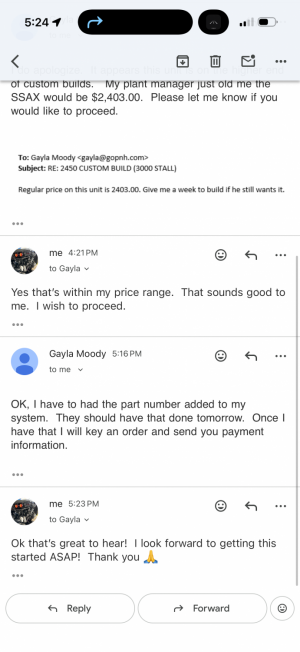
I was asked again if I wanted to proceed under that classification. I did. A unique part number was created, the build was formally accepted, and billing is being completed today.
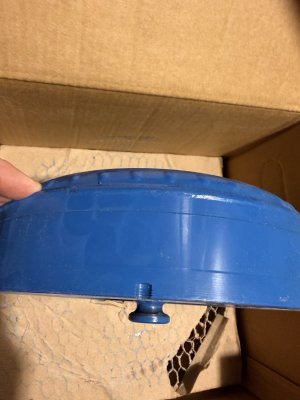
That process matters. This isn’t an off-the-shelf part, a reman, or a lightly modified unit with assumed limits. It’s a converter reviewed, approved, classified, and built at the manufacturer level around a defined torque curve, stall requirement, and performance goal.
Future Updates
I’ll continue updating this thread as the converter moves through final specification, build, and validation. Once it ships, I’ll document delivery, unpacking, and installation, followed by real-world street impressions and track data as tuning and testing progress. At that point, results will replace theory—launch behavior, coupling characteristics, drivability, sixty-foot performance, and down-track efficiency will all be logged and shared.
For anyone following along at any stage of their build, Precision of New Hampton isn’t limited to extreme custom work. They offer everything from solid OEM-quality remanufactured converters to mild and moderate performance upgrades, all the way up to fully custom extreme-duty solutions. Whether your goal is reliability, improved street performance, or a purpose-built race converter, they function as a true one-stop shop.
If you’re evaluating torque converter options at any level, I highly recommend checking them out. GOPNH.Com
To frame this correctly, it’s important to start with where my understanding of torque converters actually was earlier in the build.
On my previous setup—stock engine and stock transmission—the car produced strong results, but not exactly all on the same run. My best sixty-foot was a 1.66, while my best eighth-mile (7.1 @ 99 mph) and best quarter-mile (11.06 @ 123 mph) occurred together on a separate pass. At the time, like most people on the platform, I believed the majority of performance lived in the engine, turbos, and tuning. The torque converter felt more like a supporting component than a defining one.
As my build progressed and I began collecting parts for what would become my new build starting in November 2020, I purchased the GearHead torque converter in late 2021 or early 2022. At that point, it seemed like a safe decision. Options were limited, technical transparency across the platform was minimal, and GearHead had an established reputation. I didn’t yet have the experience or broader drivetrain understanding to question stall characteristics, lock-up strategy, clutch capacity, or how converter design fundamentally affects how power is applied—not just how much power is made.
Why The GearHead Converter Became a Concern
As power goals increased and the scope of the build expanded, my expectations for the torque converter changed. What initially felt like a conservative choice began to raise legitimate questions—not because of opinions or forum noise, but because of real-world outcomes and the absence of hard technical information.
One of the most telling data points was Ryan Spencer’s single-turbo SHO. A single-turbo setup places significantly higher transient and sustained torque demand on the drivetrain than a comparable twin-turbo configuration, especially during launch and early gear acceleration. That converter did not survive sustained use, despite the car only recording a best quarter-mile of 11.50. The unit was later sold to Jordan, who ultimately had to have a new converter built anyway. That wasn’t a case of extreme power or abuse—it was a mismatch between converter design and torque demand.
At the same time, I began looking for actual technical documentation on the GearHead converter: stall behavior under load, clutch configuration, friction materials, lock-up strategy, torque limits, thermal considerations. None exists publicly. Not on a website, not in documentation, and not even in detailed manufacturer disclosures. Descriptions consistently rely on general statements—brazed fins, custom stator, stronger lock-up—without defined specifications or a documented performance envelope.
This isn’t about talking down on anyone or attacking a business. Technical evaluation requires technical data. If full specifications exist, I genuinely welcome them and would be happy to reassess. Until then, relying on a critical drivetrain component without documented limits or design intent becomes a real risk as torque, traction, and load increase.
That realization pushed me to stop accepting “this is what people use” as a sufficient answer.
Exploring Alternatives and Hitting Dead Ends
My next step was to look for alternatives with actual history in converter engineering. I started with Circle D, largely because of their early involvement with the platform going back to the early 2010s. Historically, higher-stall converters from that era did improve sixty-foot times, but often at the expense of trap speed—an indicator of inefficiency or excessive slip on the big end. It’s also important to remember that tuning strategies and direct-injection understanding were far more limited at the time, especially when constrained within SCT’s narrow scope, which still limits visibility today.
I filled out Circle D’s custom request form in detail. I received a generic response stating the converter wasn’t in their catalog—which is expected for a custom request. I followed up to clarify intent and application, but that follow-up went unanswered. That path ended there.
I then reached out to ATS regarding their Freeman 6F55 converter, specifically asking about performance-oriented options or stall variance. Their response was straightforward and professional: they do not currently offer performance variants or custom configurations for this transmission. Another dead end.
At that point, it became clear that the traditional answers for this platform simply no longer existed in a way that supported where this build was headed.
Precision of New Hampton—Performance Division: What They Actually Build and Why It Matters
That’s what led me to keep digging—and ultimately to Precision of New Hampton’s Performance Division.
What immediately separates Precision of New Hampton from anything previously available on this platform is that they don’t offer a single vague “performance” torque converter. They offer a scalable performance ladder, ranging from OEM-quality remanufactured units, to mild and moderate upgrades, all the way to fully custom Stage 3 EXTREME converters built for serious torque and competition-level use. That alone makes them a true one-stop shop for any level of build.
At the extreme end—where my build lives—the converter stops being a background part and becomes a load-management device. This is where PNH focuses their engineering. Furnace-brazed internals prevent fin deflection and hydraulic loss under load. Anti-ballooning protection and billet components prevent shell distortion at high boost and RPM. Reinforced spline interfaces and hardened hubs address shock loading common in AWD launches. Multi-disc lock-up clutches allow lock-up to actually hold torque instead of slipping and turning power into heat.
In real terms, this means the engine finally gets loaded the way it wants to be loaded.
Instead of rolling into boost as vehicle speed climbs, the converter allows the engine to come up on torque immediately. On the brake, the car can build boost instead of creeping forward. At launch, torque multiplication is controlled instead of chaotic. That directly translates to harder, more repeatable launches and meaningful sixty-foot improvements—not because more power was added, but because more of the existing power is now usable.
From a drivability standpoint, I’m not pretending this behaves like stock—and it shouldn’t. Light throttle and casual stop-and-go will feel a little delayed compared to an OEM converter. That’s the trade-off. But once you’re into moderate throttle, the payoff is immediate. The converter is already coupled, throttle response is instant, and the car feels locked in and connected. Mid-throttle acceleration feels on rails because the drivetrain is no longer slipping its way into motion.
That same coupling advantage carries through the gears. Instead of falling out of the powerband or bleeding energy as heat between shifts, torque stays available and usable all the way through the quarter-mile. The engine stays where it wants to be, the turbos stay lit, and the transmission stops being a limiter and starts acting like a multiplier.
Platform First — The Actual Build Process
This converter represents a platform-first application for the 6F55—not because Precision of New Hampton is new, but because this is the first time their Stage 3 EXTREME performance path is being applied intentionally and end-to-end to a high-power AWD build.
My request was explicit: a Stage 3 EXTREME, multi-disc lock-up converter with a target 3,000 RPM stall, engineered around a high-torque, boosted AWD application. I outlined approximate horsepower and torque goals, along with ET targets—deep into the 10s on 93 octane and into the 9s on E85 with supplemental methanol.
Before anything moved forward, they verified I was serious and not tire-kicking. An initial $1,000 commitment was required before escalation. Once accepted, the request was sent directly to the plant manager. From there, a firm $2,400 total was issued for a fully custom build, internally classified as SSAX—their designation for extreme, application-specific converters beyond standard performance offerings.
I was asked again if I wanted to proceed under that classification. I did. A unique part number was created, the build was formally accepted, and billing is being completed today.
That process matters. This isn’t an off-the-shelf part, a reman, or a lightly modified unit with assumed limits. It’s a converter reviewed, approved, classified, and built at the manufacturer level around a defined torque curve, stall requirement, and performance goal.
Future Updates
I’ll continue updating this thread as the converter moves through final specification, build, and validation. Once it ships, I’ll document delivery, unpacking, and installation, followed by real-world street impressions and track data as tuning and testing progress. At that point, results will replace theory—launch behavior, coupling characteristics, drivability, sixty-foot performance, and down-track efficiency will all be logged and shared.
For anyone following along at any stage of their build, Precision of New Hampton isn’t limited to extreme custom work. They offer everything from solid OEM-quality remanufactured converters to mild and moderate performance upgrades, all the way up to fully custom extreme-duty solutions. Whether your goal is reliability, improved street performance, or a purpose-built race converter, they function as a true one-stop shop.
If you’re evaluating torque converter options at any level, I highly recommend checking them out. GOPNH.Com