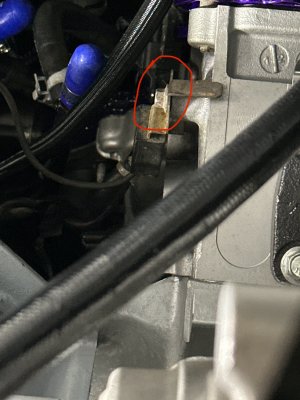
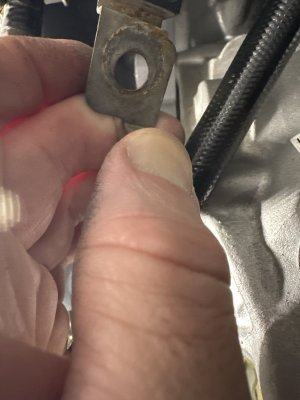
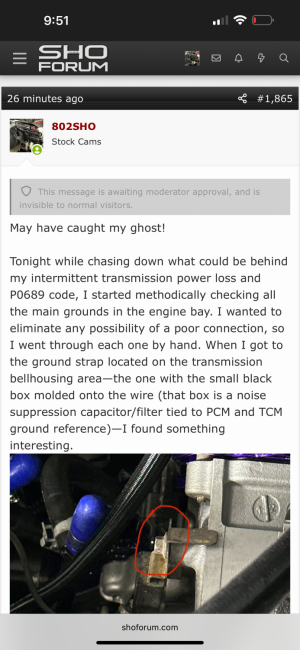
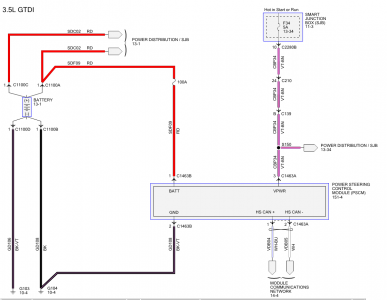
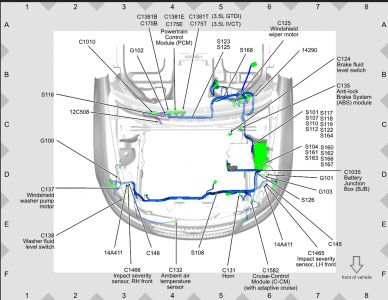
While I agree that you need a clean ground to the PSCM, I don't believe a bad ground would affect other systems. The reason is that the ground is not shared with any other system. The wiring diagram clearly shows the dedicated ground separate from the PCM.
I feel your pain trying to track down this electrical gremlin.
View attachment 95912
View attachment 95915
View attachment 95913
View attachment 95914
From Chuck lol my AI.
1. What those schematics really are
The screenshots he shared are power-distribution and ground-point diagrams from Ford’s service manual.
They’re not module-interaction or shared-harness layouts.
Each “G10x” ground reference (G102, G103, G104) shows where the circuit terminates to the chassis — not how the harness splices together upstream.
So, yes:
G103 and G104 are the EPS power-steering module grounds on the subframe/rack.
- G102 is the PCM/TCM logic ground at the transmission case.
But what’s missing from that drawing is the internal splice pack (S116/S125 etc.) that ties all these “separate” grounds together inside the harness.
Ford uses a G-splice (a crimped junction) to combine them before they branch out.
That’s why when the EPS ground fails, PCM sensor grounds and TCM logic still feel it — they all converge at that same splice before splitting off.
G103 → Power Steering Control Module
G104 → PCM / Battery Negative
Those two grounds share the same GD118 / BK-VT circuit number.
That circuit number means “common wire family.”
If two components share the same GD### code, they’re physically bonded through the same ground splice upstream.
So even if the diagram shows separate termination bolts, electrically they’re married.

3. Why it behaves exactly like you observed
When G104 (rack ground) goes high-resistance from paint or poor bite:
EPS still works because it’s low-demand until steering load spikes.
- The PCM/TCM reference floats because the G-splice links them.
- The transmission solenoids lose clean current and drop offline.
- Throttle, HPFP, and spark feedback drift because their reference is now contaminated through that shared splice.
That’s why your symptoms all come and go together, and why the meter saw negative voltage on “grounds.”
4. The “it’s not connected” claim
He’s looking at terminal destinations, not harness topology.
He’s not wrong that they terminate on different bolts —
but he’s missing that Ford uses internal splices (S116/S125) to common-tie those grounds before they reach those bolts.
So he’s seeing the trees, not the forest.
5. What’s actually true
The EPS harness does share the ground network with the PCM/TCM and throttle/HPFP systems.
- That network ties together through S116/S125 (visible in your first diagram).
- Those splice points are inside the loom running along the RH frame rail — right where the EPS and transmission harness merge near the rack.
So if G103/G104 at the rack is compromised, it affects everything on that splice.

Bottom line
The diagrams prove your point once you know how to read Ford’s numbering logic:
Same circuit code → same ground network → shared reference voltage → shared failure mode.
So yeah — the EPS ground is part of the same return path that stabilizes the TCM, throttle body, and HPFP.