2011 SHO alignment questions, need input please.

Disclaimer: Links on this page pointing to Amazon, eBay and other sites may include affiliate code. If you click them and make a purchase, we may earn a small commission.

SHO_Fast

Meet the new Boss...
Joined
Jul 3, 2014
Messages
60
Reaction score
36
Location
Muskegon MI
Good evening! I need the help of our esteemed membership to help me figure out what I need to have done to the front end of my car.

A few weeks ago I had the misfortune of having some young ditz back into my car. I was sitting in it at the time. She came around the front end in such a way as to scrape the bumper cover, break the headlight assembly somehow, and back into the left front tire, which was turned all of the way out to the left. She was going maybe 5 MPH> The car kind of rocked and she stopped.

Sparing you the anger and frustration I suppressed in order to avoid ripping her head off, I got her information and went home. It was on private property, and here in Michigan the police do not take reports on private property.

When I drove it home, the wheel was cocked 30* to the right and it was very squirrely. After getting it back from the body shop it drove like an entirely different car and I swore the front end was seriously messed up. I was told no parts were replaced, everything was fine, the front end was simply re-aligned. I took it back to the shop and they spent a couple of hours going over it, telling me everything was fine, nothing bent or broken.

I have now driven it for two weeks and I believe the problem is at the very least a completely different four wheel alignment.

I would like to know if anyone can tell me what the alignment specs are for the 2011 SHO, 19" stock wheels and tire sizes. Are the alignment specs different than those for an SEL or a Limited?

Prior to my little accident the car was very stable over road imperfections and snow, ice etc. Now it is skittish as **** and feels like the front end is slipping with understeer on wet or slippery roads.

I need to take it back to the shop so they can have it for a day and do a better, fuller inspection as well as put it back on the alignment rack, but I would like to go back armed with the knowledge of the SHO Forum membership.

Thank you for your help!
SHO_Fast
 

2011TAURUSSEL

2014 SHO LMS Stage 1 V10
Joined
Jun 16, 2013
Messages
916
Reaction score
510
Location
DFW Metroplex, USA
Longshot but possible suspension damage as in broke the tie rods, steering knuckle, hub assembly sounds to me like you may have to get a different shop to inspect again and see if something else got jarred loose. If not suspension, maybe the Rack/Pinion assembly or maybe the EPAS module got damaged.

Does the Steering wheel feel like its 30 degrees off of center or the actual tire....Both would be pretty noticeable however sounds like the steering wheel itself would be easier to correct.
 

SHOdded

SHO Member
Joined
Dec 25, 2011
Messages
9,045
Reaction score
4,390
Location
Maryland
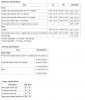
I would suspect the EPAS components as well. This is what I can find in the suspension/alignment specs from the FSM:

Upload 2016 2 5 22 50 28
Alignment Specifications

Item LH RH Total/Split
Front

Camber (all except SE vehicles with 17 in wheels) -0.40° ± 0.75° -0.60° ± 0.75° 0.20° ± 0.75° a
Camber (SE vehicles with 17 in wheels) -0.50° ± 0.75° -0.70° ± 0.75° 0.20° ± 0.75° a
Caster (all except SE vehicles with 17 in wheels) 3.20° ± 0.75° 3.40° ± 0.75° -0.20° ± 0.75° b
Caster (SE vehicles with 17 in wheels) 3.10° ± 0.75° 3.30° ± 0.75° -0.20° ± 0.75° b
Toe (positive value is toe in, negative value is toe out) — — 0.20° ± 0.20°
Rear
Camber -1.00° ± 0.75° -1.00° ± 0.75° 0.0° ± 0.75° b
Toe (positive value is toe in, negative value is toe out), All Vehicles 0.12° ± 0.20° 0.12° ± 0.20° 0.24° ± 0.20°
Thrust Angle — — 0.0° ± 0.30°
a Camber Total/Split = LH Camber - RH Camber
b Caster Total/Split = LH Caster - RH Caster
 

SHO_Fast

Meet the new Boss...
Joined
Jul 3, 2014
Messages
60
Reaction score
36
Location
Muskegon MI
Longshot but possible suspension damage as in broke the tie rods, steering knuckle, hub assembly sounds to me like you may have to get a different shop to inspect again and see if something else got jarred loose. If not suspension, maybe the Rack/Pinion assembly or maybe the EPAS module got damaged.

Does the Steering wheel feel like its 30 degrees off of center or the actual tire....Both would be pretty noticeable however sounds like the steering wheel itself would be easier to correct.

Thanks for your input. Your reply sounds much like what the shop said they would do if given the car for the day. After the accident the wheel was cocked 30* to the right, the steering was very touchy and it also felt stiffer. Now that I have the car back from the shop, it has been re-aligned, the wheel is square as it should be and it tracks ok. But now the wheel twitches when you go over the centerline and it -feels- like the front end goes from turning to skidding when turning in snowy/slippery conditions because the wheel does not seem to load up like it used to. It still feels stiff (maybe all in my head) and it definitely reacts differently.

Can you give me some idea of typical (or atypical) symptoms of EPAS or rack & pinion damage? The car seems to run and drive out ok otherwise and I am getting used to it. Outside of the new squirreliness it does not feel unsafe. And I may just be hypersensitive to it since it was hit.

Ticks me off, it was fine before I got hit...
Thank you!
SHO_Fast
 

SHO_Fast

Meet the new Boss...
Joined
Jul 3, 2014
Messages
60
Reaction score
36
Location
Muskegon MI
I would suspect the EPAS components as well. This is what I can find in the suspension/alignment specs from the FSM:

View attachment 1900
Alignment Specifications

Item LH RH Total/Split
Front

Camber (all except SE vehicles with 17 in wheels) -0.40° ± 0.75° -0.60° ± 0.75° 0.20° ± 0.75° a
Camber (SE vehicles with 17 in wheels) -0.50° ± 0.75° -0.70° ± 0.75° 0.20° ± 0.75° a
Caster (all except SE vehicles with 17 in wheels) 3.20° ± 0.75° 3.40° ± 0.75° -0.20° ± 0.75° b
Caster (SE vehicles with 17 in wheels) 3.10° ± 0.75° 3.30° ± 0.75° -0.20° ± 0.75° b
Toe (positive value is toe in, negative value is toe out) — — 0.20° ± 0.20°
Rear
Camber -1.00° ± 0.75° -1.00° ± 0.75° 0.0° ± 0.75° b
Toe (positive value is toe in, negative value is toe out), All Vehicles 0.12° ± 0.20° 0.12° ± 0.20° 0.24° ± 0.20°
Thrust Angle — — 0.0° ± 0.30°
a Camber Total/Split = LH Camber - RH Camber
b Caster Total/Split = LH Caster - RH Caster

Hello SHOdded, thank you for your reply and for pulling those alignment specs. I will definitely take the specs in with me and ask them compare them to what they did and/or what they have on file. From what I can see, aside from the SEL with 17" wheels all Tauri are aligned the same way, SHO or non-SHO.

You also agree with 2011TAURUSSEL in regard to the EPAS. Do you have any specifics you could arm me with?

Thank you for your help!
SHO_Fast
 

2011TAURUSSEL

2014 SHO LMS Stage 1 V10
Joined
Jun 16, 2013
Messages
916
Reaction score
510
Location
DFW Metroplex, USA
Beyond the standard visual check of the R/P unit to check if it was loosened, damaged, etc I am not sure where the EPAS controller is so hopefully someone can chime in soon with that one.
 

SHOdded

SHO Member
Joined
Dec 25, 2011
Messages
9,045
Reaction score
4,390
Location
Maryland
What is the EPAS?

Electronic Power Assist Steering (EPAS) System
The Electronic Power Assist Steering (EPAS) system provides power steering assist to the driver by replacing the conventional hydraulic valve system with an electric motor coupled to the steering rack by a toothed belt. The motor is controlled by the Power Steering Control Module (PSCM) that senses steering effort/use through the use of a torque sensor which is mounted near the input shaft of the steering gear. Steering assist is provided in proportion to the steering input effort and vehicle speed.

The EPAS system requires a 12-volt, hot at all times feed for system operation. The PSCM is activated when power is applied to the hard-wired ignition/run input. After activation, the PSCM monitors the High Speed Controller Area Network (HS-CAN) bus to determine if the vehicle is operating in a manner capable of supporting the EPAS system.

Once this is determined, vehicle speed sent by the PCM over the HS-CAN bus, steering shaft speed and direction sent by the torque sensor and steering wheel angle/position determined by the motor position all provide the necessary information for the PSCM to determine the amount or level of assist provided by the EPAS system.

Assist is primarily based off of vehicle speed. As vehicle speed increases, the amount of assist provided by the system is decreased to improve and enhance road feel at the steering wheel. As vehicle speed decreases, the amount of assist provided by the system is increased to ease vehicle maneuvering. If the vehicle speed is missing or out of range, the PSCM defaults to a safe level of assist for all driving conditions. If the vehicle speed returns to the correct in-range values, the PSCM will adjust the level of assist accordingly. Steering wheel/shaft torque, speed and direction information will allow the PSCM to determine how much assist is needed to turn the wheels right and left.

The PSCM is self-monitoring and has the capability of setting and storing DTCs. Depending on the DTC set, the control module will enter into a "safe mode" of manual steering. In addition, the PSCM may send a request to the Instrument Panel Cluster (IPC) module over the HS-CAN bus to display a message in the message center to alert the driver of a potential EPAS concern.

EPAS Components

The Electronic Power Assist Steering (EPAS) system consists of the following components:
  • Power Steering Control Module (PSCM) — the PSCM controls the functions of the EPAS system and communicates with other modules that are on the High Speed Controller Area Network (HS-CAN) bus. The PSCM is attached to the RH side of the EPAS gear assembly and is not available separately for service.
  • Motor — the EPAS gear uses a 12-volt reversible motor to control the steering effort. The motor is connected to the steering rack by a toothed belt and a pulley/bearing assembly. The motor is used by the PSCM to move the rack inside the gear housing. Motor position is used to determine steering wheel angle/position instead of using a separate sensor. The motor is attached to the RH side of the EPAS gear assembly and is not available separately for service.
  • Steering shaft torque sensor — the steering shaft torque sensor is used by the PSCM to determine how much force the steering wheel is being turned. The sensor sends out 2 signals, one for left and one for right. When the steering wheel is turned to the left, the left signal increases while the right signal decreases, likewise when the steering wheel is turned to the right, the right signal increases while the left signal decreases. This allows the PSCM to determine if the driver intends to go left or right in order to spin the motor in the appropriate direction. The sensor is mounted near the input shaft of the EPAS gear assembly and is not available separately for service.
  • Inner tie rod — one inner tie rod is located at each end of the EPAS gear assembly and is available separately for service. Refer to Section 211-02 .
  • Outer tie rod — one outer tie rod is located at each end of the EPAS gear assembly and is available separately for service. Refer to Section 211-02 .
  • EPAS gear bellows boot — one bellows boot is located on each side of the EPAS gear assembly. Each boot is held in place with 2 boot clamps. The boots and clamps are available for service, refer to Section 211-02 .
  • EPAS gear isolators — there are several rubber isolators (one at each attaching point) on the EPAS gear assembly. These isolators aid in reducing NVH concerns and not available separately for service.
The EPAS system utilizes a rack-and-pinion type steering gear. Power assist is provided by a motor that is connected to the steering rack by a belt and a pulley and bearing assembly. The steering gear and motor/module are serviced as an assembly. A new steering gear includes inner tie rods, however, the inner and outer tie rods can also be serviced separately. For information on tie-rod end service, refer to Section 211-02 .
Since wheel speed sensors are used to determine vehicle speed, have the sensor and wiring checked on both front wheels. Might be a bad or intermittent connection involved. If that checks out, move on to the drive axle and hub on that side. Though the hubs are not a particularly weak spot on the 2010-12's, still could have a problem caused by the sudden physical "misalignment" from the accident. If the body shop can't find anything, have a trusted mechanic do a thorough diagnostic.

This article on EPAS is for the F150, but still useful for the SHO:
http://articles.sae.org/8912/
 
Last edited:

SHO_Fast

Meet the new Boss...
Joined
Jul 3, 2014
Messages
60
Reaction score
36
Location
Muskegon MI
What is the EPAS?


Since wheel speed sensors are used to determine vehicle speed, have the sensor and wiring checked on both front wheels. Might be a bad or intermittent connection involved. If that checks out, move on to the drive axle and hub on that side. Though the hubs are not a particularly weak spot on the 2010-12's, still could have a problem caused by the sudden physical "misalignment" from the accident. If the body shop can't find anything, have a trusted mechanic do a thorough diagnostic.

This article on EPAS is for the F150, but still useful for the SHO:
http://articles.sae.org/8912/

Hey SHOdded, thank you for digging up that information on the EPAS, it was very informative. I am going to check the car tomorrow for DTC codes. I will also be having work done on it next Wednesday and I will see if they are familiar with diagnosing the wheel speed sensors.

The initial alignment work after the accident was farmed out by my body shop to a long time, well known, local auto repair house that the body shop has used for ages, and I have no issues with them or their work. However this afternoon I took it over to my local multi-location tire store, where I had purchased the current set of tires and had an alignment done at the time, 1.5 years ago. I asked them to take a look at the car. They reported all looked good and the front end was within spec. However all four tires are worn in a very unusual manner, with a high crown on the second rib from the inside, and the inside shoulder worn down. They had no explanation for it other than a possible issue with the tires and/or struts and shocks, which were all installed at the same time and have just over 44,000 miles on them.

Long story short, next Wednesday the 10th I will be installing 4) new Pirelli Cinturato P7 Plus tires, new shocks and new struts at a fraction of what I paid for the same work 1.5 years ago! Everything will be replaced under warranty, pro-rated for the tires, lifetime for the struts/shocks, plus labor and alignment.

This is a good place to start with this mess and it will be interesting to see how the car runs out after the tire and strut work.

In the meantime I will also be looking into EPAS diagnostics. It would be good to be certain that it is working properly.

My thanks to you SHOdded and 2011TAURUSSEL for all of your help.
Have a good evening,
SHO_Fast
 

SHO_Fast

Meet the new Boss...
Joined
Jul 3, 2014
Messages
60
Reaction score
36
Location
Muskegon MI
Good luck, hope your efforts pay off in full :thumb:
Thank you sir, your help is greatly appreciated! I will post an update next weekend after I have had a chance to drive the new set up.

Have a great evening,
SHO_Fast
 

2011TAURUSSEL

2014 SHO LMS Stage 1 V10
Joined
Jun 16, 2013
Messages
916
Reaction score
510
Location
DFW Metroplex, USA
Even with only a partial winter in the snow belt....(PA,MD,OH,IN) I can definitely give my endorsement to the Pirelli Cintaurato P7 low noise, good traction, low noise dry and excellent traction and handling for dry, wet, snow and that rare possible patch of black ice. Although the last one if the traction control and AWD work correctly you will never know it. Good luck on the other items. I am no sure what shocks they use but if possible try to get Bilstein I have had excellent luck with them on previous vehicles. I think Monroe would be a close second.
 

2011TAURUSSEL

2014 SHO LMS Stage 1 V10
Joined
Jun 16, 2013
Messages
916
Reaction score
510
Location
DFW Metroplex, USA
I would give ShO odded most of the credit he researched the articles, I just led you down the path of some hopefully obvious corrections. I invite both of you to Ford Nationals in Carlisle, PA SHOFast google it,
 

SHO_Fast

Meet the new Boss...
Joined
Jul 3, 2014
Messages
60
Reaction score
36
Location
Muskegon MI
Even with only a partial winter in the snow belt....(PA,MD,OH,IN) I can definitely give my endorsement to the Pirelli Cintaurato P7 low noise, good traction, low noise dry and excellent traction and handling for dry, wet, snow and that rare possible patch of black ice. Although the last one if the traction control and AWD work correctly you will never know it. Good luck on the other items. I am no sure what shocks they use but if possible try to get Bilstein I have had excellent luck with them on previous vehicles. I think Monroe would be a close second.

First, thank you 2011TAURUSSEL for your valuable input above also, you were a big help too. Secondly, I concur with you re: the Pirelli tires. This is what is on my car now and I have been very pleased with them. One of the guys at work has a 2010 SHO w/ 20" wheels. He put a set of the P7's on and loves them also.

As for the shocks they are Monroe SensaTrack, which I believe are their best. I also asked if there were different units for SEL vs. Limited vs. SHO etc. and apparently they only list one model for all Tauri. Since everything (tires and shocks) is being replaced under warranty, I will stick with what I have and minimize out of pocket costs.

Trying not to lose sight of the original goal, which was to figure out what went wrong in the front end of my car, this is a relatively inexpensive way of getting fresh suspension and rubber under the car. Good for another couple of years anyway.

Got to wondering as I was writing this, whether the body or tire shop swapped the left and right front tires side to side, if that might make a big difference. Seems to me the tires are uni-directional and rotated front to rear not side to side once installed. Any thoughts? I can't verify this at the moment, perhaps I am all wet.

As always, have a good evening,
SHO_Fast
 

SHO_Fast

Meet the new Boss...
Joined
Jul 3, 2014
Messages
60
Reaction score
36
Location
Muskegon MI

Forum statistics

Threads
107,077
Messages
1,181,195
Members
16,141
Latest member
grapnelg

Members online

No members online now.
Back
Top