GH Tuning and 100% meth injection don’t mix.

Disclaimer: Links on this page pointing to Amazon, eBay and other sites may include affiliate code. If you click them and make a purchase, we may earn a small commission.

802SHO

Boost > VE, MBT, Cams
Supporting Member
Joined
Oct 8, 2019
Messages
3,272
Reaction score
7,833
Location
Essex Junction Vermont
Matt Robinson from GearHead Tuning keeps pushing this strange idea that methanol injection doesn’t need to be tuned for, or that it should only be used for cooling. It’s the kind of statement that sounds safe on the surface, but it defies basic physics and every practical reality of how meth actually works inside a combustion chamber. When you add 100% meth through a proper system, you’re introducing a real, measurable mass of additional fuel, and you’re raising the octane to the equivalent of race gas. That’s not a “minor cooling effect,” that’s a full-blown change in the fuel energy balance. To pretend that isn’t happening or to let the PCM “sort it out” is the mechanical version of closing your eyes and hoping the engine magically adjusts. Engines don’t run on hope. They run on fuel, timing, airflow, and pressure.

What’s even funnier is the claim that people shouldn’t tune for meth because “if the meth fails, the car will blow up.” That’s backwards. You tune meth in stages, you verify the system, you datalog, you build in fallbacks, and you choose a high-quality kit from a brand that has real engineering behind it. You don’t dumb down the tuning, cripple the gains, and lie to customers about how much meth they should use just to protect yourself from liability. If you’re that worried, just say you don’t tune for meth. Don’t rewrite the laws of physics to make it sound like no one should. The real liability isn’t tuning for meth — the real liability is pretending meth is “just cooling” and letting customers drive around rich enough to wash cylinders for tens of thousands of miles.

And then there’s the false-knock circus. For seven years in this platform there was no “false knock epidemic.” Then suddenly there is — but only from one tuning philosophy. Funny how that works. If you run auto octane and build a universal tune that tries to cater to every possible fuel quality from 87 to E30, of course timing strategy gets weird. Of course borderline tables get abused. Of course the PCM will start thinking random noise is detonation. A universal tune is always weaker than a fuel-specific tune — it has to be. You can’t optimize for every condition at once. You can’t get perfect spark control and perfect torque logic when you refuse to commit to a specific fuel. So customers chase ghosts, add E85 because the tune can’t stabilize itself, and convince themselves something is wrong with their engine instead of looking at the philosophy behind the calibration.

Meth gains “without tuning” are the biggest joke of all. People feel something because IAT2 drops like a rock, but they only get the cooling benefit — not the real power. They get half the gains a proper meth tune delivers. And they get all the long-term side effects: over-rich mixtures, diluted oil, extra blow-by, unnecessary ring and bore wear, and sensors seeing a fuel curve that was never corrected. The whole reason meth is such a powerful mod on the SHO is because it replaces 10–20% of your fuel mass under boost and raises octane so you can run more timing and more boost safely. If you don’t tune for it, you’re literally running the worst possible version of meth — all the extra fuel with none of the optimization.

The part that makes me shake my head is how confidently all this gets preached to the community. Half the platform now repeats this “cooling only” logic like gospel. Meanwhile the people who actually understand meth, people like Juan from Alky Control or anyone who built a fast SHO in the last decade, know exactly how much meth volume is required for a meaningful effect. Five hundred cc isn’t doing anything special on a 4,000-pound twin-turbo V6. Fifteen hundred cc is where the physics say the system starts to matter. That’s not opinion; that’s empirical. That’s experience. That’s what people who actually go fast do.

And the irony is thick. The whole “no meth tuning” stance is supposed to avoid liability, but it actually creates a different kind of liability — a quieter, slower, more destructive one. Because if you actively tell people not to tune for a huge shift in effective fuel and octane, you’re not protecting the engine. You’re just protecting yourself. Customers aren’t paying for padded safety; they’re paying for results. They’re paying for truth. They’re paying for accuracy. And instead they get a universal tune, a watered-down strategy, and a platform-wide misunderstanding about what meth actually does.

That’s the part that bothers me. Not the philosophy, not the risk avoidance — it’s the misinformation. Let people make an informed decision. Tell them you won’t tune meth if that’s your stance. Don’t redefine thermodynamics to justify a shortcut. Don’t pretend “cooling only” is real tuning. And definitely don’t act shocked when someone who has actually run meth for years points out the holes in the logic. If anyone should understand the consequences of running an engine too rich for too long, it’s an engineer.
 

802SHO

Boost > VE, MBT, Cams
Supporting Member
Joined
Oct 8, 2019
Messages
3,272
Reaction score
7,833
Location
Essex Junction Vermont
Matt often responds with a lot of detail that doesn’t actually address the core technical issue being discussed. The disagreement here isn’t about whether a system can run with methanol present — it’s about whether a meaningful amount of methanol should be intentionally accounted for in calibration. That distinction matters, because methanol is not just a cooling agent. It is fuel mass and octane, and it directly alters combustion behavior.

The reason this discussion keeps resurfacing is because your public explanations frame methanol as something that doesn’t require specific tuning consideration, often described as “cooling only.” From a combustion and calibration standpoint, that framing doesn’t hold up. When a system is delivering real meth volume at pressure, the effective fuel energy and knock margin change. That necessarily affects lambda targets, spark requirements, and overall optimization. Saying the ECU can simply absorb a 10–20 percent shift in effective fuel and octane without calibration changes isn’t a physics-based position, it’s a risk-avoidance philosophy.

There’s nothing wrong with choosing not to support methanol as a power adder. That’s a business and liability decision, and every tuner is entitled to draw their own boundaries. The issue arises when that decision is presented as a technical truth rather than a choice. A system delivering meaningful meth flow does have tuning implications, whether those implications are acted on or not. Pretending otherwise doesn’t make them disappear.

What also tends to get overlooked is the long-term mechanical side. Running supplemental fuel without accounting for it can lead to richer overall mixtures than intended, increased oil dilution, cylinder wash, and accelerated wear over time. Avoiding a rare catastrophic failure by leaving performance on the table doesn’t automatically mean the engine is being treated optimally. It just shifts the risk into a slower, less visible category.

The same pattern shows up in auto-octane calibration strategies. A tune designed to accommodate a wide range of fuels cannot be optimized for any one of them. That trade-off is real and unavoidable. Conservative spark strategies may preserve compatibility, but they also reduce precision and can introduce knock control behavior that looks like “false knock” when the system is constantly walking a wide safety margin. That’s not mysterious, and it’s not random — it’s a consequence of trying to make one calibration serve too many masters.

None of this is personal. It’s a technical disagreement about methodology. Properly tuned methanol systems are well understood across many platforms and have been for years. When meth is treated as fuel and octane and calibrated accordingly, it delivers real gains with controlled risk. When it’s treated as “cooling only,” the result is a compromised middle ground: some safety benefit, reduced performance benefit, and unaddressed long-term effects.

If the position is that methanol shouldn’t be tuned for, that should be stated clearly as a policy choice. What shouldn’t happen is redefining how methanol behaves in an engine to justify that choice. Customers and the community are best served by clear distinctions between what physics requires and what a particular tuning philosophy is willing to support.
 
Last edited:

kryptto

The Best Thing About Cars... ones in my mirror.
Supporting Member
Joined
Mar 24, 2023
Messages
3,201
Reaction score
2,072
Location
South East, Florida
It was your convo about tuning your car that concerned us..... not mine to share and not forcing you to explain however in light of this.
 

802SHO

Boost > VE, MBT, Cams
Supporting Member
Joined
Oct 8, 2019
Messages
3,272
Reaction score
7,833
Location
Essex Junction Vermont
I brought this topic hear among intellegent level headed members. Who aren’t swayed by smoke and mirrors and lost in irrelevant technical jargon. But mostly bc here someone can read and respond and not resort to personally attacking me for setting the record straight.
 

BradM

SHO Member
Joined
Dec 22, 2022
Messages
377
Reaction score
339
Location
60010
This is an interesting and fact-based read which certainly supports my experience and opinion that there are a lot of "internet tuners" who operate outside their area of expertise and simply parrot unproven myths. If you are tuning with alternative fuels then I need to see a resume, period. You need to be the lead tuner on drag team XYZ who runs on an alternative fuel. Putting aside Matt's response to this, I'd like to see his resume first. Just selling tunes on-line would not be enough for me. Care to indulge us Matt?
 

802SHO

Boost > VE, MBT, Cams
Supporting Member
Joined
Oct 8, 2019
Messages
3,272
Reaction score
7,833
Location
Essex Junction Vermont
What hits me hardest about all this methanol nonsense is that I’ve lived the difference between “spray it for cooling only” and “properly tuned meth.” I’ve actually been on both sides of it. My first meth tune years ago with Livernois was basically the same thing these guys preach now: no boost change, no timing change, and definitely no leaning out the mix to let the meth carry its part of the load. The car ran fine, but it was half a tune. The only real gain was the massive IAT2 drop, which anyone gets the moment meth hits the charge air. That’s physics. But it wasn’t the power I built the system for.

Then I switched tuners. Same car, same parts, same pump, same tank, same nozzles. The only thing that changed was the calibration and the understanding of how meth is actually supposed to be used. And what happened? The power was night and day. A different car. It finally matched the potential of the hardware. And that right there is why this whole new wave of misinformation irritates me. People deserve to know what’s possible, and they aren’t getting told the truth.

So when I see tuners and their followers repeating this idea that meth doesn’t need tuning, that it’s “just for cooling,” that it’s somehow safer to leave all the power on the table and let the ECU deal with a huge unmetered fuel swing… I have to speak up. Not because I’m trying to fight with anyone, but because the logic is broken. It defies basic engine physics. If you add a major source of fuel and octane and don’t calibrate for it, you aren’t playing it safe. You’re quietly causing long-term damage from running excessively rich under load. Fuel dilution. Ring wash. Blow-by. Contaminated oil. It’s the slow, invisible kind of damage that doesn’t show up until the engine is tired, not the instant meltdown everyone is apparently terrified of.

And what really bothers me is how confidently this stuff is repeated. People think they’re protected because the tuner refuses to tune meth. But no, the customer just gets a system that isn’t being used correctly and is delivering a fraction of its potential. They think they’re safe. They’re not told they’re actually running blind. They’re not told they’re using a setup equivalent to installing a blower and running two psi. They’re not told the nozzle they were advised to use isn’t even in the effective range for maximum detonation resistance or meaningful fuel mass. They’re not given the choice. And that’s the real problem.

For me this isn’t theoretical. I’ve seen both outcomes with my own car. One tune left power on the table and felt incomplete. The next tune was fully dialed for the methanol mass flow and transformed the car into what I wanted in the first place. And now, years later, I’m watching people get fed the same dismissive logic that kept my own car artificially limited in the beginning. That’s why I’m vocal about it. Someone has to set the record straight so people don’t spend money on hardware only to get half the performance it’s capable of and long-term consequences nobody warns them about.

It’s not about bragging. It’s not about being “right.” It’s about the fact that I know exactly how much difference proper meth tuning makes, and I know exactly how much people are losing by following this watered-down tuning philosophy. I won’t just sit quietly while a whole group of people gets misled into thinking that’s how meth is supposed to work, or worse, that they’re safer because of it. I’ve been on both sides — that’s why I’m speaking up.
 

mattr66usa

Active Member
Joined
Nov 22, 2025
Messages
145
Reaction score
108
Location
Texas
I guess the Facebook crowd booted you (except your little group that you control). Don't you have something better to do than put words in my mouth and try to drive customers from my business? What is your game Andrew? New tuner (Ryan) offering to give you free tunes for trying to drive business from me? I've seen this before and that says a lot about that person if so.

Let's give a little bit of factual information to counteract your misunderstanding of how I tune....

1. The AO tune does not go up to E30, that is a dedicated file for reasons you don't obviously understand.
2. There are wideband O2 sensors on the car that can quickly tune out the additional fuel.
3. Once the OAR is maxed, on the methanol capable tune, the knock sensors can add timing up to the MBT point that I set.
4. On a full competition car, I have tuned for full meth utilization where it is acting as an actual fuel source, but I don't recommend that to customers unless they have the boost dump solenoid that is offered on some systems.

Please stop showing everyone your lack of knowledge of how these systems work buy trying to disparage me and my business.

Regards,
Matt

BTW, here is the full explanation I posted on Facebook:
Alright.... Since someone is calling me out because he thinks I'm doing something wrong, let's talk about meth injection. Methanol has a lower MBT (look it up if you are unfamiliar) than gasoline so you actually run less timing with it vs race fuel all else equal. So how is allowing the knock sensors to add timing up to a maximum I set such a terrible thing? Okay so there is the extra timing for meth available as well. It just takes a sustained wot blast of a few seconds to get there with the way I do it.... Big deal! The timing difference at say 18 lbs of boost between pump gas and full meth timing at WOT is around 5 degrees on average above 4000 rpms. So I let the knock sensors add it.

And this fuel wash you are referring to..... Where do I start. Wideband on these cars is a wonderful thing. So let's say that the meth is making up 20% of the fuel and you don't "tune" for it. The meth comes on at 8 psi and progressively comes on until maximum at 14 psi or so. The engine isn't being "flooded" with fuel as you insinuated. The mixture may dip down to .78 lambda or so (which happens to be the factory wot mixture) until the widebands quickly pull the fuel out of the factory injectors to bring the mixture back to the commanded value.
The beauty of this is that the tune can run with or without the meth flowing and not hurt anything. The methanol adds octane and air density. Yes you leave a tiny bit of ET on the table until the timing has a chance to catch up, but it sure beats the alternative of engine damage when the meth stops flowing.

Is this making the most power possible under all conditions? Nope. Are 99% of my customers hoping to drive their cars home after playing or tracking? Yep! Since the PCM has no idea if the meth is actually flowing and how much, my way is much safer.
 

802SHO

Boost > VE, MBT, Cams
Supporting Member
Joined
Oct 8, 2019
Messages
3,272
Reaction score
7,833
Location
Essex Junction Vermont
Matt, let me be absolutely clear so this doesn’t get twisted into some imaginary tuner-war. This has nothing to do with any other tuner, no one offered me anything, and nobody put me up to anything. This is about one thing only: the way methanol tuning is presented publicly and how your AO system contributes to ideas that spread widely across the platform. That’s what I addressed, and that’s what I’m continuing to address.

You’ve said I’m putting words in your mouth, but what I commented on comes directly from positions that have been repeated publicly for years: that tuning for meth isn’t necessary, that it’s primarily for cooling, that small nozzles and diluted mixes are preferred, that the PCM should “deal with it,” and that knock sensors will add timing as needed. That framework is what leads to limited performance outcomes and unrealistic expectations about what methanol is actually doing. If someone is running meaningful meth flow, the increase in fuel mass and effective octane requires intentional calibration. That’s physics, not preference. If the goal is to limit usage for conservatism, that’s a valid choice — but it shouldn’t be framed as the optimal or complete approach.

Your own explanations highlight the tension here. You acknowledge that methanol changes combustion behavior and creates additional knock margin, yet the strategy relies on the ECU gradually adapting rather than placing the engine directly in an optimized window. For short pulls, street use, or roll racing, that means the system often never reaches the conditions where meth’s benefits are fully realized. Any performance difference appears small largely because the calibration never uses the methanol aggressively or deliberately.

The wideband argument doesn’t resolve this either. While widebands can correct AFR quickly, they don’t account for the broader effects of introducing a significant supplemental fuel source. AFR correction alone doesn’t address airflow modeling, torque calculation, combustion phasing, or altered knock thresholds. Those require calibration choices, not just feedback correction.

The same tradeoff exists in auto-octane strategies. A tune designed to tolerate a wide range of fuels cannot be optimized for any single one. That conservatism has consequences, including less precise spark control and knock behavior that can be misinterpreted as fuel or hardware issues. That isn’t mysterious — it’s the cost of building a calibration that prioritizes coverage over optimization.

You’ve mentioned that full meth utilization has been tuned successfully in certain applications, which reinforces the point that meth can be tuned effectively when it’s treated as a true fuel contributor. The question isn’t whether it’s possible — it’s how consistently that reality is communicated to everyday customers. When those distinctions aren’t clear, people walk away believing meth “doesn’t require tuning,” and that misunderstanding spreads.

None of this is personal. It’s a disagreement over methodology and messaging. Properly tuned methanol systems have delivered real gains across many platforms for decades. When meth is treated as fuel and octane and calibrated accordingly, it works. When it’s treated as “cooling only,” the result is a compromised middle ground. People deserve to understand that difference so they can make informed decisions about how they want to run their cars.

That’s the entire point of this discussion.
 
Last edited:

mattr66usa

Active Member
Joined
Nov 22, 2025
Messages
145
Reaction score
108
Location
Texas
This is an interesting and fact-based read which certainly supports my experience and opinion that there are a lot of "internet tuners" who operate outside their area of expertise and simply parrot unproven myths. If you are tuning with alternative fuels then I need to see a resume, period. You need to be the lead tuner on drag team XYZ who runs on an alternative fuel. Putting aside Matt's response to this, I'd like to see his resume first. Just selling tunes on-line would not be enough for me. Care to indulge us Matt?
I don't think I need to divulge my complete resume to you guys. But..... I have a degree in engineering technology and have been into cars since I was 13 where I had a job rebuilding carburetors for my local shop that wasn't very good at it, built a few engines and transmissions along the way, did some vlavetrain and cam design and got into tuning in 2004. Started a business in 2007 that has been tuning ever since. Been featured on a couple of TV shows, and entertain myself at 47 years old by rebutting people trying to say I don't know how to tune.

Hope that helps,
Matt
 

802SHO

Boost > VE, MBT, Cams
Supporting Member
Joined
Oct 8, 2019
Messages
3,272
Reaction score
7,833
Location
Essex Junction Vermont
Matt, your resume is noted, but it doesn’t address the core issue. Experience isn’t the same thing as transparency, and listing credentials isn’t an answer to the technical points raised. Nobody questioned whether you’ve been around cars. The conversation is about the logic and physics behind your methanol approach, the messaging you put into the community, and the downstream results that follow from it.

You keep framing this as a matter of people not understanding your method, but the concern isn’t about misunderstanding your tuning style — it’s about the consequences of it. When someone chooses to run methanol, they are expecting one of two things: a meaningful performance gain or an intentionally conservative strategy. Those are valid paths, but only when they are clearly communicated, not implied through omission.

You’ve shaped a large portion of the community into believing that methanol tuning is optional, that the PCM will simply adapt, that the widebands will “pull back,” and that this approach is inherently safer. Except the physics don’t support that conclusion. The PCM cannot detect meth flow, cannot validate meth volume, cannot distinguish airflow density change from octane change, and cannot protect the engine from long-term enrichment effects that never get corrected because the tune wasn’t built to utilize the added fuel mass in the first place. These limitations are well understood at an engineering level.

That’s why your explanation raises more questions than it answers. If meth makes up 15–20% of fuel supply under boost, and calibration changes are intentionally avoided, then the strategy relies almost entirely on post-event wideband correction and knock-sensor reaction instead of proactive control. That isn’t eliminating risk — it’s shifting it from immediate knock to long-term cylinder and oil contamination. The community believes this method removes risk. In reality, it redistributes it.

You also frame the timing strategy as “letting the knock sensors add timing,” but that approach does not fully utilize the value methanol brings. A measurable amount of power and efficiency remains unused when the calibration is not intentionally designed around the added fuel and octane. If that is the chosen approach, it should be stated directly so customers understand what they are receiving and what they are not.

My only goal in speaking up is clarity. None of this is about any other tuner, or about your business, or about anyone attempting to “drive customers” anywhere. It’s about ensuring that people understand what they’re actually getting. If your method is truly safer and more effective, it should stand on its own technical merit. If it only stands when supported by credentials alone, that speaks for itself.

Respectfully.
 
Last edited:

mattr66usa

Active Member
Joined
Nov 22, 2025
Messages
145
Reaction score
108
Location
Texas
Matt, let me be absolutely clear so this doesn’t get twisted into some imaginary tuner-war. This has nothing to do with any other tuner, no one offered me anything, and nobody put me up to anything. This is about one thing only: the way you present methanol tuning to the public and the way your AO system encourages misinformation that spreads everywhere. That’s what I addressed, and that’s what I’m continuing to address now. So keep this focused where it belongs.

You said I’m putting words in your mouth, but everything I commented on comes directly from the logic you’ve repeated for years: “tuning for meth isn’t necessary”, “just use it for cooling”, “keep the nozzle small”, “50/50 is safer”, “let the PCM deal with it”, and “knock sensors will add the timing”. That philosophy is exactly what produces half-power results, false expectations, and the long-term side effects people don’t notice until their motors aren’t as healthy as they think. You can’t have it both ways. If someone’s truly running meaningful meth flow, the fuel mass increase and octane increase demand actual calibration. That’s physics, not preference. If you intentionally limit people to tiny volume and diluted mixes solely for safety, then just say that. But don’t frame that limited setup as the “correct” way and act like tuning meth out of the equation is magically optimal. It isn’t.
Wrong, if you could actually comprehend what I wrote, you will understand that this isn't the case.
Your own explanation proves the contradiction. You say methanol has a lower MBT than gasoline so more timing isn’t really desirable, yet in the same breath you acknowledge the combination of octane increase and charge cooling creates a timing window about five degrees higher at WOT. So you’re admitting that real gains exist but then brushing it off as “knock sensors will add it when they get around to it.” That isn’t tuning for meth, that’s trying to let the ECU stumble toward the right number after a few seconds of WOT. And for people running short pulls, street hits, or roll races, that means they are literally never reaching the power the system is capable of. They’re getting a chopped-down version of what the hardware provides because the calibration never puts them in the optimized window from the start. You call the lost ET “tiny”, but that’s entirely because the tune never uses the meth correctly in the first place.
Again you obviously don't understand what MBT timing is. MBT timing is if you had unlimited octane the point of diminishing returns where the power doesn't increase with the rise of cylinder pressure. I said the MBT on alcohol added to the mix is less than the MBT of race fuel. So the timing is more than on pump gas when you run methanol. Again, you are putting words into my mouth.
Your wideband argument doesn’t hold up either. Yes, widebands correct rich spikes, but pretending that covers the entire impact of introducing 20 percent of extra fuel mass is just wrong. You can correct AFR quickly, but you cannot magically correct the airflow modeling, the torque model, the combustion phasing, or the changed knock threshold without intentional calibration. AFR correction is not meth tuning. AFR correction is the bare minimum the ECU does to keep the motor alive. Pretending that AFR alone accounts for the real dynamics of meth’s contribution is where your logic falls apart.
The increased timing being run does in fact automatically change the torque modeling on Ford applications.... so wrong again.
You also frame your method as “safer,” but safety isn’t defined as leaving power on the table. The real safety decision is whether you should support meth at all. And if you genuinely believe full meth utilization is risky, then the responsible approach is to tell customers, plainly, that you don’t tune for full utilization. It’s not responsible to recommend tiny nozzles, diluted mixes, and partial usage while letting customers believe they have a complete meth setup. That’s not transparency. That’s managing liability by keeping the system intentionally underpowered. And doing that while selling performance parts does create confusion about what “performance” actually means to the people buying your work.
On a street car, full meth is just fine and up to a 20% fuel substitution ratio where diminishing returns begin. If you are on a race application, things are different and that is just a small fraction of the people running methanol on a street car.
You bring up the competition cars where you “have tuned full meth utilization,” which actually proves my point. You know exactly how to tune it when you want to. You just choose not to for most people. That’s fine, but again, say that plainly. Because the moment you say you only do real meth tuning for a select few, it becomes obvious the limitation isn’t physics, it’s your business approach. And that’s why I called it out. Customers deserve to know when they’re getting a capped system versus a fully optimized one. When they don’t know, misinformation spreads, and we’re right back to people telling each other “meth doesn’t require tuning”, which defies everything we’ve learned from every proven high-power platform since the early 2000s.
So you are telling me on a stock turbo car where airflow is the limiting factor, you can keep making more power as long as you keep adding timing (well past MBT) with big meth flow?
None of this is personal. None of this is about another tuner. None of this is about driving business anywhere. It’s about the fact that your method has become the internet gospel, and it misleads people into thinking that half-use of a system is the same as full tuning. That’s why I’m setting the record straight. Because I lived through it personally — the difference between untuned meth and properly tuned meth is night and day. Same parts, same car, same hardware, completely different engine. That experience is exactly why I’m pushing back. People deserve to know the truth so they can make informed decisions. If someone wants to run meth only for cooling, great. If someone wants the real performance, that should be a real option too. But they shouldn’t be led to believe the capped version is the complete picture.
NO, I inform people of the way I see it on something they need to drive home at the end of the fun, so I let them make the decision.
And you made it personal for some reason. I've never said anything to you that wasn't factual..... but you made it personal.1763853468973
That’s the whole point of this discussion.
I don't know what the point is when you are clearly wrong about a lot of stuff. The AI you have been absorbing is skewing your reality.
 

mattr66usa

Active Member
Joined
Nov 22, 2025
Messages
145
Reaction score
108
Location
Texas
Are you done or was your resume your Hail Mary?
The other guy asked for one.... I don't need a Hail Mary when arguing with facts against someone that thinks they have facts but are really wrong....
 

802SHO

Boost > VE, MBT, Cams
Supporting Member
Joined
Oct 8, 2019
Messages
3,272
Reaction score
7,833
Location
Essex Junction Vermont
Matt, I understood exactly what you wrote. The problem isn’t comprehension, it’s that the explanation doesn’t address the underlying contradiction. You’re defending a strategy that leaves timing, combustion phasing, and torque modeling reactive instead of calibrated. I’m pointing out the consequences of that approach, not putting words in your mouth.

You keep saying I don’t understand MBT, but what I’m telling you has nothing to do with MBT itself. It’s about the gap between “theoretical MBT with unlimited octane” and the real-world timing window created when meth increases knock tolerance. Whether that window is +5 degrees or +2 is irrelevant. What matters is that the window exists, and in your method the calibration never places the engine there intentionally. It waits for the knock sensors to crawl toward it. That isn’t tuning. That’s letting the ECU feel around in the dark until it finds the ceiling. For anyone who isn’t doing a 5+ second WOT pull, they never see that extra power at all. That’s why I call it a half-utilized system.

On the wideband point, AFR correction doesn’t equal meth tuning. The wideband can correct the mixture, but AFR alone doesn’t fix the airflow model, it doesn’t fix the torque model until after the fact, and it doesn’t fix combustion phasing. You said yourself that the mixture may dip to .78 until corrections pull it back. That dip is evidence the underlying tables are not mapped for the added mass flow. Correcting rich spikes is not a substitute for calibrating the areas meth actually affects: knock threshold, charge temperature sensitivity, timing targets, borderline tables, and proper fuel substitution ratios. These are separate concepts. AFR correction is the band-aid; meth calibration is the architecture.

You brought up torque modeling changing “automatically” with timing, and that is true in the most surface-level sense — Ford torque models adjust with spark. But that’s not the same thing as modeling the real airflow and real fuel mass that meth adds. The PCM’s torque inverse system isn’t a genie. It doesn’t magically update load, inferred torque, and temperature tables to reflect the cooling and fuel contribution of meth. It adjusts torque output based on timing delta, not on the altered combustion environment. Those are not interchangeable.

Your safety argument is where this becomes the most confusing. You say full meth utilization is fine on a competition car and that you’ve tuned it properly when you choose to. That means you know how to do it correctly. But if your position is that full utilization is too risky for most people, then transparency means explaining that plainly, not presenting the capped strategy as a universal best practice. Telling people to run tiny nozzles and diluted mixtures while calling it “safer” only works because they aren’t told they’re getting a limited version of what the hardware is capable of. If the real position is “I don’t tune full meth utilization for liability reasons,” then the honest answer is to tell people that. Let them choose. There’s no harm in saying it directly.

As for airflow being the limiting factor on stock turbos, that doesn’t change the argument. Nobody said you can make infinite power just by adding timing. The point is that when meth increases knock tolerance and reduces charge temperature, it changes how the engine can use its airflow. If you don’t map for it, you never use the window that cooling provides. You only let the knock sensors stumble into it. That’s the missed potential.

And on the broader point — none of this is about another tuner, and none of it is about driving business anywhere. It’s about the fact that your partial-utilization method has become the dominant message online, and people genuinely believe that meth doesn’t benefit from intentional calibration. That’s why I’m pushing back. Because I’ve lived both sides of it personally. Same car. Same parts. Same injection hardware. Untuned meth barely woke the car up. Properly tuned meth transformed it. That experience alone is why I speak up. People deserve to know the difference so they can choose what they want, not what they are steered toward.

You keep insisting I don’t know what I’m talking about, but nothing I said contradicts physics or Ford’s calibration structure. And pointing to AI doesn’t address the technical points. It doesn’t change airflow modeling, torque model behavior, combustion phasing, or how long it takes for knock sensors to reach their ceiling. It doesn’t change the fundamental fact that reactive timing isn’t the same as calibrated timing. If anything, your own explanations confirm that you understand the limitations — you just don’t want to tune past them for most people.

That’s fine. Just say that plainly. That’s all I’ve been arguing for.
 

802SHO

Boost > VE, MBT, Cams
Supporting Member
Joined
Oct 8, 2019
Messages
3,272
Reaction score
7,833
Location
Essex Junction Vermont
The other guy asked for one.... I don't need a Hail Mary when arguing with facts against someone that thinks they have facts but are really wrong....
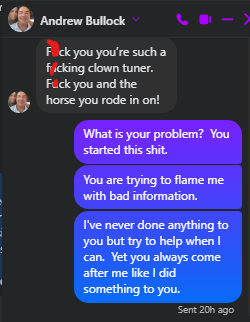
I could go all night you don’t stand a chance and I like that you shared that screenshot of me telling you to go F yourself I mean, I don’t even have to say it again
 

mattr66usa

Active Member
Joined
Nov 22, 2025
Messages
145
Reaction score
108
Location
Texas
I could go all night you don’t stand a chance and I like that you shared that screenshot of me telling you to go F yourself I mean, I don’t even have to say it again
Let the AI tune your car and keep writing your good sounding diatribes that are misguided about this platform. I wish you the best.
 

802SHO

Boost > VE, MBT, Cams
Supporting Member
Joined
Oct 8, 2019
Messages
3,272
Reaction score
7,833
Location
Essex Junction Vermont
Matt, for someone who just listed off decades of tuning, engine building, cam design, and TV appearances, ending the discussion with “let the AI tune your car” is a pretty dramatic downgrade in confidence. If your method were as airtight as you imply, you wouldn’t need to fall back on dismissing the argument by blaming a tool, especially after spending several comments emphasizing how long you’ve been in the industry. The contrast between the resume and the final reply is hard to ignore.

When the technical questions get specific, your responses shift from explaining your logic to explaining your background. And that’s exactly why this conversation matters. You’ve built a strong reputation in the platform, and people rely on what you say. That’s why accuracy matters more than authority. Your method isn’t “wrong,” but it is incomplete, and the moment it’s questioned past the surface level, the foundation shows its cracks.

This isn’t me misunderstanding the platform, and it certainly isn’t AI skewing anything. It’s simply pointing out what your own explanations reveal: you do know how to fully tune for meth, because you’ve done it for competition cars. You just choose not to for the majority of customers. That’s a business decision, not a physics one. That’s the disconnect. You call it safer, but the safety you’re referring to is primarily for the tuner, not necessarily the engine, and that distinction is important for people to understand.

You’re right that customers need to drive home safely. But they also deserve clarity. If someone wants meth strictly for cooling, fine. If someone wants it fully optimized, that should be clearly defined as well, not implied to be equivalent to the partial approach. And dismissing the discussion by pointing to AI doesn’t change the technical realities being discussed. It just avoids them.

Ryan Martin is tuning my car now. He knows it’s a 2010 and didn’t flinch
 

mattr66usa

Active Member
Joined
Nov 22, 2025
Messages
145
Reaction score
108
Location
Texas
You keep saying I don’t understand MBT, but what I’m telling you has nothing to do with MBT itself. It’s about the gap between “theoretical MBT with unlimited octane” and the real-world timing window created when meth increases knock tolerance. Whether that window is +5 degrees or +2 is irrelevant. What matters is that the window exists, and in your method the calibration never places the engine there intentionally. It waits for the knock sensors to crawl toward it. That isn’t tuning. That’s letting the ECU feel around in the dark until it finds the ceiling. For anyone who isn’t doing a 5+ second WOT pull, they never see that extra power at all. That’s why I call it a half-utilized system.
The system works and will carry that timing through the entire run when set up correctly. As I said before, the 2-3 seconds where the gains aren't happening also aren't hurting things.
On the wideband point, AFR correction doesn’t equal meth tuning. The wideband can correct the mixture, but AFR alone doesn’t fix the airflow model, it doesn’t fix the torque model until after the fact, and it doesn’t fix combustion phasing. You said yourself that the mixture may dip to .78 until corrections pull it back. That dip is evidence the underlying tables are not mapped for the added mass flow. Correcting rich spikes is not a substitute for calibrating the areas meth actually affects: knock threshold, charge temperature sensitivity, timing targets, borderline tables, and proper fuel substitution ratios. These are separate concepts. AFR correction is the band-aid; meth calibration is the architecture.
What airflow? it is same airflow on the my "mild" meth tuning whether the meth is running or not. The expansion and cooling in the manifold is automatically figured into the speed density formula with the map and IAT2 sensors and plays into the torque model.
As for airflow being the limiting factor on stock turbos, that doesn’t change the argument. Nobody said you can make infinite power just by adding timing. The point is that when meth increases knock tolerance and reduces charge temperature, it changes how the engine can use its airflow. If you don’t map for it, you never use the window that cooling provides. You only let the knock sensors stumble into it. That’s the missed potential.
Guess what, the temperature drop in the manifold also automatically adds timing and in some cases, the LSPI map will add boost if I allow it depending on the aggressiveness of the tune.

It's time you realize that I have never misrepresented anything to anyone and the limits I put in the tune in no way reflect the limits of my tuning ability. I'm probably the only one of a handful of tuners that actually have successfully tuned a ported head and bigger cams 4 liter ecoboost using a factory computer. Not many can say that. Is more than setting the cubic inches in the tune for the new engine size btw. I understand way more about this platform than you can imagine sir....
 

802SHO

Boost > VE, MBT, Cams
Supporting Member
Joined
Oct 8, 2019
Messages
3,272
Reaction score
7,833
Location
Essex Junction Vermont
Matt, your résumé isn’t the issue. Nobody questioned whether you’ve been around cars or whether you’ve tuned platforms. The discussion here is about the internal logic of what you’re claiming, and that logic still doesn’t line up. Listing your background doesn’t resolve the inconsistencies in your own explanations — it just sidesteps them.

You keep repeating that “the system works,” but the problem isn’t whether it functions, it’s whether it’s optimized. The entire disagreement is that your method depends on adaptation rather than intention. You rely on widebands to correct the added mass flow, rely on LSPI logic to add boost if conditions allow, rely on charge-temp effects to add timing, rely on knock sensors to climb toward the ceiling. But none of that is meth calibration — it’s the ECU reacting to disturbances. Those reactions are safeguards, not tuning strategy.

And when you say “what airflow?”, you’re demonstrating my exact point. The airflow doesn’t magically stay the same because the ECU corrects AFR. Cooling, density changes, and octane changes all affect the torque model, combustion phasing, and borderline timing. That’s the entire reason meth is powerful when tuned intentionally. You keep referring to those changes as things the ECU “automatically figures out,” but that’s not how model-based systems work. The ECU only reacts to inputs within the model you give it. It doesn’t rewrite the model for you. Treating AFR correction and temp-compensation as a substitute for direct calibration is exactly why people experience half-usage — because the tune never actually maps the areas meth affects.

You also didn’t answer the core contradiction. You say meth has a lower MBT than race fuel, but at the same time you acknowledge that meth raises knock tolerance enough to support several additional degrees of timing over pump gas. Those two statements aren’t mutually exclusive — but your method ignores the second one. The fact that you let the knock sensors wander into that window at their own pace instead of commanding it directly is the entire reason people never see full utilization unless they do sustained pulls. That isn’t misunderstanding MBT. That’s identifying the objective gap between reactive control versus intentional tuning.

And the transparency point still stands. You openly admit you tune full meth utilization on competition cars, which proves you understand exactly how to do it. But your standard approach deliberately avoids that. That’s fine if you explain that clearly to customers. But when most people walk away thinking they’re running a fully tuned meth system when they aren’t, misinformation spreads. That’s the entire reason I’m pushing back: not to attack you, but because the community deserves clarity. People deserve to know when they’re running a capped setup instead of a fully optimized one. That isn’t personal. That’s just honesty about what they’re paying for.

Your final comment — “the AI skewing your reality” — says more about how cornered you feel than anything else. If the argument was wrong, you would dismantle it directly with logic. But so far, every rebuttal has leaned on résumé, misdirection, or rephrasing the same claim without addressing the underlying contradiction.

Respectfully,
Andrew
 
Back
Top