I've brought rubydists responses about this intermittent smoking/oil separator sloshing/catch can together here to ask a few more questions.
It is not smoking out the tailpipe from valve stem seals. On this engine, with the way the shim cap fits over the top of the valve stem, they use almost no oil even with ruined valve stem seals. I have taken apart engines that did not smoke and the exhaust valve stem seals were all totally gone (all the rubber was gone).
What you are describing is much more likely that there is enough oil in the "oil separator" that in certain cases (how you turn or the angle of the car) it will **** some of that into the intake and cause it to smoke. A catch can is a very good idea anyway on this engine.
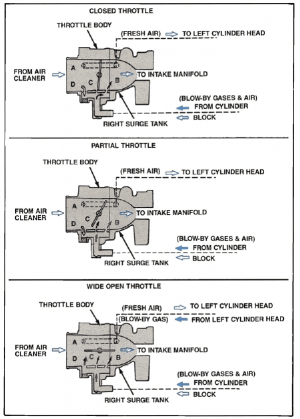
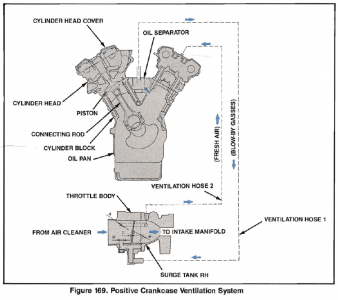
Modern emission controlled engines do not vent crankcase pressure (blowby) to the atmosphere, they recycle it into the intake via the pcv valve (positive crankcase ventilation). On the SHO engine, that is different from many engines in that it consists of a hose to a rectangular enclosure (oil separator) under the intake manifold that is supposed to separate out the oil so as to minimize the amount of oil ingested by the intake. This does not work as well as it might, as the oil separator tends to collect a good amount of oil, some of which can get sucked into the intake in excessive amounts in certain situations. This can be improved by installing a catch can. The catch can is designed in such a way that the blowby and oil mixture enters the catch can and the flow takes a sharp turn, which tends to separate the oil out of the mixture and allow it to be captured in the can rather than being sucked into the engine. In the SHO engine, the catch can should be installed before the oil separator. If you search online for "catch can" you will see examples of what this is and how they are installed.
The catch can needs to be emptied from time to time. Its not a difficult job to do, except that the hose to the oil separator will likely be hard as a rock from being roasted for 20 years, so it will be hard to get off.
The catch can will fill with oil over time. Depending on the exact style of the catch can you obtain, they typically unscrew or unclip the "pail" from the "head" so you can dump the oil out of the "pail" part, at which point you can clean it as you wish. If you never empty the catch can, eventually it fills up with oil so the oil is carried into the factory oil separator just like it is now.
Additional Quesstions:
Can the oil separator be checked to see if its full as a first step?
If it is full, should or can it be emptied as part of the job along with replacing the hose, PVC valve, and putting the catch can in.
What would be a fair price for this job - just a ballpark?
Can most professional mechanics do this work?
And does the intake manifold have to come off each time I empty the catch can?
It would help to get answers to these. My mechanic may have decided not to work with the car anymore. I sure hope not, but it may be. I may be in search of a mechanic again. I would like to keep on with the car. I live in a lonely place to have this car and many of the mechanics are not honest.