Tweecer question?

Disclaimer: Links on this page pointing to Amazon, eBay and other sites may include affiliate code. If you click them and make a purchase, we may earn a small commission.

jpSHO

New Member
Joined
Nov 12, 2008
Messages
214
Reaction score
16
Location
Massachusetts
I'm thinking about buying a tweecer for my 95 ATX. Right now the only mods I have is a cold air intake, high flow cat and dynamax exhaust. It's a daily driver but I will be be doing a few more mods soon. My question is will a Tweecer benefit any on a basically stock motor. My next mods are going to be a bigger MAF and underdrive pulleys.
 

Kens1992mtxSHO

Ken is a bad, bad boy and should be banned
Staff member
Club Mod
Joined
Jun 4, 2007
Messages
2,526
Reaction score
293
Location
The Commonwealth
You will definitely need the Tweecer for the bigger MAF. The Tweecer can benefit even a stock motor. It will even allow you to change your shift points in the ATX I believe.
 

hawkeye18

Sorta cares
Joined
May 18, 2004
Messages
5,631
Reaction score
2,727
Location
Norfolk, VA
A tweecer is of enormous benefit in a stock motor, and especially on an ATX. The ATX tweaking alone is what makes it worth it for me. The fact that you can mess with fuel and spark settings is kind of icing on the cake!
 

rubydist

SHO Master
Staff member
Super Moderators
Joined
Jun 25, 2007
Messages
7,521
Reaction score
3,399
Location
Denver
Since the engine will run fine on regular fuel, you should be able to add spark advance and find some power by running premium.
 

hawkeye18

Sorta cares
Joined
May 18, 2004
Messages
5,631
Reaction score
2,727
Location
Norfolk, VA
Indeed. I'm running 7 degrees of global advance, and it works on 87, but it really wakes up with 93! I think I could probably run more, up to 9-10 degrees with no issues.
 

Sho Amo

SmkTyresntDrugs
Joined
Feb 23, 2006
Messages
3,299
Reaction score
856
Location
Olney, Md
I don't know what you're talking about...
you bastard lol, now when i search for tuning crap i gotta remember slo instead of sho.

advanced on n/a and retard with boost right? so if i advanced my timing about 10 deg id have to run 93 or it would knock?
 

yamahaSHO

E85 whore
Joined
Jul 25, 2002
Messages
10,646
Reaction score
2,516
Location
Arkansas
10 degrees of WOT timing advacne is a hefty number, especially with total timing advance. Stock is around 31 or 32 degrees, IIRC. Timing is something you'll have to determine with the tuning process as you bring your injectors and MAF into 'tune'. 'Generally', when adding 2 PSI, subtracting 1 degree of timing (you'll want to adjust the entire curve too - how the boost hits will play a roll) is widely accepted as a starting point.

The whole part of tuning you'll learn is that each car is different. You'll want to find what works with your car and use it.
 

Sho Amo

SmkTyresntDrugs
Joined
Feb 23, 2006
Messages
3,299
Reaction score
856
Location
Olney, Md
by subtracting 1 degree you mean from the stock 32? so 10 degress advanced timing is a good deal less than stock.

let me go over what i know about timing. 0 degrees of timing would be firing the plug at exactly TDC on the combustion stroke. advanced timing would be any degree before TDC and would be on the compression stroke. ******** timing would be for boosted cars and is any degree AFTER TDC and would be on the combustion stroke.

thankyou for helping btw
 
Last edited:

yamahaSHO

E85 whore
Joined
Jul 25, 2002
Messages
10,646
Reaction score
2,516
Location
Arkansas
Um... not quite. You'll never see a piston firing at TDC or after TDC. If you look at the WOT timing table, you'll see that it's always a timing advance. As the motor speeds up, so does the timing advance as it takes time for combustion once the spark has happened. In stock form, timing reaches up to 31 or 32 degrees of advanced timing during WOT (we can save non WOT timing talk for later).

Even with a boosted car, you're still going to be at timing advance, however, you will have to subtract off of what stock timing is (or from what you safely ran it at in NA form on the same motor).

Make sense? If not, let me know and I'll load the TwEECer software on this computer and make some screen shots.
 
Last edited:

hawkeye18

Sorta cares
Joined
May 18, 2004
Messages
5,631
Reaction score
2,727
Location
Norfolk, VA
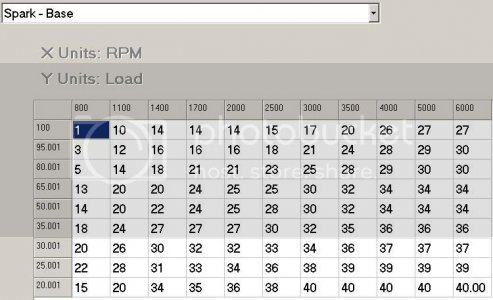
Lemme show you what my base spark table looks liek.

Disclaimer: This is from a CCF file that was taken off a D4U1 Ted B. LPM, so all the values are his, not mine. The only things I've changed past what he did are all the shift schedules/pressures, and global spark. How does this look?

Spark
 

Axianator

I am a banana!
Joined
Dec 20, 2001
Messages
1,372
Reaction score
25
Location
Roanoke, TX
My question is will a Tweecer benefit any on a basically stock motor.
Yes, especially if--as Ken noted--you plan to utilize a larger MAF down the road or have other significant modifications planned for your engine.

Generally speaking, a stock ATX SHO will benefit more from a TwEECer than will a stock MTX SHO.

Indeed. I'm running 7 degrees of global advance, and it works on 87, but it really wakes up with 93! I think I could probably run more, up to 9-10 degrees with no issues.
I'm curious--why are you adding so much global timing to your calibration? Ted B. never added more than 4 degrees of global spark to his programs, and I have personally never seen, measured, or felt any benefit to adding more than 2.5 degrees on my '95, both with the factory 3.2L and my low-comp 3.3L.

Not really even sure I know how to get the answer to that question. I changed the "spark-global adder" field in the Scalars tab. I haven't really quite figured out all that tables stuff yet.
If you're running the updated D4U1.DAT data logging file from Josh's TwEECer site, you should be able to log (and view) your total commanded timing from CalCon.

If you're looking to get more power, you need to twEEC the WOT spark advance. Once you go WOT, the Global Spark adder is ignored.
Don't forget that we're talking about an ATX SHO, f0kker. We don't use the same functions. ;)

Lemme show you what my base spark table looks liek.

Disclaimer: This is from a CCF file that was taken off a D4U1 Ted B. LPM, so all the values are his, not mine. The only things I've changed past what he did are all the shift schedules/pressures, and global spark. How does this look?
Ted's modifications are an improvement, but they don't take into account all of the other timing tables, and consequently, the overall timing equation for the ATX computers. When modifying values in the base timing table for the D4U1, you also have consider the values in the borderline table, as well as the smaller multiplier and adder tables that are present in the listing.

Unlike the MTX calibrations, spark tuning on an ATX computer involves a bit more forethought and experimentation. ;)
 

BlackonBlack89

SHO Member
Joined
Mar 8, 2006
Messages
1,508
Reaction score
364
Location
burlington county,NJ
Andrew I didn't understand timing either really but this link just helped me out alot. I could not figure out wat degree actually ment.(the meaning actually) Thats what confused me. Now all those numbers make a little more sense now after reading that. this linked helped.

Math is everywhere u know!!!!!!!!!!!

http://www.miata.net/garage/KnowYourCar/S10_Timing.html

so basically all those numbers mean is when the spark fires and the higher the number (in the table), the lower the piston is from TDC. (is that right???? lol)

SO.....what's this global spark thingy???
 
Last edited:

hawkeye18

Sorta cares
Joined
May 18, 2004
Messages
5,631
Reaction score
2,727
Location
Norfolk, VA
Degrees is pretty much exactly that. Imagine the crankshaft timing sprocket (assuming you've seen it lol) as it rotates. When the dot on the sprocket lines up with the dot on the block, that's 0 degrees BTDC. There are 360 degrees in a circle, right? so if a piston fires 20 degrees BTDC, the spark plug will ignite when the dot on the sprocket is still 20 degrees (or 1/18th of a circle) away from the dot on the block.

So yes, you are right; a higher spark advance means the spark occurs when the piston is farther away from the top of its stroke.

The danger, of course, is having the flame wave hit the top of the piston while it's still in its upstroke. That is bad, as it will severely hamper power production (at best) and crack your piston/explode your engine (at worst). This is called detonation, and it's real bad like. Detonation is usually preceded by knock (a small detonation), and is why the engine has a knock sensor. If it detects the beginnings of detonation, it will yank timing from the engine (make the spark occur when the piston is closer to TDC) until it no longer detects knocking. The EEC dedicates a test solely to the knock sensor during the KOER test for this reason (it's kind of an important sensor). You may have heard of this as the "goose test", and if you do it right, you will be able to hear the knocking the engine makes (the EEC advances timing to a point that is guaranteed to knock for the test).

This is also why running 89, or even 87 is not a problem in most SHOs; the knock sensor will automatically retard timing to adjust for the lower grade fuel. This does, however, result in less power as now the flame wave is now likely hitting the cylinder on its downstroke after TDC. It's also why Ford recommends premium; the engine can advance spark more with it.

Also, Adam: I'm bumping up the global spark because, honestly, I don't know any better. I'm not confident enough to go messing around with all the spark tables. I was not aware that the EEC didn't look at it during WOT, which would explain a few things. To be honest, I haven't made a single datalogging run yet, as it would involve hooking the laptop up inside the car and I haven't gotten the moxy up to do that yet.
 
Last edited:

Axianator

I am a banana!
Joined
Dec 20, 2001
Messages
1,372
Reaction score
25
Location
Roanoke, TX
Also, Adam: I'm bumping up the global spark because, honestly, I don't know any better. I'm not confident enough to go messing around with all the spark tables. I was not aware that the EEC didn't look at it during WOT, which would explain a few things. To be honest, I haven't made a single datalogging run yet, as it would involve hooking the laptop up inside the car and I haven't gotten the moxy up to do that yet.
That's fine. I was simply curious about your reasoning and your results with using so much added timing. ;)

Personally, I've never seen an ATX SHO gain power output from using such a large increase in global timing. In fact, I've seen quite the opposite. The other side of the coin that has not yet been discussed in this thread--or the the addition of too much timing--can actually place you on the other side of the optimal ignition window, causing sluggish performance and reduced power output, especially when higher octane fuels are utilized.

Also, for the record, the H3Zx and D4U1 ATX computers do use the Global Spark Adder at WOT. This is one reason why it is labeled a "global" adder. Jason's earlier comment only applies to the MTX computers, which have throttle-state-specific adders for closed, part, and wide open throttle. The later ATX calibrations dumped these various adders in favor of a single, global adder and a set of granular spark adder/multiplier tables.
 

Forum statistics

Threads
107,077
Messages
1,181,199
Members
16,142
Latest member
Kaevorlly

Members online

Back
Top