

Power Surge
SHO Member
Had some free time today, so I threw the SHO on the dyno and did some tuning on it. Found some interesting info, so I wanted to share it with everyone.
First, let's start with the baseline dyno pull from a few weeks back. Specs on the car at time of dyno were: stock 90 MTX car, 128k miles, no recent servicing.
Here's the graph:
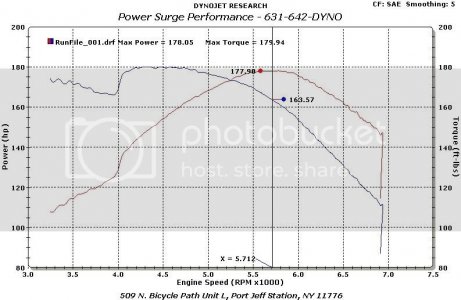
If you notice, the peak hp was about 5700 rpms, and then it dropped off pretty bad from there. You can see the IMRCs opening at 4000 rpms. Not too shabby for a bone stock 128k mile car.
Now, I did a few things to the car recently. The main thing was I wanted to do an upper 60k. So off came the intake and valve covers. Well, the motor was in really good shape, and only required one shim out of all the valves. However, while it was apart, I had the intake powdercoated which meant the insides were cleaned out. I added BBBs, and removed the air horns as suggested here on the forum. I also modded the fuel rails and regulator and added 42s, but that has nothing to do with power output. Lastly, I replaced the stock 55mm MAF with a 73mm C&L one that I got with my 90 parts car (I had it, so why not).
After spending some time building a new MAF x-fer and doing all the part throttle tuning, I then started WOT tuning the car.
Here is the final graph when done:

Now here are some interesting things I found, while tuning...
The car made best power at 12.8 A/F across the board. Pretty average, but some NA cars like to be closer to 13.0. My car didn't gain anything at that point. Increased mid range spark added some good power. And an extra few degrees up top, also netted some nice power additions to the graph.
Peak hp is still at 5700, but now it holds it at higher rpms, which will make the car faster and pull more up top.
Interestingly, my tuning software showed the IMRCs opening stock at 3000 rpms, but the car clearly opened right at 4000. This was verified not only on the dyno graph, but with me also watching the movement through the open hood. Oddly, changing the values in the software made no difference at all. I will have to look into that and see if I can get it fixed.
It should be also noted that the C&L MAF made the car VERY lean. Since I was going to be making a new air model x-fer anyway it didn't matter to me, but that's scary thinking about someone putting one on a stock car with no tuning correction.
Another thing I want to point out, was something I was surprised to see. As mentioned, I installed some BBBs, and removed the air horns as per posts from this site. Looking at the results, I think that may actually be a bad thing to do. Take a look at the graph below, with the baseline and new pulls overlayed. In stock form, when the IMRCs open, you can see a jump in power right after. Most of us can "feel" this in the car as well. After I did the new setup, I no longer felt this power burst. The dyno shows why. Now with the BBBs and NO air horns, there is no longer a power gain, now there is a power LOSS when the IMRCs open.
For those not familiar with the term "ram tuning", that is when manufacturers design an intake to use the intake pulses to gain maximum intake and velocity to bring as much air into the cylinders when the intake valve opens. Some cars have intakes that are designed so well, that they can EXCEED 100% VE (volumetric efficiency), which means the ram tuning is actually forcing more air volume in the cylinder than the cylinder holds. Think of it as supercharging on a much smaller scale. The SHO is one of those cars.
From what I've seen on my car, I believe that removing the air horns kills the ram tuning effect, and that is why we see the power drop. Now, the BBBs MAY give you higher rpm power, and some may feel that's a good trade off for the loss of mid range. Personally, I'd really like to make some new air horns that match the size of the BBBs and redo this test.
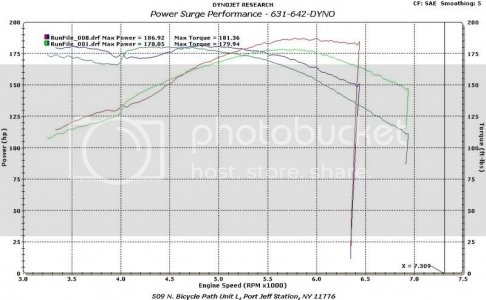
The last thing to mention, is that for the last pull I popped the airbox top off. For all these runs, I have been using a standard ole used paper filter. Well, uncorking the airbox and letting the motor have full air feed netted zilch. Nada. Nothing. Not one hp through the entire powerband.
BTW, these are SAE dyno numbers. If you use STD numbers, then the baseline was 185 and the new dyno numbers were 191.
Anyway, I hope my findings today were helpful, and I will post more in the future when I do more to the car.
First, let's start with the baseline dyno pull from a few weeks back. Specs on the car at time of dyno were: stock 90 MTX car, 128k miles, no recent servicing.
Here's the graph:
If you notice, the peak hp was about 5700 rpms, and then it dropped off pretty bad from there. You can see the IMRCs opening at 4000 rpms. Not too shabby for a bone stock 128k mile car.
Now, I did a few things to the car recently. The main thing was I wanted to do an upper 60k. So off came the intake and valve covers. Well, the motor was in really good shape, and only required one shim out of all the valves. However, while it was apart, I had the intake powdercoated which meant the insides were cleaned out. I added BBBs, and removed the air horns as suggested here on the forum. I also modded the fuel rails and regulator and added 42s, but that has nothing to do with power output. Lastly, I replaced the stock 55mm MAF with a 73mm C&L one that I got with my 90 parts car (I had it, so why not).
After spending some time building a new MAF x-fer and doing all the part throttle tuning, I then started WOT tuning the car.
Here is the final graph when done:
Now here are some interesting things I found, while tuning...
The car made best power at 12.8 A/F across the board. Pretty average, but some NA cars like to be closer to 13.0. My car didn't gain anything at that point. Increased mid range spark added some good power. And an extra few degrees up top, also netted some nice power additions to the graph.
Peak hp is still at 5700, but now it holds it at higher rpms, which will make the car faster and pull more up top.
Interestingly, my tuning software showed the IMRCs opening stock at 3000 rpms, but the car clearly opened right at 4000. This was verified not only on the dyno graph, but with me also watching the movement through the open hood. Oddly, changing the values in the software made no difference at all. I will have to look into that and see if I can get it fixed.
It should be also noted that the C&L MAF made the car VERY lean. Since I was going to be making a new air model x-fer anyway it didn't matter to me, but that's scary thinking about someone putting one on a stock car with no tuning correction.
Another thing I want to point out, was something I was surprised to see. As mentioned, I installed some BBBs, and removed the air horns as per posts from this site. Looking at the results, I think that may actually be a bad thing to do. Take a look at the graph below, with the baseline and new pulls overlayed. In stock form, when the IMRCs open, you can see a jump in power right after. Most of us can "feel" this in the car as well. After I did the new setup, I no longer felt this power burst. The dyno shows why. Now with the BBBs and NO air horns, there is no longer a power gain, now there is a power LOSS when the IMRCs open.
For those not familiar with the term "ram tuning", that is when manufacturers design an intake to use the intake pulses to gain maximum intake and velocity to bring as much air into the cylinders when the intake valve opens. Some cars have intakes that are designed so well, that they can EXCEED 100% VE (volumetric efficiency), which means the ram tuning is actually forcing more air volume in the cylinder than the cylinder holds. Think of it as supercharging on a much smaller scale. The SHO is one of those cars.
From what I've seen on my car, I believe that removing the air horns kills the ram tuning effect, and that is why we see the power drop. Now, the BBBs MAY give you higher rpm power, and some may feel that's a good trade off for the loss of mid range. Personally, I'd really like to make some new air horns that match the size of the BBBs and redo this test.
The last thing to mention, is that for the last pull I popped the airbox top off. For all these runs, I have been using a standard ole used paper filter. Well, uncorking the airbox and letting the motor have full air feed netted zilch. Nada. Nothing. Not one hp through the entire powerband.
BTW, these are SAE dyno numbers. If you use STD numbers, then the baseline was 185 and the new dyno numbers were 191.
Anyway, I hope my findings today were helpful, and I will post more in the future when I do more to the car.
Last edited:


