Reading A Datalog of a Methanol Injected SHO

Disclaimer: Links on this page pointing to Amazon, eBay and other sites may include affiliate code. If you click them and make a purchase, we may earn a small commission.

mattr66usa

Active Member
Joined
Nov 22, 2025
Messages
145
Reaction score
108
Location
Texas
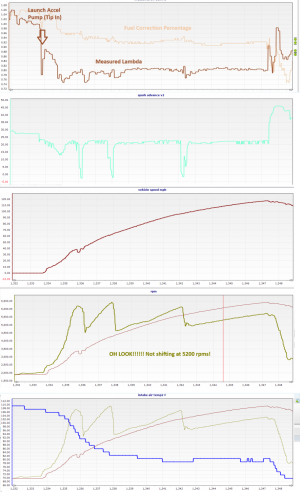
Okay, here's a 11.7x run on a full weight SHO running methanol. Go ahead and pick this apart and ask questions.... There should be a lot of questions if you guys can figure out what you are looking at...... No questions are dumb questions, but let's take a deep dive into tuning that actually works in the real world. This is a "safe" tune with all safeties enabled. Your will see there are no "dangerous rich" mixtures being run at any point during the curve of this adaptive tune. It also dispels the BS about shifting at 5200 rpms that someone was throwing out there as well. Hopefully this dispels any myths that some people are pushing to try and discredit me.
1765603420256
1765603761445
 
Last edited:
Joined
Oct 23, 2025
Messages
37
Reaction score
28
Location
South Carolina
Okay, here's a 11.7x run on a full weight SHO running methanol. Go ahead and pick this apart and ask questions.... There should be a lot of questions if you guys can figure out what you are looking at...... No questions are dumb questions, but let's take a deep dive into tuning that actually works in the real world. This is a "safe" tune with all safeties enabled. Your will see there are no "dangerous rich" mixtures being run at any point during the curve of this adaptive tune. It also dispels the BS about shifting at 5200 rpms that someone was throwing out there as well. Hopefully this dispels any myths that some people are pushing to try and discredit me.
View attachment 96177
View attachment 96178
So in my understanding with these graphs is lambda and fuel correction are pretty much done in real time keeping mixture right. Sprak advance stays pretty tight except on shifts but that's normal. At the end of the run before spark jumps from lift is that spark clipping from safety limit set or normal? Was any safety ceiling hit on this run? On spark why the dip right after takeoff? Is this contributed to Traction control kicking on at this time? Was the 1-2 shift slow/flare on this run causing mph loss? Roughly 25 degree temp drop from the spray on intake temp is noted. Other questions would be what percent was sprayed in this run, was it a ramped spary and if so at what psi does it start and what psi to full spray, is my understanding on the data correct, and have I missed any key notes?
 

mattr66usa

Active Member
Joined
Nov 22, 2025
Messages
145
Reaction score
108
Location
Texas
So in my understanding with these graphs is lambda and fuel correction are pretty much done in real time keeping mixture right.
Lambda shows the how the exhaust is mixed coming out of the engine. Lambda is lambda and how the chemical process happening in the combustion chamber is fairing. Think of an end result of every calculation going on before combustion occurs. Good lambda is good lambda no matter how it gets there.

Sprak advance stays pretty tight except on shifts but that's normal. At the end of the run before spark jumps from lift is that spark clipping from safety limit set or normal?
when you lift off the throttle, the load (VE) drops so the spark called for increases because of that. Lower load means more spark all else equal.

Was any safety ceiling hit on this run?
By safety ceiling do you mean like a timing ceiling? If that's what you mean, the timing was pretty much at MBT the whole time except right at the beginning of the run which can actually help spoolup in some cases.

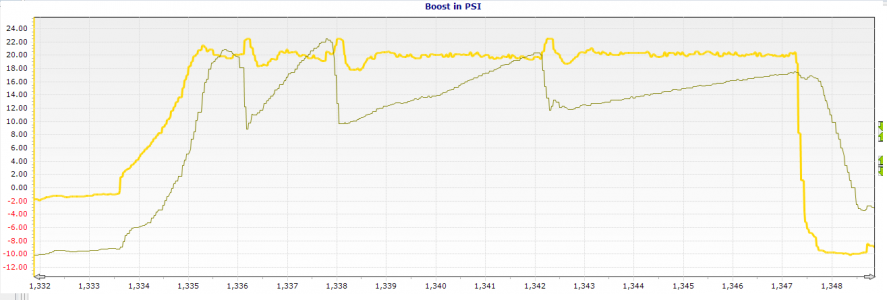
If you mean being meth dependent tune or not, no this tune isn't meth dependent. Customer has an XDI pump and the GH gen 3 turbos and is not running more boost than the fuel pump can support without meth. But the meth does allow the rail pressure to stay higher during the entire run which actually helps combustion.

On spark why the dip right after takeoff? Is this contributed to Traction control kicking on at this time?
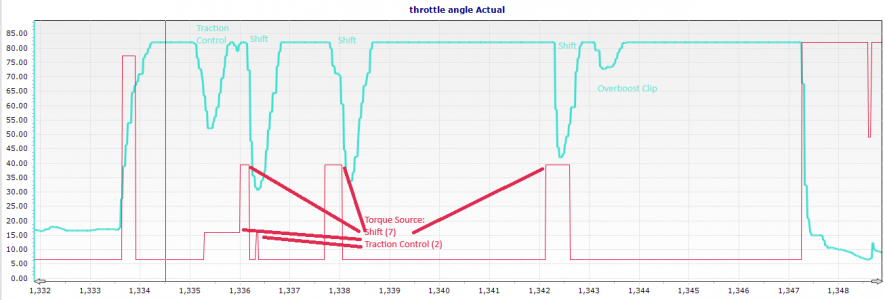
Look at the torque source when that happened, you have traction control kicking in before and after the shift. Torque reductions can happen with timing reduction (less severe) or throttle closure (more severe).
Was the 1-2 shift slow/flare on this run causing mph loss?
Car was having a hard time with traction so the traction control was trying to get that back to not spinning.
Roughly 25 degree temp drop from the spray on intake temp is noted. Other questions would be what percent was sprayed in this run, was it a ramped spray and if so at what psi does it start and what psi to full spray, is my understanding on the data correct, and have I missed any key notes?
We had started with a M15 Nozzle and 50/50 mix on an alky controls system with a start around 8 psi and full tilt by 25 psi to keep things light at first so we could check distribution etc. I think we ended up at full tilt by 15 PSI and a 70% mix from what I remember, but don't quote me as I'm bad about keeping notes. I sent an email to the customer and will give clarification when I get it.

Thank you for engaging and actually adding to a real technical discussion.

Matt
 
Joined
Oct 23, 2025
Messages
37
Reaction score
28
Location
South Carolina
Lambda shows the how the exhaust is mixed coming out of the engine. Lambda is lambda and how the chemical process happening in the combustion chamber is fairing. Think of an end result of every calculation going on before combustion occurs. Good lambda is good lambda no matter how it gets there.
So would afr be measured before/during combustion and lambda measured after combustion? In this example it is safe to say the car was not running lean or rich right?

By safety ceiling do you mean like a timing ceiling? If that's what you mean, the timing was pretty much at MBT the whole time except right at the beginning of the run which can actually help spoolup in some cases.

If you mean being meth dependent tune or not, no this tune isn't meth dependent. Customer has an XDI pump and the GH gen 3 turbos and is not running more boost than the fuel pump can support without meth. But the meth does allow the rail pressure to stay higher during the entire run which actually helps combustion.

I meant Timing/mbt ceiling. With this being a non meth dependent tune. That would mean it is safe for the engine to run even if the meth is not flowing. A non meth dependent tune is a different tune from the standard AO tune so it has been adjusted for the meth flow but it does not depend on the flow correct? If this is the case what gains are there for the tune to be dependent on the meth flow considering it is already at timing/mbt ceiling if there are any? What is the risk to reward here if there is any gains? The difference in dependent and not dependent would be the engine would be safe to run even if the meth ran dry, air in line, or an issue with the controller causing meth to not flow on non dependent tune and a depended tune would be it would cause an issue on the dependent tune if the flow was not there?

We had started with a M15 Nozzle and 50/50 mix on an alky controls system with a start around 8 psi and full tilt by 25 psi to keep things light at first so we could check distribution etc. I think we ended up at full tilt by 15 PSI and a 70% mix from what I remember, but don't quote me as I'm bad about keeping notes. I sent an email to the customer and will give clarification when I get it.

Thank you for engaging and actually adding to a real technical discussion.

Matt

So starting at 50/50 and slow ramp was to see the reaction with timing/mbt to see what way to adjust from there efficiently? As the widebands would pull fuel to keep lambda within range if it needed to right? Distribution checking is this seeing meth per cylinder? In this case there was room to up the mix and make the ramp faster to get to the timing/mbt point?

Thank you too for taking the time out of your day for us. Some of us enjoy learning how this works!
 

mattr66usa

Active Member
Joined
Nov 22, 2025
Messages
145
Reaction score
108
Location
Texas
So would afr be measured before/during combustion and lambda measured after combustion? In this example it is safe to say the car was not running lean or rich right?
Lambda can be converted to AFR if you know the exact fuel combination, but lambda tells you the mixture independent of what fuel is running. You don't have to think about AFR when using lambda.

I meant Timing/mbt ceiling. With this being a non meth dependent tune. That would mean it is safe for the engine to run even if the meth is not flowing. A non meth dependent tune is a different tune from the standard AO tune so it has been adjusted for the meth flow but it does not depend on the flow correct? If this is the case what gains are there for the tune to be dependent on the meth flow considering it is already at timing/mbt ceiling if there are any? What is the risk to reward here if there is any gains? The difference in dependent and not dependent would be the engine would be safe to run even if the meth ran dry, air in line, or an issue with the controller causing meth to not flow on non dependent tune and a depended tune would be it would cause an issue on the dependent tune if the flow was not there?
I won't give the exact how, but this is a non-dependent tune shown. You can see the short term fuel correction is pulling the fuel out of the tune to maintain the desired lambda. If it wasn't able to compensate properly, you would see the lambda go very low because the computer couldn't react fast enough to correct for it. In my methodology a meth-dependent tune would elevate the boost past what the fuel system would normally not be able to support without the meth flowing. In that case the methanol has to be running not to drop the rail pressure dangerously low. The fuel trim is telling us that in some spots, we are getting an 8% fuel substitution. That means the HPFP is needing to deliver 8% less fuel when the meth is at full flow. Since the customer doesn't want a meth-dependent tune in this case, there is no need to push further with concentration or volume. So in this case, we are using the methanol for supplemental octane and fueling.
So starting at 50/50 and slow ramp was to see the reaction with timing/mbt to see what way to adjust from there efficiently? As the widebands would pull fuel to keep lambda within range if it needed to right? Distribution checking is this seeing meth per cylinder? In this case there was room to up the mix and make the ramp faster to get to the timing/mbt point?
So one of the negatives of manifold methanol injection is poor distribution. With any customer running meth I have them datalog at low flow to show how the distribution is between banks, then we increase meth flow and/or concentration to get were we want to for the fuel substitution ratio. The ramp speed of the sensors is the same on all of my tunes and part of the AO calibration. Also, once the knock sensors have added 5 degrees, they hold that until it needs to drop back. The knock sensors are set up to listen for "quiet" combustion and then add timing until the combustion gets a bit noisier or the timing limit (MBT in this case) is met. The sensors on these cars are so good, they can detect knock before any knock actually occurs. Call it "pre knock" detection.
 
Joined
Oct 23, 2025
Messages
37
Reaction score
28
Location
South Carolina
Lambda can be converted to AFR if you know the exact fuel combination, but lambda tells you the mixture independent of what fuel is running. You don't have to think about AFR when using lambda.

I had some time to research a little more about afr vs lambda. I now understand lambda is universal and not dependent on fuel type for mixture and why it is preferred over afr. On that note, what would be ideal targets given loads of idle, part/daily driving, and wot?

I won't give the exact how, but this is a non-dependent tune shown. You can see the short term fuel correction is pulling the fuel out of the tune to maintain the desired lambda. If it wasn't able to compensate properly, you would see the lambda go very low because the computer couldn't react fast enough to correct for it. In my methodology a meth-dependent tune would elevate the boost past what the fuel system would normally not be able to support without the meth flowing. In that case the methanol has to be running not to drop the rail pressure dangerously low. The fuel trim is telling us that in some spots, we are getting an 8% fuel substitution. That means the HPFP is needing to deliver 8% less fuel when the meth is at full flow. Since the customer doesn't want a meth-dependent tune in this case, there is no need to push further with concentration or volume. So in this case, we are using the methanol for supplemental octane and fueling.

I can understand not giving the exact how and dont blame you. Would I be correct in seeing this happening in real time on the graph and not taking seconds to "catch up"? Let's say you setup a tune for meth to substitute 8% of fuel is there any time lost or power gain with a nondependent tune vs a dependent tune? If not, why would someone want to be on a dependent tune? Also is there a maximum percentage of substitution of fuel and if so, is there a easy explanation of why? Does this come down to air volume limit to match the fuel volume? When it comes to meth mixture (50/50) what is the benefit of mixing vs running 100% and less flow?

So one of the negatives of manifold methanol injection is poor distribution. With any customer running meth I have them datalog at low flow to show how the distribution is between banks, then we increase meth flow and/or concentration to get were we want to for the fuel substitution ratio. The ramp speed of the sensors is the same on all of my tunes and part of the AO calibration. Also, once the knock sensors have added 5 degrees, they hold that until it needs to drop back. The knock sensors are set up to listen for "quiet" combustion and then add timing until the combustion gets a bit noisier or the timing limit (MBT in this case) is met. The sensors on these cars are so good, they can detect knock before any knock actually occurs. Call it "pre knock" detection.

So our limits in this case are knock and mbt. Once one is reached there is no more to gain without huge risks?
 

mattr66usa

Active Member
Joined
Nov 22, 2025
Messages
145
Reaction score
108
Location
Texas
I had some time to research a little more about afr vs lambda. I now understand lambda is universal and not dependent on fuel type for mixture and why it is preferred over afr. On that note, what would be ideal targets given loads of idle, part/daily driving, and wot?
For mileage - 1.0 or leaner - Also depends on catalytic converter performance and design if mfgr runs leaner than 1.0 lambda
For power - .85-.78 depending on rpm and specific engine and fuel. Richer can allow for more spark if you are running timing right at the edge of what the octane will support. Running leaner than factory can give you more fuel pump headroom on a system like ours where the fuel pump can't keep up with increased airflow demands. That's more of the reason we run leaner than stock when tuned typically. You give up some knock resistance on pump gas when running leaner because some cylinders can run leaner than others, so often times the base tune has to be richened up to keep knock at bay on some cars. This gets harder and harder as injectors get plugged up and cylinder-to-cylinder balance starts to suffer.
I can understand not giving the exact how and dont blame you. Would I be correct in seeing this happening in real time on the graph and not taking seconds to "catch up"? Let's say you setup a tune for meth to substitute 8% of fuel is there any time lost or power gain with a nondependent tune vs a dependent tune? If not, why would someone want to be on a dependent tune? Also is there a maximum percentage of substitution of fuel and if so, is there a easy explanation of why? Does this come down to air volume limit to match the fuel volume? When it comes to meth mixture (50/50) what is the benefit of mixing vs running 100% and less flow?
What you see is what you get. Lambda is Lambda at that time. Fuel substitution ratio comes down to goal of the mod. If the customer does not want a meth-dependent tune, we stop adding meth flow when we reach a cooling or octane goal plus a little bit of a margin. This saves methanol and probably one of the reasons Gearhead has this moniker of "using meth for cooling only". If they are wanting a race tune that depends on meth, or has the safety system installed, we push boost higher. I have guys in the middle east that run 30% substitution of fuel flow because their pump gas is so bad there and it doesn't have ethanol in it.
So our limits in this case are knock and mbt. Once one is reached there is no more to gain without huge risks?
Once you reach MBT in that spot, there's no more room for timing in that spot (I wish we could go back to the technical thread where I discuss the ford borderline/mbt strategy). I can turn up the airflow (boost) but see above point about fuel pump support without meth.

PS: Also look at the shift points because it debunks a myth being pushed by one of the parties attacking me. Also notice they are different for different gears. This will play into a VE discussion that I want to have after we put technical topic #2 to bed so I do want folks to get on that thread when possible.
 
Last edited:
Joined
Oct 23, 2025
Messages
37
Reaction score
28
Location
South Carolina
For mileage - 1.0 or leaner - Also depends on catalytic converter performance and design if mfgr runs leaner than 1.0 lambda
For power - .85-.78 depending on rpm and specific engine and fuel. Richer can allow for more spark if you are running timing right at the edge of what the octane will support. Running leaner than factory can give you more fuel pump headroom on a system like ours where the fuel pump can't keep up with increased airflow demands. That's more of the reason we run leaner than stock when tuned typically. You give up some knock resistance on pump gas when running leaner because some cylinders can run leaner than others, so often times the base tune has to be richened up to keep knock at bay on some cars. This gets harder and harder as injectors get plugged up and cylinder-to-cylinder balance starts to suffer.

What you see is what you get. Lambda is Lambda at that time. Fuel substitution ratio comes down to goal of the mod. If the customer does not want a meth-dependent tune, we stop adding meth flow when we reach a cooling or octane goal plus a little bit of a margin. This saves methanol and probably one of the reasons Gearhead has this moniker of "using meth for cooling only". If they are wanting a race tune that depends on meth, or has the safety system installed, we push boost higher. I have guys in the middle east that run 30% substitution of fuel flow because their pump gas is so bad there and it doesn't have ethanol in it.
Okay thank you. I think we have exhausted this and I have a lot more understanding on it now.
Once you reach MBT in that spot, there's no more room for timing in that spot (I wish we could go back to the technical thread where I discuss the ford borderline/mbt strategy). I can turn up the airflow (boost) but see above point about fuel pump support without meth.
I was originally trying to let someone with more technical knowledge lead the discussion. As far as the fuel pump on these we run out of pressure before we run out of boost is my understanding and why the need to upgrade to the xdi and use meth to substitute along with improving octane when unable to get higher octane. Higher the octane the more knock resistance thus enabling more timing room up to a point.
PS: Also look at the shift points because it debunks a myth being pushed by one of the parties attacking me. Also notice they are different for different gears. This will play into a VE discussion that I want to have after we put technical topic #2 to bed so I do want folks to get on that thread when possible.
I did notice this and was curious but didn't point it out. I did notice the shifting points where pushed past the 5200 rpm mark. I also noticed each shift was at a different rpm and was curious about that. Looks like the 1-2 shift was around 6200 rpm, the 2-3 shift was closer to 6400 rpm and the 3-4 rpm was under the 1-2 shift around 6100 rpm. So we are able to adjust by gear rpm shifting points on these? Referencing the mph graph with the shift points as side for the mph loss due to traction issue there seems to be no mph loss and a nice mph incline shifting at these higher rpm points.
 

mattr66usa

Active Member
Joined
Nov 22, 2025
Messages
145
Reaction score
108
Location
Texas
Okay thank you. I think we have exhausted this and I have a lot more understanding on it now.
Hopefully even those that aren't participating in this discussion have a better understanding of what is going on as well.
I was originally trying to let someone with more technical knowledge lead the discussion. As far as the fuel pump on these we run out of pressure before we run out of boost is my understanding and why the need to upgrade to the xdi and use meth to substitute along with improving octane when unable to get higher octane. Higher the octane the more knock resistance thus enabling more timing room up to a point.
Yes, once you reach the MBT timing for the conditions you are currently operating at, there isn't any more power to be made. Timing just can't keep increasing up to infinity. It doesn't work this way.
I did notice this and was curious but didn't point it out. I did notice the shifting points where pushed past the 5200 rpm mark. I also noticed each shift was at a different rpm and was curious about that. Looks like the 1-2 shift was around 6200 rpm, the 2-3 shift was closer to 6400 rpm and the 3-4 rpm was under the 1-2 shift around 6100 rpm. So we are able to adjust by gear rpm shifting points on these? Referencing the mph graph with the shift points as side for the mph loss due to traction issue there seems to be no mph loss and a nice mph incline shifting at these higher rpm points.
Let's talk about getting down the track as fast as possible. That happens by running the most "average horsepower" the entire run. Gear splits require compromises at every shift. Look at the power curves below:
1766760311302
The goal with shift splits is to run in the "sweet spot" of the powerband as much as possible at wot. in the case of the 2-3 shift, you have to run past the power curve the most (6200 rpms or so) in order to not have the rpms back at 4000 rpms after the shift. Otherwise, if the above is your power curve most of the shifts don't need to shift that high because you are overrevving out of the power band for no good reason. In a perfect world the above power curve would accelerate the car best between 5200 and 5800 rpms the whole time at wot, but again we are having to compromise. A different planetary gear set for these cars in the transmission that would make the 2-3 split smaller would pay major dividends.
 
Joined
Oct 23, 2025
Messages
37
Reaction score
28
Location
South Carolina
Let's talk about getting down the track as fast as possible. That happens by running the most "average horsepower" the entire run. Gear splits require compromises at every shift. Look at the power curves below:
View attachment 96283
The goal with shift splits is to run in the "sweet spot" of the powerband as much as possible at wot. in the case of the 2-3 shift, you have to run past the power curve the most (6200 rpms or so) in order to not have the rpms back at 4000 rpms after the shift. Otherwise, if the above is your power curve most of the shifts don't need to shift that high because you are overrevving out of the power band for no good reason. In a perfect world the above power curve would accelerate the car best between 5200 and 5800 rpms the whole time at wot, but again we are having to compromise. A different planetary gear set for these cars in the transmission that would make the 2-3 split smaller would pay major dividends.
I would agree. Just like you said it falls off a cliff lol. Nothing we can really do about this either.
 

mattr66usa

Active Member
Joined
Nov 22, 2025
Messages
145
Reaction score
108
Location
Texas
I would agree. Just like you said it falls off a cliff lol. Nothing we can really do about this either.
To 802SHO's point there is. We are at the mercy of the exhaust flow, but on stock location turbos, you can't do a whole lot past putting a bigger turbine wheel in the factory exhaust housings until someone starts casting larger housings. Once you get the turbine restriction out of the way, you have to have an engine package where you can actually drive the larger exhaust sections where the natural VE of the engine can carry airflow up into the higher rpms. The result of the mismatched airflow (stock heads and cams) is a very short powerband where you gave up all the bottom end torque with a non-responsive turbine without a lot of gain up top because the engine can't breathe up that high.
 
Last edited:

Forum statistics

Threads
107,100
Messages
1,181,414
Members
16,164
Latest member
Brad kirk

Members online

Back
Top