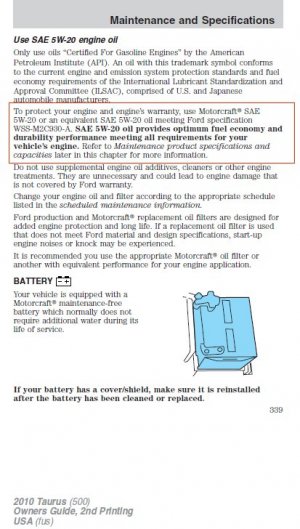
WSS-M2C930-A
Shall meet all the requirements of the “ILSAC GF-4 Minimum Performance Standard for Passenger Car Engine Oils" plus the following:
3.2.1 ASTM Sequence VG Test Follower Pin Wear, average 30 um, max. (Cyl #8 intake and exhaust)
Ring Gap Increase, average 225 um, max (Cyl #1 and #8)
The following photographs of the VG test engine are required:
· Rocker arm cover and camshaft baffle
· Oil pan and baffle
· Oil pick-up screen
· Cylinder block underside
· Cylinder head valve decks
· Cylinder block front
· Timing chain cover
· Average and worst piston skirts, thrust sides
· Rear seal housing
All required engine tests shall be conducted in accordance with the most recently approved procedures as described in ASTM Standards and the applicable ASTM Standards Research Reports and Information Letters. All tests under surveillance by ASTM must be conducted using test equipment monitored by and calibrated to the requirements of the ASTM Test Monitoring Center.
PHYSICAL/CHEMICAL PROPERTIES
3.3.1 Copper Corrosion 1b max (ASTM D 130 or ISO 2160, 3 h at 100 °C) (Dark Orange)
3.3.2 High Temperature Deposits, mg 30 max (TEOST MHT-4)
3.3.3 Physical Appearance and Odor Shall be clear and bright with no objectionable odor.
3.3.4 Contaminants Shall be free of carcinogens, toxins, metals not removed in refining or from previous use.
QUALIFICATION PROCEDURE
3.4.1 Documentation Supplier must furnish to Fuels and Lubricants Engineering a completed and certified copy of the attached Supplement A, test reports demonstrating full compliance with all the requirements of this specification and a copy of the final ACC Monitoring Agency summary, if available. The need for ACC registration of tests will be determined by Fuels and Lubricants Engineering. The copy of the ACC Monitoring Agency summary should be sent directly from Registration Systems Inc. to Fuels and Lubricants Engineering.
The test reports must include results on both the candidate oil and the appropriate ASTM reference oils. The standard photographs of the test components are considered an essential part of the required test documentation. The oil sample code used for identification in each test document must be consistent. Any deviation in sample code uniformity must be explained and shown on the cover of each test report. All tests must be certified by a qualified and authorized representative of the test facility.
The supplier shall identify all the formulation changes and modifications that occurred in the test program that coincide with the tests listed in the ACC Monitoring Agency summary. Individual formulations should be listed in Supplement A, and for ACC registered tests, identified by the line item number and the formulation code.
3.4.2 "Read Across" Guidelines
It is required that all performance tests be conducted on the final formulation. However, exceptions may be permitted with supportive supplementary data on similar formulations to allow for final approval in the absence of complete testing.
3.4.3 Fleet Testing
Materials which constitute a significant departure from conventional formulations, whether in base stocks, refining processes or additive packages, must be fleet tested, in addition to the requirements outlined herein. These tests must include the type(s) of service judged to be affected by the difference in formulation technology. Fuels and Lubricants Engineering should be consulted prior to testing.
3.4.4 Verification
Fuels and Lubricants Engineering reserves the right to conduct verification testing. If the test results do not support the originally submitted data, the supplier must re-test the product in coordination with Fuels and Lubricants Engineering. This re-test must be conducted and certified by a mutually agreed upon test facility.
3.4.5 Chemical and Physical Properties
Supplier shall furnish appropriate chemical and physical properties as required on Supplement A along with the manufacturing limits that apply to the material as requested.
3.4.6 Performance Requirements
Conformance to the engine test requirements listed in Supplement A will be determined by using Multiple Test Acceptance Criteria (MTAC). All data and reports from the tests used for MTAC must be provided by the supplier. Identify the engine tests on Supplement A that have been used to determine the MTAC results by the corresponding line item number on the ACC Monitoring Agency summary. Fuels and Lubricants Engineering reserves the right to use all tests when averaging in place of MTAC.
3.4.7 Quality Control
Upon engineering approval supplier and Fuels and Lubricants Engineering shall establish mutually agreed upon quality control limits to be listed in Supplement B. These will be used for ongoing product verifications at mutually agreed upon frequencies. The infrared absorption spectra of the approved material shall constitute the reference standard and shall be kept on file. All samples shall produce infrared curves that correspond to the reference standard when tested under the same
conditions as those specified on the master curve.