$150 serious header and a thorough exhaust air flow analysis *long*

Disclaimer: Links on this page pointing to Amazon, eBay and other sites may include affiliate code. If you click them and make a purchase, we may earn a small commission.

shomethe$$$

SHO Member
Joined
Sep 10, 2007
Messages
480
Reaction score
131
Location
Washington D.C.
Header specs

Primary Diameter: 1 3/4 primaries (1.65" ID)
Primaries Equal Length: 21"
Gauge: 18 gauge mild steel
Merge angle 10-15 degrees
Merge outlet: 2.5"
Primary Extension: 17.75"
Weight Savings over stock: 2 lb
Fabrication Time: 25 hours

Pre-bent Piping $90
Flex pipe $26
Flanges and gaskets $12
weld wire $8
Paint $8
Cutting and grinding wheels $6
Total $150

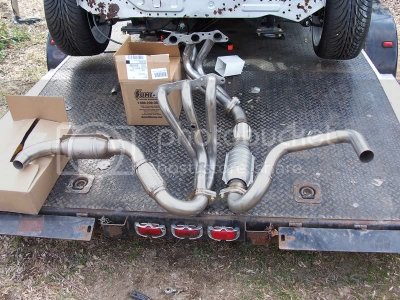
header_001.jpg


I ended up using the stock ******, the SHO cast iron manifold outlets are very large, about 1.75" x 1.5, I welded the piping to it and then took a die grinder and matched the port to the pipe. I hope to gain a bit of low end with this and good top end flow. I analyzed the header versus stock enough airflow for 600-700 hp. As you all know exhaust systems area compromise between velocity and flow, too big the velocity goes down, too small the pressure goes up making it harder to exhaust out of the engine. Lets first take a look at pressure for straight piping:
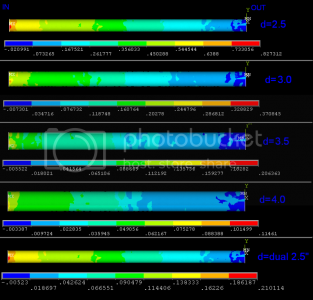
TOGTHER PRESSURE

What this shows is the pressure above atmosphere, although each are less than 1psi, in real world application, this may be 5 times higher if you account for temperature. As you can see a 2.5" pipe becomes quite restrictive, almost two time higher pressure than the 3, if you go with a dual 2.5 its comparable to a single 3.5" so ideally a 3-2.5 is the best for high hp applications. Looking at the velocity:
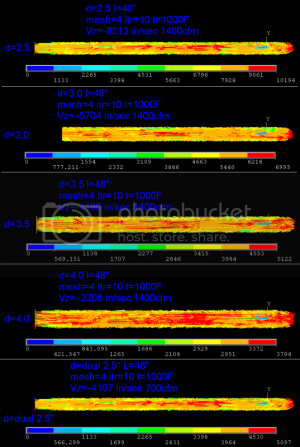
TOGTHER velocity

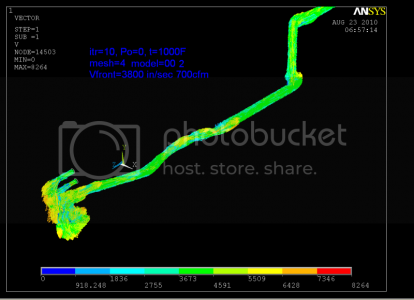
Obviously with the bigger piping the velocity drops considerably, next lets take a look at the stock manifold which has about 5" primaries:
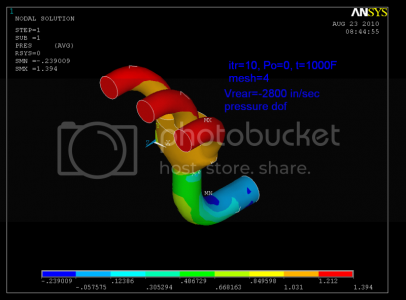
Stock mani pressure
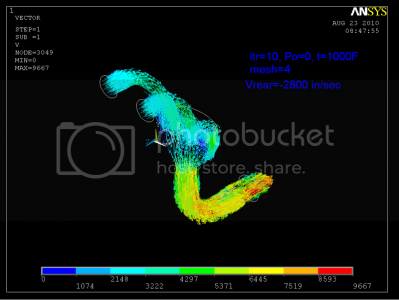
Stock mani velocity iso

versus a stock manifold with a 2.5" outlet:
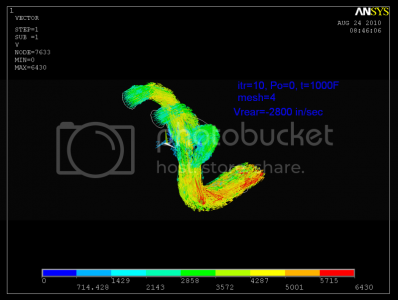
Stock mani big velocity iso
Stock mani big pressure

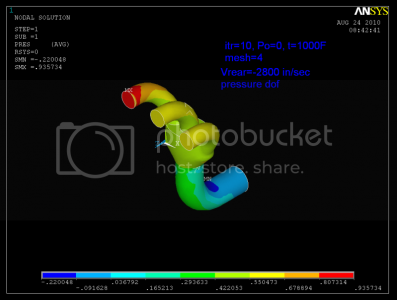
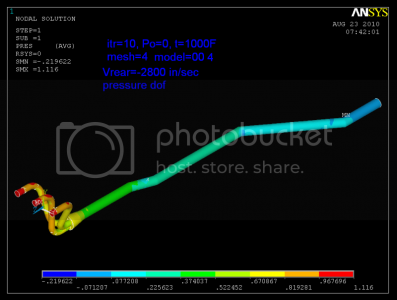
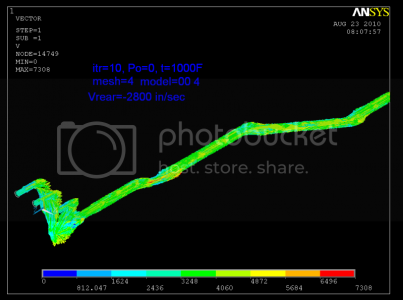
as you can see not only is the primary velocity higher than stock but the primary pressure is lower, so enlarging the outlet can be beneficial. Lets take a look at the header I fabricated modeled with a long extension this is where I think I can gain over a stock exhaust manifold:
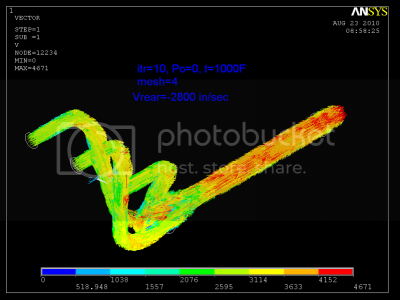
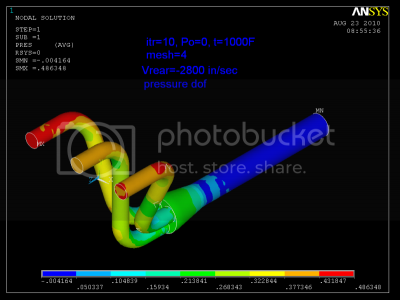
Header new velocity iso
Header new pressure

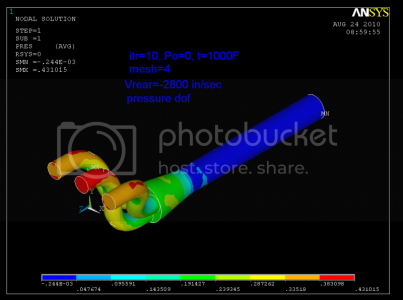
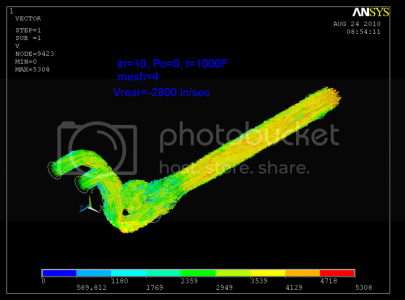
As you can see the velocity is higher and pressure is lower over stock, here is the same header with a short merge, not much difference although from research a low angle merge will help low and midrange power:
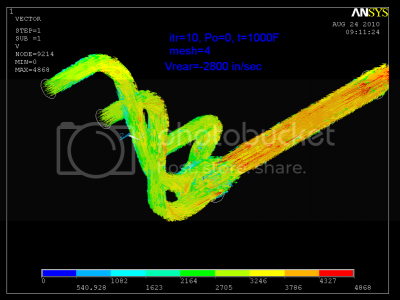
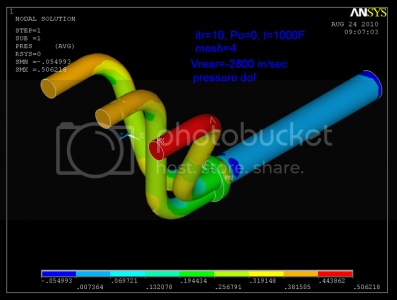
Header new 007 velocity iso
Header new 007 pressure

Lets take a look at a big header with midlength 11" primaries:
Header new 006 velocity iso
Header new 006 pressure

Not much difference, slightly higher velocity in the longer header, so not much difference between a longer and mid-length header. And this is true, a guy on the other forums put long tube headers and didn't gain much, maybe 1-2 hp over midlengths.
 

shomethe$$$

SHO Member
Joined
Sep 10, 2007
Messages
480
Reaction score
131
Location
Washington D.C.
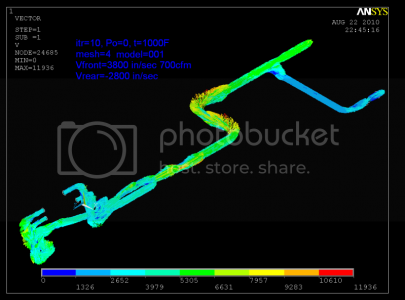
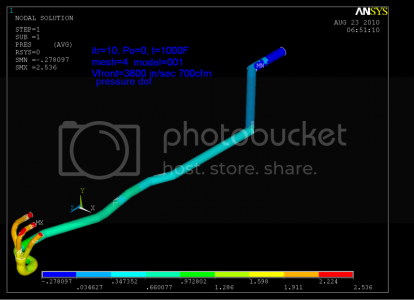
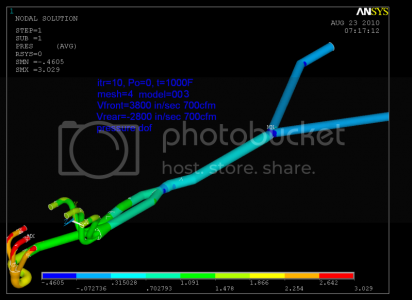
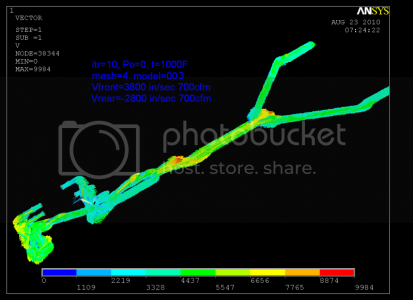
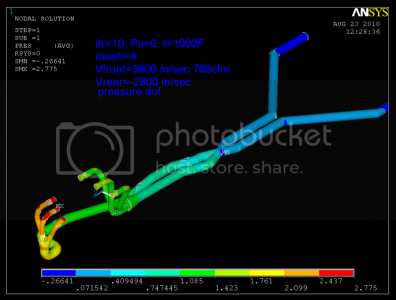
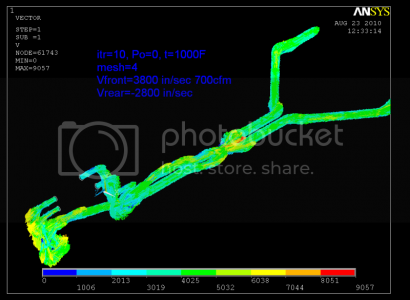
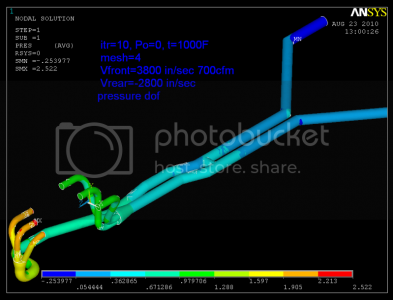
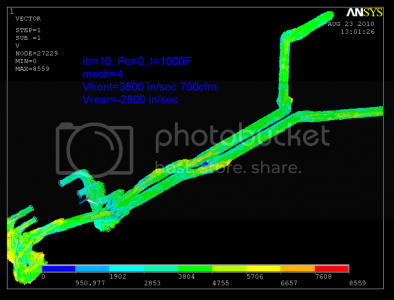
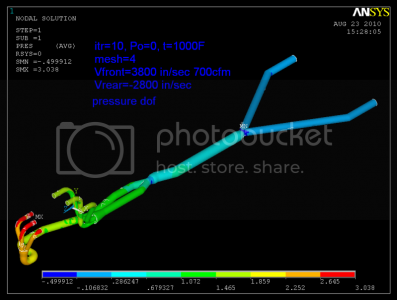
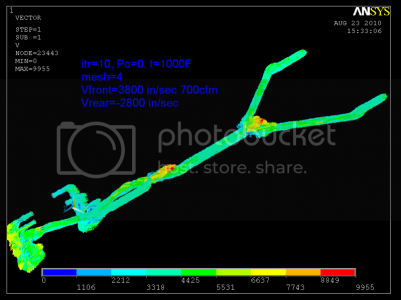
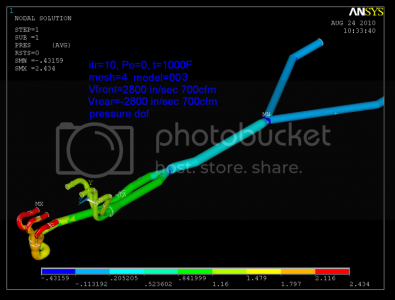
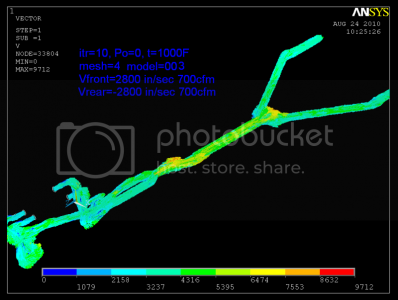
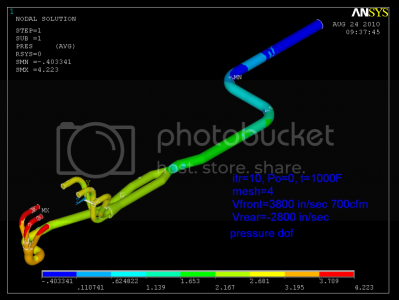
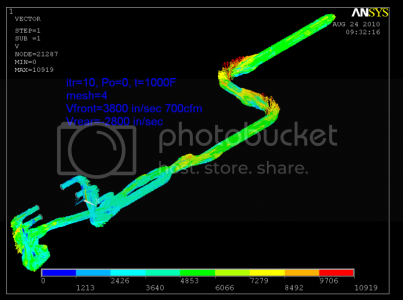
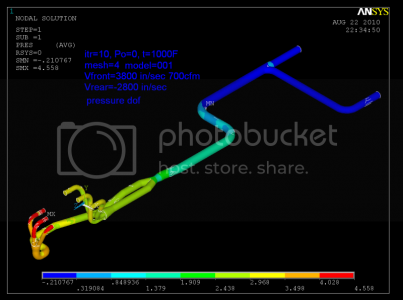
Lets take a look at different exhaust setups with the new headers and I have a unequal 1.5 headers on the front bank and the fabbed 1.75" rear bank, the downpipes are 2.5", merge into 3" then split into 2 2.5" mufflers, what I was looking for is the difference in the velocities as the two streams merge and the pressure along the system:

Complete 001 pressure
Complete 001 velocity iso 1


Dual System with 2.5" piping, front bank
Complete 002 pressure
Dual System with 2.5" piping, rear bank
Complete 004 pressure

Velocity dual 2.5" front bank
Complete 002 velocity iso
Velocity dual 2.5" rear bank
Complete 004 velocity iso

System with 2.5" downpipes into 3" single then out to 2.5" dual mufflers but this time with the fuel tank moved so the piping is dead center, see the big difference it makes:
Complete 003 pressure
Complete 003 velocity iso

Dual 2.5" system with X-pipe:
Complete 005 pressure
Complete 005 velocity iso

Dual 2.5" system with H-pipe:
Complete 006 pressure
Complete 006 velocity iso

System with 2.5" downpipes into 3.5" single then out to 2.5" dual mufflers:
Complete 007 pressure
Complete 007 velocity iso

System with equal front and rear primaries, into 2.5" downpipes and 3" single out to dual mufflers with fuel tank moved so the piping is dead center:

Complete 008 pressure
Complete 008 velocity iso

System with a single 3" exhaust, 2.5" primaries
Complete 010 pressure
Complete 010 velocity iso

My conclusions are that the stock mani is pretty good, the only thing it needs is to open up the outlet to 2.5", the header extension will definitely help over a stock system, x or h pipes don't help much and they would be hard to mount in behind the shifter is the only place, the equal length headers reducing front pipe pressure and reduces velocity but fitting them in my vehicle would be difficult, the exhaust merge has to be dead center, the bends around the gas tank basically does nothing for the other muffler, the pipe side of the muffler takes all the gas flow, I'm still deciding
if a dual system is better or a single system but a single system between 3-3.5" is the best.
So what system do you all like? Which one works for you?
 
Joined
Oct 11, 2004
Messages
4,970
Reaction score
1,456
Location
Cocoa,Florida
I love my 3" catback.
After I welded up a better Y collector and added the 3" I picked up a solid 1-1.5 mph trap speeds back when the car was N/A.
 

illSHOyou

SHO Member
Joined
Oct 1, 2001
Messages
913
Reaction score
82
Location
Troy, MO
Members on this forum have verified that increasing the collector size does increase hp. Plus the general rule of thumb is collector size should be 50% larger than the primary size. The stock primary pipes are 1.5" so 2.5" collector is about perfect. The one thing the modeling does not take into account is wave motion, its good for a flow standpoint, but it doesn't cover the wave action which will determine wether or not there will be a vacuum at the valve when the exhaust valve opens. That is where collector length tuning comes in and in many cases is much more affective then primary tuning.
 

illSHOyou

SHO Member
Joined
Oct 1, 2001
Messages
913
Reaction score
82
Location
Troy, MO
I believe a x pipe is very possible with identical exhaust manifolds. The one advantage is exhaust noise is changed and reduced in volume. Not much gain in the way of flow, but it could alter the tuning of the exhuast, make the engine think it has two exhaust banks 24" long and thats it. Maybe a high hp screamer, but it would take some talent to fab, but possible and I have been spending alot of time looking at it...
 

gmail

Well-Known Member
Joined
Jun 25, 2008
Messages
870
Reaction score
290
Location
sunbury pa
this is a project i wanted to get on myself..

nice to see you did your homework on this..

after spending that much time might as well make some kind of exhaust that comes out the back of the rocker molding like side pipes but hide it inside the rocker panel
 

NovaSS

Project MINIGUN
Joined
Aug 22, 2005
Messages
532
Reaction score
580
Location
Maryland
I would think you would not see much differance between running an X pipe or not on an even fire v/6 (but they do tend to help on odd fire v/8) They also need to be a close as possible to the collectors.

As far as exhaust, the farther you get away from the exhaust valve seats the less changes effect flow. Miniguns headers are almost an exact match to yours.

100 1081
 
Last edited:

zak

Supporting Member
Supporting Member
Joined
May 15, 2002
Messages
1,771
Reaction score
497
Location
east of Hartford
The stock primaries are oval and have equivalent area to a 1.75 inch OD round tube. One would think anything smaller than 1.625 inch OD would hurt top end power. The stock collector on an MTX is 1.875 inch ID for 3.0 MTX and 2.0 inch ID on the 3.2 ATX app. to offer a comparison.

For a single mid pipe, my calcs show a 2.75 inch OD to be ideal, and I'm in the process of building such a system (just got the $100 smooth bore 2.65 inch ID flex pipe, need to machine one of the inlets on my resonator). This is based on Vizard's often quoted flow spec of 115 cfm per square inch of exhaust area, and further calculating (using 2.2 cfm/hp rule) based on a 300 shp target. The 3" OD single mid pipe will get you to 340 hp on a theoretical basis, but no NA V6 has ever gotten there and you are just killing the low end torque for no gain up high.

Read the SHOtimes exhaust sizing article for a little more background. Dual 2.5 inch will be overkill unless you are going forced induction.
 
Last edited:

gmail

Well-Known Member
Joined
Jun 25, 2008
Messages
870
Reaction score
290
Location
sunbury pa
The stock primaries are oval and have equivalent area to a 1.75 inch OD round tube. One would think anything smaller than 1.625 inch OD would hurt top end power. The stock collector on an MTX is 1.875 inch ID for 3.0 MTX and 2.0 inch ID on the 3.2 ATX app. to offer a comparison.

For a single mid pipe, my calcs show a 2.75 inch OD to be ideal, and I'm in the process of building such a system (just got the $100 smooth bore 2.65 inch ID flex pipe, need to machine one of the inlets on my resonator). This is based on Vizard's often quoted flow spec of 115 cfm per square inch of exhaust area, and further calculating (using 2.2 cfm/hp rule) based on a 300 shp target. The 3" OD single mid pipe will get you to 340 hp on a theoretical basis, but no NA V6 has ever gotten there and you are just killing the low end torque for no gain up high.

Read the SHOtimes exhaust sizing article for a little more background. Dual 2.5 inch will be overkill unless you are going forced induction.


there has been a NA 3.0 SHO engine making more then 340 hp
 

Sho Amo

SmkTyresntDrugs
Joined
Feb 23, 2006
Messages
3,299
Reaction score
856
Location
Olney, Md
Ive got 400 for you to make me a stock length header :) Im right up 495
 

gmail

Well-Known Member
Joined
Jun 25, 2008
Messages
870
Reaction score
290
Location
sunbury pa
Completely Naturally Aspirated, or on Nitrous?


completely N/A

i always like using this one for reference..
the lakester SHO
500 hp n/a and it was a 3.0 running a carb, from the pictures it had nice looking headers on it and ran a GM coil.

it had some custom head work done and i assume a wild cam the likes we never seen.

ernies car was built to a lot of the specs that the lakester was

i truely believe the dyno ernie has its a bad machine


also there is a few combos some havent tried yet out of parts from the vendors on this site.

for example area91 has roughly 320 hp without n20 if you look at his numbers with the quaife hes on stock pistons injectors and everything...

now bore it and add some high compression pistons i bet he will be over 340 all day long.

simply saying i hate when people throw numbers out saying this is the max when no one has tried to get the max.
 
Back
Top