got asked "how do the SHO ecu's deal with knock" - anyone know ?

Disclaimer: Links on this page pointing to Amazon, eBay and other sites may include affiliate code. If you click them and make a purchase, we may earn a small commission.

HotRodKid

mmmmm ... turbo
Joined
Jul 14, 2006
Messages
1,441
Reaction score
642
Location
Western NY
hey way the ecu displays knock.... has anyone done research in the SHO community to see how the ecu deals with knock.

reason i ask. ive seen naturally aspirated ecus only indicate knock once audible knock is detected... ie you hear knock in the car (ie bad) and then the ecu pulls some timing and indicates knock.

all turbo ecus that i know of, are much more sensitive to know and indicate knock and pull timing far before you ever hear it with your ears.
you could make a detonation can/earmuffs setups and listen closely and watch tweecer to see if you are getting indicated knock. if you dont
hear barely anything in the earmuffs or the slightest tick and tweecer indicates knockm then the system is working to a safe level.


i dont know about all ecus but i know that turbo chrysler ecus have additional circuitry to "store" the peak of the knock signal using a capacitor after every ignition pulse so that the ecu can easily read it without having to deal with the small window of time when the knock occurs and then it clears the capacitor to ground before the next ignition cycle. here is a diagram.

http://www.squirrelpf.com/bucar/ecu%...ation_diag.gif

the other think you need to know is if the knock sensor has a flat frequency response and the filtering is done in the ecu or if the sensor is tuned to a specific frequency. my sensor is sensitive to noises in the 6000-6300hz range. i dont know what sho sensors are or if the ECU does filtering.

so what say the tuning gods ? lol

how sensitive is the SHO knock sensor and such ?
 
Last edited:

Phoenix

SHOHOLIC
Joined
Mar 2, 2007
Messages
3,767
Reaction score
1,646
Location
QC , Canada
I would send an email to Josh (tweecer) or the guys at nesho (sct) , they are probably the guys that knows best about what the ECU thinks/does exactly.
 

SHOZ123

SHO Member
Joined
Dec 2, 2000
Messages
12,152
Reaction score
673
Location
Illinois
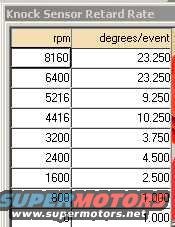
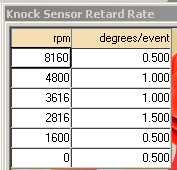
Here's the retard rate from the DU41 PCM.

Du41 ks retard rate

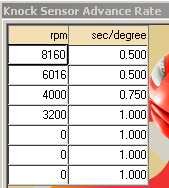
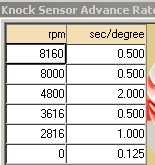
And here is the advance rate from the DU41.

Du41 ks advance rate

As you can see the KS are most aggressive at the peak torque range. This is where you will get the highest chance of knock. Also once the KS kick in the return of timing to before event settings is really slow. Which means once knock is seen you have lost most of your advancement and will not get it back in time for the next shift.

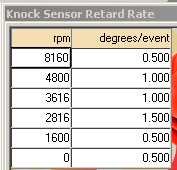
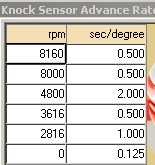
Looking at the B9B1 strategy it is just about toothless and does not really do much.

B9b1 ks retard rate

B9b1 ks advance rate
 
Last edited:

sho_sc

New Member
Joined
Jan 8, 2004
Messages
754
Reaction score
69
Location
Georgetown, KY
As you can see the KS are most aggressive at the peak torque range. This is where you will get the highest chance of knock. Also once the KS kick in the return of timing to before event settings is really slow.

... Looking at the B9B1 strategy it is just about toothless and does not really do much.

B9b1 ks retard rate

B9b1 ks advance rate

I've really considered to "reshape" those 2 tables to match the TQ curve of my blower SHO. Eventhough, I've only logged knock a handful of times, it seems to almost always occur in the 5500-6000 range. When you examine how it handles the return rate, it always returns it too quickly and has a repeat knock event or 2. OR I guess you could look at it as is not pulling enough timing to start off with, 1 degree ain't that much.
 

rubydist

SHO Master
Staff member
Super Moderators
Joined
Jun 25, 2007
Messages
7,521
Reaction score
3,399
Location
Denver
You have to understand what an "event" is. An event is the detection of knock on a particular cylinder firing (at least on the obd2 pcm's), so if the engine is starting to knock, you get 3 events per revolution. 3000 rpm is 50 rev/sec, so you can potentially have 150 events per second at 3000 rpm. So, if it starts to knock, with the D4U1 pulling out 3.75* per event, it will quickly pull out however much its allowed to (based on the table of max retard due to the knock sensor) - usually around 10 degrees in the code that I've studied.

In general, Ford engineers think knock is to be avoided like the plague, and pull timing out 30-100 times faster than they return it.

On the other hand, GM engineers seem to like operating on the edge of knock, and (at least in the pcm's that I've seen data on) pull out timing 2 times as fast as they put it back in.

On my Ranger, I re-shaped the tables to pull out knock 4 times as fast as it puts it back in (rather than 30x like the stock program was), and its much more driveable if I get some gas that's shaky on the octane rating, but it still pulls out the timing quickly if it needs to.
 

1slickRED89

Guest
Joined
Feb 13, 2001
Messages
1,234
Reaction score
9
Location
Toledo Ohio
the stock knock sensor is pretty unreliable, works OK at some RPMs, totally blind in others. these engine are also solid lifter, so there may be false positives, who knows. New engines have two knock sensors with advanced control systems to try to overcome these limitations. having worked with engines with pressure sensors I have found that your ear is just as good a tool to detect knock as a $40K piezoresistive in cylinder pressure sensor system, if the muffler is not too loud. and if it is you can get a microphone, put in the valley of the engine, hook up a EQ and clip everything but 5-7KHZ. works as good as anything out there.
 

justin mccluske

New Member
Joined
Apr 7, 2005
Messages
415
Reaction score
15
Location
washington
Does any one think there would be any bennifit to retarding my timming a few deg at around 4000 rpm using my dis-4? i have it ******** at 6000 by 2 deg for my zex.
 

rubydist

SHO Master
Staff member
Super Moderators
Joined
Jun 25, 2007
Messages
7,521
Reaction score
3,399
Location
Denver
Pulling out timing will generally cause a drop in torque/power, so don't just do it because you can... Why do you think you might want/need to do that?
 

SHOZ123

SHO Member
Joined
Dec 2, 2000
Messages
12,152
Reaction score
673
Location
Illinois
The stock KS is not unreliable. The stock programming for the KS is what's unreliable.
 

sho_sc

New Member
Joined
Jan 8, 2004
Messages
754
Reaction score
69
Location
Georgetown, KY
Pulling out timing will generally cause a drop in torque/power, so don't just do it because you can... Why do you think you might want/need to do that?

The short, short version:

When you increase the air/fuel density within the cylinder, you need less timing. This is because the denser mixture burns quicker.
 

rubydist

SHO Master
Staff member
Super Moderators
Joined
Jun 25, 2007
Messages
7,521
Reaction score
3,399
Location
Denver
I understand that denser mixture burns quicker, and I also understand that there is an optimal spark setting (for each set of conditions) to provide maximum brake torque. I also know that in general, engines do not operate w/ as much spark advance as would be optimal for mbt, because of detonation of the mixture. That's why I asked him why he thought he might want/need to pull out timing.
 

Toolman

Boost it!
Club Mod
Joined
Jan 28, 2001
Messages
6,765
Reaction score
3,163
Location
Grand Lake, Oklahoma, USA
Eh, just use 116! Serisouly though, after I got my tweecer, I was amazed at the timing as set from the SHOSHOP.

Here are the "spark WOT advance-vs-RPM" parameters, first the stock XJ2 calibration, followed by the SHOSHOP lpm parameters for my turbo SHO (which I no longer use), then a sample curve from a Vortech SHO -


800rpm = 5 - 5 - 16
1900rpm = 16 - 16 - 16
2500rpm = 16 - 21.5 - 16
3300rpm = 21 - 27.5 - 24.5
3650rpm = 28.75 - 29.75 - 27.75
4800rpm = 29.5 - 29.5 - 27
7600rpm = 33 - 27 - 25.5


I am currently running a tune with a lot less timing than the SS tune, yet making more power. SS relied on DUMPING fuel into the mixture, perhaps in hopes of cooling the charge to prevent detonation, and by relying on the stock knock sensor. The car ran this tune for quite some time, with no ill effects it seems other than high fuel consumption. So it seems to me that the stock knock sensor does its job well.

What is the common thought regards how much timing you pull versus boost pressure?
 

justin mccluske

New Member
Joined
Apr 7, 2005
Messages
415
Reaction score
15
Location
washington
Iv got a 75 shot. Do you think if someone where to ******** the timing at say 5500 rpm there would be any benefit? I ask this because if i recall tork starts to drop at 5500.
 

1993MTXSHO

Its a Taurus...
Joined
Feb 3, 2006
Messages
4,720
Reaction score
330
Location
Jersey
Iv got a 75 shot. Do you think if someone where to ******** the timing at say 5500 rpm there would be any benefit? I ask this because if i recall tork starts to drop at 5500.

not to be a dick but you don't ******** timing you retard and "tork" is spelled torque, again don't mean to sound like dick, just trying to make you look better if you were to say or spell those things in a professional environment. Anyway you say 5500 rpm are you speaking of when the HP and TQ curves cross? If so its 5252RPM:thumb:
 

rubydist

SHO Master
Staff member
Super Moderators
Joined
Jun 25, 2007
Messages
7,521
Reaction score
3,399
Location
Denver
I am currently running a tune with a lot less timing than the SS tune, yet making more power. SS relied on DUMPING fuel into the mixture, perhaps in hopes of cooling the charge to prevent detonation, and by relying on the stock knock sensor. The car ran this tune for quite some time, with no ill effects it seems other than high fuel consumption. So it seems to me that the stock knock sensor does its job well.

What is the common thought regards how much timing you pull versus boost pressure?

You bring up a good point, Tim, regarding a/f ratio. Dumping a lot of extra fuel will allow more spark advance, but that advance will also be needed to keep the torque up.

Since an engine will generally make max torque at ~12.5:1 a/f, and since that is generally regarded as too lean to run under much boost, the a/f is also a significant factor in determining what the timing can/should be, and what power/torque output will result.
 

HotRodKid

mmmmm ... turbo
Joined
Jul 14, 2006
Messages
1,441
Reaction score
642
Location
Western NY
Iv got a 75 shot. Do you think if someone where to ******** the timing at say 5500 rpm there would be any benefit? I ask this because if i recall tork starts to drop at 5500.

if by benefit you mean extra power, you basically want as much (advanced) timing as possible w/o knock happening,

retarding the timing kills power, but reduces the chance of detonation

retard the timing to far and you start running into other problems from having gone to far
 

sho_sc

New Member
Joined
Jan 8, 2004
Messages
754
Reaction score
69
Location
Georgetown, KY
What is the common thought regards how much timing you pull versus boost pressure?

1 - 1.5 degrees per 2 psi of boost is a good starting point. Our problem is that when you change cams/intake mods/headers/etc. you change the VE of the engine as it pertains to RPM and that in itself "slighty" changes the "best" timing curve from OEM.


And with the N20, 1 degree per 30 cHP?
 
Back
Top