

Hey guys, I have a code that keeps coming back from time to time and I'm not able to find the cause. I read some threads from other people on the forum and I feel like I have verified everything. I no longer have a catalyst. the downpipes are tight and not likely to leak. the code started to appear when I removed the catalyst and yet I put j for the o2 sensors. do you have any idea what is causing my problem?

You are using an out of date browser. It may not display this or other websites correctly.
You should upgrade or use an alternative browser.
You should upgrade or use an alternative browser.
P219b check engine
- Thread starter gaboubi97
- Start date
Disclaimer: Links on this page pointing to Amazon, eBay and other sites may include affiliate code. If you click them and make a purchase, we may earn a small commission.


yes I informed myself before making the post. I feel like I've checked everything and was wondering if anyone could help me.This is the code
There are a few peeps here that can give you some ideas. Just trying to add to the kb of the discussion for what I can contribute for now.yes I informed myself before making the post. I feel like I've checked everything and was wondering if anyone could help me.

Junkyard_Mad-Scientist
SHO Member
based on the recent mods and the info @kryptto provided my money is on the EGR system. I would go back through it with a fine tooth comb and ensure all your connections are made and nothing is loose or melted. also worth checking the EVAP since I have recently learned that is a silent killer and is also on the list of probable causes.
I just saw that it could be the egr system. I'm going to check this further. I checked almost everything on the car but I noticed that the code says air fuel imbalance bank 2 on the sctx4 . I checked and the long term fuel trim on bank 2 is at 24.9% when I check the code on forscan. I checked the sparkplugs and it seems correct but I have the impression that it could be a faulty injector.
Attachments


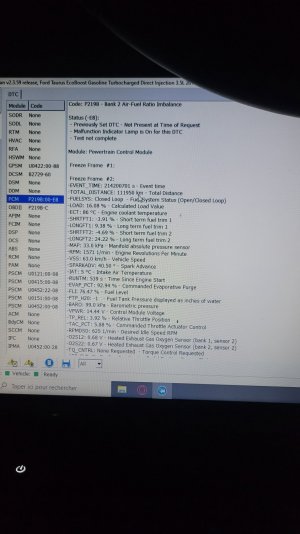
Forscan an invaluable tool, those plugs look fine - if the injector was going bad - just thinking out loud not declaring anything specific - could the injector be fine - the plugs look normal - if it was faulty wouldnt it show signs of fouling?
that's what I think too but the code appears more often than before that's why I think it's something mechanical but the car runs fineForscan an invaluable tool, those plugs look fine - if the injector was going bad - just thinking out loud not declaring anything specific - could the injector be fine - the plugs look normal - if it was faulty wouldnt it show signs of fouling?
Note: Do not clear the DTCs or reset the keep alive memory (KAM).
- Access the PCM and record the engine coolant temperature (ECT) PID from the freeze frame data. The freeze frame data is used to recreate the concern.
- Carry out the PCM self-test.
Are any DTCs present other than the following: P0171, P0172, P0174, P0175, P2195, P2196, P2197, P2198, P219A, or P219B?
Yes
- DISREGARD the current diagnostic trouble code (DTC) at this time. DIAGNOSE the next DTC. GO to Section 4, Diagnostic Trouble Code (DTC) Charts and Descriptions See: Computers and Control Systems > Diagnostic Trouble Code Tests and Associated Procedures > Diagnostic Trouble Code (DTC) Charts and Descriptions.
No
- GO to H3
H3 CARRY OUT A VISUAL INSPECTION
- Ignition OFF.
- Check the air filter element and housing for blockage.
- Inspect the entire air intake system from the mass airflow (MAF) sensor to the intake manifold for leaks such as:
- hoses connecting to the MAF sensor assembly
- cracked or punctured intake air tube
- loose connections on the intake air tube at the air cleaner housing or throttle body
- hoses connecting to the throttle body
- obstructions, restrictions, or damage
- Check the throttle plate for obstructions or sludge.
- Inspect the entire length of all the vacuum hoses for:
- correct connections
- damage or cracks
- damaged or cracked vacuum tees
- Inspect the intake manifold or gasket for leaks.
- Inspect the exhaust gas recirculation (EGR) system for leaks such as:
- EGR valve gasket leak to intake manifold
- EGR valve diaphragm or control solenoid
- Verify the integrity of the positive crankcase ventilation (PCV) system.
- Verify the proper PCV valve part number, (if equipped).
- Inspect the exhaust system for leaks at flanges and gaskets.
- Visually inspect the HO2S for:
- pinched, shorted, and corroded wiring and pins
- oil or water contamination
- crossed sensor wires
- Inspect for an incorrectly seated engine oil dipstick, dipstick tube, or oil fill cap.
Is a concern present?
Yes
- For vacuum leak concerns, GO to H9
.
- For all others, REPAIR as necessary.
- Clear the PCM DTCs. REPEAT the self-test.
No
- GO to H4
H4 CARRY OUT THE RELATIVE INJECTOR FLOW TEST
Note:The IDS test referenced in this step may not be available on all vehicles. Follow the YES answer if the IDS test is not available.
- Ignition OFF.
- Carry out the Relative Injector Flow Test. Refer to the instruction manual provided by the scan tool manufacturer.
Does the test pass?
Yes
- For DTCs P2270, P2271, P2272 or P2273, GO to H24
.
- For all others, GO to H5
.
No
- INSTALL a new Fuel Injector. REFER to the Workshop Manual Section
303-04, Fuel Charging and Controls. RESET the keep alive memory (KAM).
REFER to Section 2, Resetting The Keep Alive Memory (KAM). REPEAT the
self-test.
H5 CHECK THE EVAP SYSTEM FOR A STUCK OPEN EVAP PURGE VALVE
- Ignition ON, engine running.
- Access the PCM and monitor the FTP (PRESS) PID.
- Access the PCM and control the EVAPCP (PER) PID.
- Close the EVAP purge valve by commanding the EVAPCV PID to 0%.
- Access the PCM and control the EVAPCV (MODE) PID.
- Close the EVAP canister vent valve by commanding the EVAPCV PID to ON (100% duty cycle).
Does the FTP PID decrease, the engine RPM change, or the engine stall, as an indication that the EVAP purge valve is stuck open?
Yes
- INSTALL a new Evaporative Emission (EVAP) Purge valve. REFER to the Workshop Manual Section 303-13, Evaporative Emissions,
- Clear the PCM DTCs. REPEAT the self-test.
No
- For Edge 2.0L, Escape 1.6L, Escape 2.0L, Explorer 2.0L, Explorer GTDI
3.5L, F-150 3.5L, Fiesta 1.6L TiVCT, Flex GTDI 3.5L, Focus GTDI, Fusion
1.5L, Fusion 1.6L, Fusion 2.0L, MKS 3.5L, MKT 2.0L, MKT 3.5L, MKZ 2.0L,
Taurus 2.0L, Taurus GTDI 3.5L and Transit Connect 1.6L with DTCs P0171,
P0174, P2195 or P2197, GO to H7
.
- For DTCs P0172, P0175, P219A or P219B, GO to H11
.
- For DTCs P2196 or P2198, GO to H10
.
- For all others, GO to H6
.
H6 CHECK FOR THE PRESENCE OF A VACUUM LEAK
Note:Fuel trim values at idle are more sensitive to a vacuum leak. The vacuum leak (unmetered air) represents a larger portion of the total airflow at idle than at part throttle.
Note:When calculating the total fuel correction in the following steps, if LONGFT1 equals +13% and SHRTFT1 equals +23%, the total fuel correction for bank 1 equals +36%. If LONGFT2 equals +24% and SHRTFT2 equals -3% the total fuel correction for bank 2 equals +21%.
Note:If the freeze frame ECT PID is available, stabilize the engine at the temperature recorded by the freeze frame ECT PID. If the freeze frame ECT PID is not available, maintain the engine coolant temperature between 82°C - 101°C (180°F - 215°F) and the intake air temperature less than 46°C (115°F).
- Ignition ON, engine running.
- Access the PCM and monitor the ECT (TEMP), CHT (TEMP) and IAT (TEMP) PIDs.
- Access the PCM and monitor the LONGFT1 (PER), SHRTFT1 (PER), LONGFT2 (PER) and SHRTFT2 (PER) PIDs.
- Allow the engine to stabilize at the temperature necessary to recreate the concern.
- Mathematically add and record the LONGFT PID value to the SHRTFT PID value for each bank, for a total fuel correction at idle.
- Increase the engine speed to 3,500 RPM for 10 seconds.
- Record the LONGFT1, SHRTFT1, LONGFT2, and SHRTFT2 PID values.
- Mathematically add and record the LONGFT PID value to the SHRTFT PID value for each bank, for a total fuel correction at 3,500 RPM.
Is the total fuel correction value difference between idle and 3,500 RPM, less than 15 percent of the total value at idle?
Yes
- No vacuum leak is present.
- For DTCs P0171 or P0174, GO to H11
.
- For all others, GO to H10
.
No
- GO to H8
.
H7 MONITOR THE KOEO AND KOER MAP SENSOR VOLTAGE
- Ignition ON, engine OFF.
- Access the PCM and monitor the MAP_V (VOLT) PID.
- Record the MAP voltage.
- Ignition ON, engine running.
- Record the MAP voltage.
Does the PID value change?
Yes
- For DTCs P0171 or P0174, GO to H11
.
- For all others, GO to H10
.
No
- GO to Pinpoint Test DN See: Computers and Control Systems > Diagnostic Trouble Code Tests and Associated Procedures > DN: Pressure and Temperature Sensors - Introduction
- Access the PCM and record the engine coolant temperature (ECT) PID from the freeze frame data. The freeze frame data is used to recreate the concern.
- Carry out the PCM self-test.
Are any DTCs present other than the following: P0171, P0172, P0174, P0175, P2195, P2196, P2197, P2198, P219A, or P219B?
Yes
- DISREGARD the current diagnostic trouble code (DTC) at this time. DIAGNOSE the next DTC. GO to Section 4, Diagnostic Trouble Code (DTC) Charts and Descriptions See: Computers and Control Systems > Diagnostic Trouble Code Tests and Associated Procedures > Diagnostic Trouble Code (DTC) Charts and Descriptions.
No
- GO to H3
H3 CARRY OUT A VISUAL INSPECTION
- Ignition OFF.
- Check the air filter element and housing for blockage.
- Inspect the entire air intake system from the mass airflow (MAF) sensor to the intake manifold for leaks such as:
- hoses connecting to the MAF sensor assembly
- cracked or punctured intake air tube
- loose connections on the intake air tube at the air cleaner housing or throttle body
- hoses connecting to the throttle body
- obstructions, restrictions, or damage
- Check the throttle plate for obstructions or sludge.
- Inspect the entire length of all the vacuum hoses for:
- correct connections
- damage or cracks
- damaged or cracked vacuum tees
- Inspect the intake manifold or gasket for leaks.
- Inspect the exhaust gas recirculation (EGR) system for leaks such as:
- EGR valve gasket leak to intake manifold
- EGR valve diaphragm or control solenoid
- Verify the integrity of the positive crankcase ventilation (PCV) system.
- Verify the proper PCV valve part number, (if equipped).
- Inspect the exhaust system for leaks at flanges and gaskets.
- Visually inspect the HO2S for:
- pinched, shorted, and corroded wiring and pins
- oil or water contamination
- crossed sensor wires
- Inspect for an incorrectly seated engine oil dipstick, dipstick tube, or oil fill cap.
Is a concern present?
Yes
- For vacuum leak concerns, GO to H9
.
- For all others, REPAIR as necessary.
- Clear the PCM DTCs. REPEAT the self-test.
No
- GO to H4
H4 CARRY OUT THE RELATIVE INJECTOR FLOW TEST
Note:The IDS test referenced in this step may not be available on all vehicles. Follow the YES answer if the IDS test is not available.
- Ignition OFF.
- Carry out the Relative Injector Flow Test. Refer to the instruction manual provided by the scan tool manufacturer.
Does the test pass?
Yes
- For DTCs P2270, P2271, P2272 or P2273, GO to H24
.
- For all others, GO to H5
.
No
- INSTALL a new Fuel Injector. REFER to the Workshop Manual Section
303-04, Fuel Charging and Controls. RESET the keep alive memory (KAM).
REFER to Section 2, Resetting The Keep Alive Memory (KAM). REPEAT the
self-test.
H5 CHECK THE EVAP SYSTEM FOR A STUCK OPEN EVAP PURGE VALVE
- Ignition ON, engine running.
- Access the PCM and monitor the FTP (PRESS) PID.
- Access the PCM and control the EVAPCP (PER) PID.
- Close the EVAP purge valve by commanding the EVAPCV PID to 0%.
- Access the PCM and control the EVAPCV (MODE) PID.
- Close the EVAP canister vent valve by commanding the EVAPCV PID to ON (100% duty cycle).
Does the FTP PID decrease, the engine RPM change, or the engine stall, as an indication that the EVAP purge valve is stuck open?
Yes
- INSTALL a new Evaporative Emission (EVAP) Purge valve. REFER to the Workshop Manual Section 303-13, Evaporative Emissions,
- Clear the PCM DTCs. REPEAT the self-test.
No
- For Edge 2.0L, Escape 1.6L, Escape 2.0L, Explorer 2.0L, Explorer GTDI
3.5L, F-150 3.5L, Fiesta 1.6L TiVCT, Flex GTDI 3.5L, Focus GTDI, Fusion
1.5L, Fusion 1.6L, Fusion 2.0L, MKS 3.5L, MKT 2.0L, MKT 3.5L, MKZ 2.0L,
Taurus 2.0L, Taurus GTDI 3.5L and Transit Connect 1.6L with DTCs P0171,
P0174, P2195 or P2197, GO to H7
.
- For DTCs P0172, P0175, P219A or P219B, GO to H11
.
- For DTCs P2196 or P2198, GO to H10
.
- For all others, GO to H6
.
H6 CHECK FOR THE PRESENCE OF A VACUUM LEAK
Note:Fuel trim values at idle are more sensitive to a vacuum leak. The vacuum leak (unmetered air) represents a larger portion of the total airflow at idle than at part throttle.
Note:When calculating the total fuel correction in the following steps, if LONGFT1 equals +13% and SHRTFT1 equals +23%, the total fuel correction for bank 1 equals +36%. If LONGFT2 equals +24% and SHRTFT2 equals -3% the total fuel correction for bank 2 equals +21%.
Note:If the freeze frame ECT PID is available, stabilize the engine at the temperature recorded by the freeze frame ECT PID. If the freeze frame ECT PID is not available, maintain the engine coolant temperature between 82°C - 101°C (180°F - 215°F) and the intake air temperature less than 46°C (115°F).
- Ignition ON, engine running.
- Access the PCM and monitor the ECT (TEMP), CHT (TEMP) and IAT (TEMP) PIDs.
- Access the PCM and monitor the LONGFT1 (PER), SHRTFT1 (PER), LONGFT2 (PER) and SHRTFT2 (PER) PIDs.
- Allow the engine to stabilize at the temperature necessary to recreate the concern.
- Mathematically add and record the LONGFT PID value to the SHRTFT PID value for each bank, for a total fuel correction at idle.
- Increase the engine speed to 3,500 RPM for 10 seconds.
- Record the LONGFT1, SHRTFT1, LONGFT2, and SHRTFT2 PID values.
- Mathematically add and record the LONGFT PID value to the SHRTFT PID value for each bank, for a total fuel correction at 3,500 RPM.
Is the total fuel correction value difference between idle and 3,500 RPM, less than 15 percent of the total value at idle?
Yes
- No vacuum leak is present.
- For DTCs P0171 or P0174, GO to H11
.
- For all others, GO to H10
.
No
- GO to H8
.
H7 MONITOR THE KOEO AND KOER MAP SENSOR VOLTAGE
- Ignition ON, engine OFF.
- Access the PCM and monitor the MAP_V (VOLT) PID.
- Record the MAP voltage.
- Ignition ON, engine running.
- Record the MAP voltage.
Does the PID value change?
Yes
- For DTCs P0171 or P0174, GO to H11
.
- For all others, GO to H10
.
No
- GO to Pinpoint Test DN See: Computers and Control Systems > Diagnostic Trouble Code Tests and Associated Procedures > DN: Pressure and Temperature Sensors - Introduction
H8 LOCATE THE VACUUM LEAK
NOTICE o not clamp or pinch a hard plastic hose. Use a vacuum cap or equivalent to restrict the hose.
Note:Restricting the EVAP vapor hose while the EVAP emission canister is purging may shift the SHRTFT. Carry out a visual inspection as necessary.
Note:When monitoring for a decrease in the SHRTFT PIDs in the following steps, if SHRTFT1 equals +15% and the hose is restricted, SHRTFT1 decreases to -7%. The total decrease in the SHRTFT PIDs equals 22%.
- Locate the vacuum tees for the intake air and PCV systems.
- Ignition ON, engine running.
- Access the PCM and monitor the SHRTFT1 (PER) and SHRTFT2 (PER) PIDs.
- Restrict the vacuum lines one at a time for 30 seconds. If a vacuum leak is present, the SHRTFT PID values decrease as the hose is restricted.
Is the decrease in the SHRTFT PIDs greater than 15 percent when one of the vacuum hoses is restricted?
Yes
- GO to H9
.
No
- INSPECT the intake air system for a vacuum leak in the intake manifold or intake gaskets. REPAIR as necessary.
- For repair verification, GO to H9
.
H9 VACUUM LEAK REPAIR VERIFICATION
Note:If the freeze frame ECT PID is available, stabilize the engine at the temperature recorded by the freeze frame ECT PID. If the freeze frame ECT PID is not available, maintain the engine coolant temperature between 82°C - 101°C (180°F - 215°F) and the intake air temperature less than 46°C (115°F).
- Ignition ON, engine running.
- Access the PCM and monitor the SHRTFT1 (PER) and SHRTFT2 (PER) PIDs.
- Allow the engine to stabilize at the temperature necessary to recreate the concern.
- Record the SHRTFT1 and SHRTFT2 PID values.
- Ignition OFF.
- Repair the vacuum leak.
- Ignition ON, engine running.
- Allow the engine to stabilize at the temperature necessary to recreate the concern.
- Compare the recorded SHRTFT PID values, prior to the vacuum leak repair, to the current SHRTFT PID values.
Is the decrease in the SHRTFT PIDs greater than 15 percent?
Yes
- RESET the keep alive memory (KAM). REFER to Section 2, Resetting The Keep Alive Memory (KAM) See: Computers and Control Systems > Diagnostic Trouble Code Tests and Associated Procedures > Resetting The Keep Alive Memory (KAM). REPEAT the self-test.
No
- A vacuum leak is still present.
- GO to H8
.
H10 CHECK THE UO2SPC CIRCUIT FOR AN OPEN
Note:Only the suspect universal HO2S needs to be diagnosed.
- Ignition OFF.
- Universal HO2S connector disconnected.
- PCM connector disconnected.
- Measure the resistance between:
image
Is the resistance less than 5 ohms?
Yes
- GO to H11
.
No
- REPAIR the open circuit.
- RESET the keep alive memory (KAM). REFER to Section 2, Resetting The Keep Alive Memory (KAM) See: Computers and Control Systems > Diagnostic Trouble Code Tests and Associated Procedures > Resetting The Keep Alive Memory (KAM). REPEAT the self-test.
H11 CHECK THE FUEL PRESSURE
WARNING: WHEN CHECKING THE FUEL SYSTEM REMEMBER THAT THE FUEL SYSTEM MAY STILL BE PRESSURIZED WHEN THE ENGINE IS SWITCHED OFF. ALWAYS FOLLOW THE INSTRUCTIONS RELATED TO FUEL SYSTEM PRESSURE RELIEF. ALL FUEL HANDLING SAFETY PRECAUTIONS MUST BE OBSERVED. FAILURE TO FOLLOW THESE INSTRUCTIONS MAY RESULT IN PERSONAL INJURY.
Note:For vehicle specific fuel pressure ranges, refer to the Fuel System Specification Chart in Pinpoint Test HC.
- Remove the jumper wire(s).
- Universal HO2S connector connected.
- Relieve the fuel pressure. Refer to the Workshop Manual Section 310-00, Fuel System for the Fuel System Pressure Release procedure.
- Mechanical fuel pressure gauge connected.
- Pressurize the fuel system. Refer to the Workshop Manual Section 310-00, Fuel System for the Fuel System Pressure Release procedure to pressurize the fuel system.
- Ignition ON, engine running.
- Allow the fuel pressure to stabilize.
- Ignition OFF.
- Ignition ON, engine running.
- Access the PCM and control the FP (MODE) PID.
- Run the fuel pump to obtain maximum fuel pressure.
Is the fuel pressure within range for the vehicle being diagnosed?
Yes
- GO to H12
.
No
- GO to Pinpoint Test HC See: Computers and Control Systems > Diagnostic Trouble Code Tests and Associated Procedures > HC: Fuel Delivery System - Introduction
.
H12 CHECK THE FUEL SYSTEM FOR PRESSURE STABILITY - FAST LEAKDOWN
Note:When the fuel pump is commanded off, the fuel pressure may substantially decrease and then stabilize.
Noteuring output state control, the fuel pump stays commanded on for approximately 5 seconds.
- Ignition OFF.
- Ignition ON, engine OFF.
- Access the PCM and control the FP (MODE) PID.
- Run the fuel pump to obtain maximum fuel pressure.
- Command the fuel pump off.
- Allow the fuel pressure to stabilize.
- Record the stabilized reading.
- Monitor the fuel pressure for 10 seconds.
Does the fuel pressure remain within 34 kPa (5 psi) of the recorded reading after 10 seconds?
Yes
- GO to H14
.
No
- GO to H13
.
H13 CHECK FOR AN EXTERNAL FUEL LEAK
- Inspect the fuel tank, lines, and filler pipe for a fuel leak.
Is a concern present?
Yes
- REPAIR as necessary.
- REFER to the fuel system WARNING information at the beginning of Pinpoint Test HC. GO to Pinpoint Test HC See: Computers and Control Systems > Diagnostic Trouble Code Tests and Associated Procedures > HC: Fuel Delivery System - Introduction
.
- RESET the keep alive memory (KAM). REFER to Section 2, Resetting The Keep Alive Memory (KAM) See: Computers and Control Systems > Diagnostic Trouble Code Tests and Associated Procedures > Resetting The Keep Alive Memory (KAM). REPEAT the self-test.
No
- For DTCs P219A or P219B, GO to H14
.
- For all others, GO to H21
.
H14 CHECK THE FUEL SYSTEM FOR PRESSURE STABILITY - SLOW LEAKDOWN
- Continue to monitor the fuel pressure for 1 minute.
Does the fuel pressure remain within 34 kPa (5 psi) of the recorded reading (MRFS) or greater than 275 kPa (40 psi) (ERFS) after 1 minute?
Yes
- For DTCs P219A or P219B, UNABLE to duplicate or identify the concern at this time.
- GO to Pinpoint Test Z See: Computers and Control Systems > Diagnostic Trouble Code Tests and Associated Procedures > Z: Intermittent - Introduction
.
- For all others, GO to H15
.
No
- GO to HC13 See: Computers and Control Systems > Diagnostic Trouble Code Tests and Associated Procedures > HC: Fuel Delivery System - Pinpoint Test
.
H15 CHECK THE SEPARATION LEVEL OF THE ETHANOL, WATER AND GASOLINE MIXTURE IN THE FUEL
Note:This step requires the use of a locally obtained 200 ml beaker and a 25 ml graduated cylinder.
Note:After approximately 3 minutes of standing, the ethanol and water mixes together and settles to the bottom of the 25 ml graduated cylinder. The gasoline rises to the top.
- Fill the 200 ml beaker with 5 ml of clean water.
- Use the pressure relief valve on the mechanical fuel gauge to drain 22 ml of fuel into an approved clean container.
- Pour 20 ml of fuel from the approved clean container into the 25 ml graduated cylinder.
- Add enough water from the 200 ml beaker to the 25 ml graduated cylinder to bring the total volume of liquid to 24 ml.
- Insert a stopper plug in the opening of the 25 ml graduated cylinder.
- Firmly hold the stopper in place and shake the 25 ml graduated cylinder to mix the water and fuel.
- Allow the liquid to stand and separate for approximately 3 minutes.
- Record the separation level from the 25 ml graduated cylinder where the ethanol and water mixture and gasoline meet.
Does the ethanol and water mixture and gasoline separate?
Yes
- GO to H16
.
No
- The ethanol and water mixture will separate from the gasoline. If the
fuel does not appear to separate, then the fuel is either 100% ethanol
or a mixture of ethanol and water. REPLACE the contaminated fuel.
- Clear the PCM DTCs. REPEAT the self-test.
H16 CALCULATE THE PERCENTAGE OF ETHANOL IN THE FUEL
Note:Use the illustration as an example for calculating the percentage of ethanol in the following steps. If the separation level is at 14 ml the calculation becomes; 14 minus 4, then multiply by 5 to equal 50. The percentage of ethanol in the fuel is 50%.
- Ignition OFF.
- Take the recorded separation level from the previous step and subtract the amount of water added.
- Multiply the new value by 5. This new value is the percentage of ethanol in the fuel.
Open In New Tab Zoom/Printimage
image
- Record the calculated percentage of ethanol in the fuel.
Is any ethanol present in the fuel?
Yes
- For flex fuel vehicles, GO to H17
.
- For all others, GO to H20
.
No
- For DTCs P0171, P0174, P2195 or P2197, GO to HC3 See: Computers and Control Systems > Diagnostic Trouble Code Tests and Associated Procedures > HC: Fuel Delivery System - Pinpoint Test
.
- For all others, GO to H21
NOTICE
o not clamp or pinch a hard plastic hose. Use a vacuum cap or equivalent to restrict the hose.Note:Restricting the EVAP vapor hose while the EVAP emission canister is purging may shift the SHRTFT. Carry out a visual inspection as necessary.
Note:When monitoring for a decrease in the SHRTFT PIDs in the following steps, if SHRTFT1 equals +15% and the hose is restricted, SHRTFT1 decreases to -7%. The total decrease in the SHRTFT PIDs equals 22%.
- Locate the vacuum tees for the intake air and PCV systems.
- Ignition ON, engine running.
- Access the PCM and monitor the SHRTFT1 (PER) and SHRTFT2 (PER) PIDs.
- Restrict the vacuum lines one at a time for 30 seconds. If a vacuum leak is present, the SHRTFT PID values decrease as the hose is restricted.
Is the decrease in the SHRTFT PIDs greater than 15 percent when one of the vacuum hoses is restricted?
Yes
- GO to H9
.
No
- INSPECT the intake air system for a vacuum leak in the intake manifold or intake gaskets. REPAIR as necessary.
- For repair verification, GO to H9
.
H9 VACUUM LEAK REPAIR VERIFICATION
Note:If the freeze frame ECT PID is available, stabilize the engine at the temperature recorded by the freeze frame ECT PID. If the freeze frame ECT PID is not available, maintain the engine coolant temperature between 82°C - 101°C (180°F - 215°F) and the intake air temperature less than 46°C (115°F).
- Ignition ON, engine running.
- Access the PCM and monitor the SHRTFT1 (PER) and SHRTFT2 (PER) PIDs.
- Allow the engine to stabilize at the temperature necessary to recreate the concern.
- Record the SHRTFT1 and SHRTFT2 PID values.
- Ignition OFF.
- Repair the vacuum leak.
- Ignition ON, engine running.
- Allow the engine to stabilize at the temperature necessary to recreate the concern.
- Compare the recorded SHRTFT PID values, prior to the vacuum leak repair, to the current SHRTFT PID values.
Is the decrease in the SHRTFT PIDs greater than 15 percent?
Yes
- RESET the keep alive memory (KAM). REFER to Section 2, Resetting The Keep Alive Memory (KAM) See: Computers and Control Systems > Diagnostic Trouble Code Tests and Associated Procedures > Resetting The Keep Alive Memory (KAM). REPEAT the self-test.
No
- A vacuum leak is still present.
- GO to H8
.
H10 CHECK THE UO2SPC CIRCUIT FOR AN OPEN
Note:Only the suspect universal HO2S needs to be diagnosed.
- Ignition OFF.
- Universal HO2S connector disconnected.
- PCM connector disconnected.
- Measure the resistance between:
image
Is the resistance less than 5 ohms?
Yes
- GO to H11
.
No
- REPAIR the open circuit.
- RESET the keep alive memory (KAM). REFER to Section 2, Resetting The Keep Alive Memory (KAM) See: Computers and Control Systems > Diagnostic Trouble Code Tests and Associated Procedures > Resetting The Keep Alive Memory (KAM). REPEAT the self-test.
H11 CHECK THE FUEL PRESSURE
WARNING: WHEN CHECKING THE FUEL SYSTEM REMEMBER THAT THE FUEL SYSTEM MAY STILL BE PRESSURIZED WHEN THE ENGINE IS SWITCHED OFF. ALWAYS FOLLOW THE INSTRUCTIONS RELATED TO FUEL SYSTEM PRESSURE RELIEF. ALL FUEL HANDLING SAFETY PRECAUTIONS MUST BE OBSERVED. FAILURE TO FOLLOW THESE INSTRUCTIONS MAY RESULT IN PERSONAL INJURY.
Note:For vehicle specific fuel pressure ranges, refer to the Fuel System Specification Chart in Pinpoint Test HC.
- Remove the jumper wire(s).
- Universal HO2S connector connected.
- Relieve the fuel pressure. Refer to the Workshop Manual Section 310-00, Fuel System for the Fuel System Pressure Release procedure.
- Mechanical fuel pressure gauge connected.
- Pressurize the fuel system. Refer to the Workshop Manual Section 310-00, Fuel System for the Fuel System Pressure Release procedure to pressurize the fuel system.
- Ignition ON, engine running.
- Allow the fuel pressure to stabilize.
- Ignition OFF.
- Ignition ON, engine running.
- Access the PCM and control the FP (MODE) PID.
- Run the fuel pump to obtain maximum fuel pressure.
Is the fuel pressure within range for the vehicle being diagnosed?
Yes
- GO to H12
.
No
- GO to Pinpoint Test HC See: Computers and Control Systems > Diagnostic Trouble Code Tests and Associated Procedures > HC: Fuel Delivery System - Introduction
.
H12 CHECK THE FUEL SYSTEM FOR PRESSURE STABILITY - FAST LEAKDOWN
Note:When the fuel pump is commanded off, the fuel pressure may substantially decrease and then stabilize.
Note
uring output state control, the fuel pump stays commanded on for approximately 5 seconds.- Ignition OFF.
- Ignition ON, engine OFF.
- Access the PCM and control the FP (MODE) PID.
- Run the fuel pump to obtain maximum fuel pressure.
- Command the fuel pump off.
- Allow the fuel pressure to stabilize.
- Record the stabilized reading.
- Monitor the fuel pressure for 10 seconds.
Does the fuel pressure remain within 34 kPa (5 psi) of the recorded reading after 10 seconds?
Yes
- GO to H14
.
No
- GO to H13
.
H13 CHECK FOR AN EXTERNAL FUEL LEAK
- Inspect the fuel tank, lines, and filler pipe for a fuel leak.
Is a concern present?
Yes
- REPAIR as necessary.
- REFER to the fuel system WARNING information at the beginning of Pinpoint Test HC. GO to Pinpoint Test HC See: Computers and Control Systems > Diagnostic Trouble Code Tests and Associated Procedures > HC: Fuel Delivery System - Introduction
.
- RESET the keep alive memory (KAM). REFER to Section 2, Resetting The Keep Alive Memory (KAM) See: Computers and Control Systems > Diagnostic Trouble Code Tests and Associated Procedures > Resetting The Keep Alive Memory (KAM). REPEAT the self-test.
No
- For DTCs P219A or P219B, GO to H14
.
- For all others, GO to H21
.
H14 CHECK THE FUEL SYSTEM FOR PRESSURE STABILITY - SLOW LEAKDOWN
- Continue to monitor the fuel pressure for 1 minute.
Does the fuel pressure remain within 34 kPa (5 psi) of the recorded reading (MRFS) or greater than 275 kPa (40 psi) (ERFS) after 1 minute?
Yes
- For DTCs P219A or P219B, UNABLE to duplicate or identify the concern at this time.
- GO to Pinpoint Test Z See: Computers and Control Systems > Diagnostic Trouble Code Tests and Associated Procedures > Z: Intermittent - Introduction
.
- For all others, GO to H15
.
No
- GO to HC13 See: Computers and Control Systems > Diagnostic Trouble Code Tests and Associated Procedures > HC: Fuel Delivery System - Pinpoint Test
.
H15 CHECK THE SEPARATION LEVEL OF THE ETHANOL, WATER AND GASOLINE MIXTURE IN THE FUEL
Note:This step requires the use of a locally obtained 200 ml beaker and a 25 ml graduated cylinder.
Note:After approximately 3 minutes of standing, the ethanol and water mixes together and settles to the bottom of the 25 ml graduated cylinder. The gasoline rises to the top.
- Fill the 200 ml beaker with 5 ml of clean water.
- Use the pressure relief valve on the mechanical fuel gauge to drain 22 ml of fuel into an approved clean container.
- Pour 20 ml of fuel from the approved clean container into the 25 ml graduated cylinder.
- Add enough water from the 200 ml beaker to the 25 ml graduated cylinder to bring the total volume of liquid to 24 ml.
- Insert a stopper plug in the opening of the 25 ml graduated cylinder.
- Firmly hold the stopper in place and shake the 25 ml graduated cylinder to mix the water and fuel.
- Allow the liquid to stand and separate for approximately 3 minutes.
- Record the separation level from the 25 ml graduated cylinder where the ethanol and water mixture and gasoline meet.
Does the ethanol and water mixture and gasoline separate?
Yes
- GO to H16
.
No
- The ethanol and water mixture will separate from the gasoline. If the
fuel does not appear to separate, then the fuel is either 100% ethanol
or a mixture of ethanol and water. REPLACE the contaminated fuel.
- Clear the PCM DTCs. REPEAT the self-test.
H16 CALCULATE THE PERCENTAGE OF ETHANOL IN THE FUEL
Note:Use the illustration as an example for calculating the percentage of ethanol in the following steps. If the separation level is at 14 ml the calculation becomes; 14 minus 4, then multiply by 5 to equal 50. The percentage of ethanol in the fuel is 50%.
- Ignition OFF.
- Take the recorded separation level from the previous step and subtract the amount of water added.
- Multiply the new value by 5. This new value is the percentage of ethanol in the fuel.
Open In New Tab Zoom/Printimage
image
- Record the calculated percentage of ethanol in the fuel.
Is any ethanol present in the fuel?
Yes
- For flex fuel vehicles, GO to H17
.
- For all others, GO to H20
.
No
- For DTCs P0171, P0174, P2195 or P2197, GO to HC3 See: Computers and Control Systems > Diagnostic Trouble Code Tests and Associated Procedures > HC: Fuel Delivery System - Pinpoint Test
.
- For all others, GO to H21
H17 COMPARE THE FF_INF PID TO THE CALCULATED PERCENTAGE OF ETHANOL
Note:When determining if the FF_INF PID value is within 20% of the calculated percentage of ethanol, for example, if the calculated percentage of ethanol value is 40% then the PID value should be between 32 - 48%. The PID value cannot be less than zero.
- Ignition ON, engine OFF.
- Access the PCM and monitor the FF_INF (PER) PID.
- Compare the FF_INF PID to the calculated percentage of ethanol.
Is the FF_INF PID value within 20% of the calculated percentage of ethanol?
Yes
- For DTCs P0171, P0174, P2195 or P2197, GO to HC3 See: Computers and Control Systems > Diagnostic Trouble Code Tests and Associated Procedures > HC: Fuel Delivery System - Pinpoint Test
.
- For all others, GO to H21
.
No
- GO to H18
.
H18 RESET THE PERCENT ETHANOL PARAMETER IN THE PCM
Note:Certain customer fueling practices such as only fueling with small amounts of fuel or repeatedly switching between gasoline and an ethanol blend greater than E15 may prevent the PCM from learning the correct ethanol content in the fuel.
- Reset the keep alive memory (KAM). Refer to Section 2, Resetting The Keep Alive Memory (KAM) See: Computers and Control Systems > Diagnostic Trouble Code Tests and Associated Procedures > Resetting The Keep Alive Memory (KAM).
- Ignition ON, engine running.
- Access the PCM and monitor the FF_LRND (MODE) PID.
- Drive the vehicle approximately 11.3 km (7 miles) or until the FF_LRND PID indicates yes.
Is the PID state YES?
Yes
- GO to H19
.
No
- GO to H29
.
H19 COMPARE THE UPDATED FF_INF PID TO THE CALCULATED PERCENTAGE OF ETHANOL
- Ignition OFF.
- Ignition ON, engine OFF.
- Access the PCM and monitor the FF_INF (PER) PID.
Is the FF_INF PID value within 20% of the calculated percentage of ethanol?
Yes
- RETURN the vehicle to the customer. ADVISE the customer of the correct
fueling practices when using flex fuel. REFER to the Owner's Literature
for additional information. ADVISE the customer to continue to use the
same fuel for the next 2-3 refuels. This practice helps to verify the
PCM is learning the correct percentage of ethanol in the fuel.
No
- A fuel system concern may be present, which prevents the PCM from learning the correct percentage of ethanol in the fuel,
- GO to HC13 See: Computers and Control Systems > Diagnostic Trouble Code Tests and Associated Procedures > HC: Fuel Delivery System - Pinpoint Test
.
H20 DETERMINE IF THE PERCENTAGE OF ETHANOL IN THE FUEL IS LESS THAN 25%
- Check the recorded calculated percentage of ethanol in the fuel.
Is the calculated percentage of ethanol in the fuel less than 25%?
Yes
- For DTCs P0171, P0174, P2195 or P2197, GO to HC3 See: Computers and Control Systems > Diagnostic Trouble Code Tests and Associated Procedures > HC: Fuel Delivery System - Pinpoint Test
.
- For all others, GO to H21
.
No
- REPAIR as necessary. ADVISE the customer of the correct fuel type
required for this vehicle. REFER to the Owner's Literature for
additional information.
- RESET the keep alive memory (KAM). REFER to Section 2, Resetting The Keep Alive Memory (KAM) See: Computers and Control Systems > Diagnostic Trouble Code Tests and Associated Procedures > Resetting The Keep Alive Memory (KAM). REPEAT the self-test.
H21 CARRY OUT A VISUAL INSPECTION
- Ignition OFF.
- Universal HO2S connector disconnected.
- Visually inspect for:
- pinched, shorted, and corroded wiring and pins
- oil or water contamination
- crossed sensor wires
- contaminated or damaged sensor
Is a concern present?
Yes
- REPAIR as necessary.
- Clear the PCM DTCs. REPEAT the self-test.
No
- For Edge 2.0L,
- Escape/Kuga 1.6L,
- Escape/Kuga 2.0L,
- Explorer 2.0L,
- Explorer 3.5L GTDI,
- F-150 3.5L,
- Fiesta 1.6L TiVCT,
- Flex 3.5L GTDI,
- Focus GTDI,
- Fusion 1.5L,
- Fusion 1.6L,
- Fusion 2.0L,
- MKS 3.5L,
- MKT 2.0L,
- MKT 3.5L,
- MKZ 2.0L,
- Taurus 2.0L,
- Taurus 3.5L GTDI, and
- Transit Connect 1.6L, GO to H23
.
- For all others, GO to H22
.
H22 CHECK THE FUNCTIONALITY OF THE MASS AIRFLOW (MAF) SENSOR
Note:A MAF PID value of less than 0.6 volt may indicate an incorrectly installed air cleaner or a leak in the air inlet system.
- Ignition ON, engine running.
- Allow the engine to stabilize at the correct operating temperature.
- Access the PCM and monitor the MAF (VOLT) PID.
- Check that the MAF PID at idle and NEUTRAL is not greater than 30% of the normal MAF listed in Section 6 See: Computers and Control Systems > Diagnostic Trouble Code Tests and Associated Procedures > SECTION 6: Reference Values , Reference Values or not greater than 1.3 volts.
Is the PID value within the expected range?
Yes
- GO to H23
.
No
- To continue diagnosis of the MAF/IAT sensor,
- GO to Pinpoint Test DC See: Computers and Control Systems > Diagnostic Trouble Code Tests and Associated Procedures > DC: Mass Airflow (MAF) Sensor - Introduction
.
H23 CHECK THE UNIVERSAL HO2S ACTIVITY
- Universal HO2S connector connected.
- Ignition ON, engine running.
- Access the PCM and monitor the FUELSYS (MODE) PID.
- Allow the engine to enter closed loop fuel control.
- Access the PCM and monitor the O2S11_CUR (CUR) and O2S21_CUR (CUR) PIDs.
Does the O2S11_CUR or O2S21_CUR PID value switch?
Yes
- Unable to duplicate or identify the concern at this time.
- GO to Pinpoint Test Z See: Computers and Control Systems > Diagnostic Trouble Code Tests and Associated Procedures > Z: Intermittent - Introduction
.
No
- INSTALL a new Universal HO2S. REFER to the Workshop Manual Section 303-14, Electronic Engine Controls.
- RESET the keep alive memory (KAM). REFER to Section 2, Resetting The Keep Alive Memory (KAM) See: Computers and Control Systems > Diagnostic Trouble Code Tests and Associated Procedures > Resetting The Keep Alive Memory (KAM). REPEAT the self-test.
H24 CHECK FOR KOER DTCS
- Ignition ON, engine OFF.
- Clear the PCM DTCs.
- Ignition ON, engine running.
- Run the engine at approximately 2,000 RPM. Maintain the engine speed for 3 minutes.
- Carry out the PCM self-test.
Are DTCs P2270, P2271, P2272 or P2273 present?
Yes
- GO to H25
.
No
- Unable to duplicate or identify the concern at this time.
- GO to Pinpoint Test Z See: Computers and Control Systems > Diagnostic Trouble Code Tests and Associated Procedures > Z: Intermittent - Introduction
.
H25 CHECK FOR SHORTS BETWEEN CIRCUITS IN THE HO2S HARNESS
Noteiagnose the suspect sensor indicated by the DTC.
- PCM connector disconnected.
- For HO2S12,
- HO2S12 connector disconnected.
- Measure the resistance between:
image
- Measure the resistance between:
image
- For HO2S22,
- HO2S22 connector disconnected.
- Measure the resistance between:
image
- Measure the resistance between:
image
Are the resistances greater than 10K ohms?
Yes
- GO to H26
.
No
- REPAIR the short circuit. Clear the PCM DTCs. REPEAT the self-test.
H26 CHECK THE HO2S CIRCUIT FOR AN OPEN
- For HO2S12,
- Measure the resistance between:
image
- For HO2S22,
- Measure the resistance between:
image
Are the resistances less than 5 ohms?
Yes
- GO to H27
.
No
- REPAIR the open circuit. Clear the PCM DTCs. REPEAT the self-test.
H27 CHECK THE HO2S CIRCUIT FOR A SHORT TO VOLTAGE
- Ignition ON, engine OFF.
- For HO2S12,
- Measure the voltage between:
image
- For HO2S22,
- Measure the voltage between:
image
Is any voltage present?
Yes
- REPAIR the short circuit. Clear the PCM DTCs. REPEAT the self-test.
No
- GO to H28
.
Note:When determining if the FF_INF PID value is within 20% of the calculated percentage of ethanol, for example, if the calculated percentage of ethanol value is 40% then the PID value should be between 32 - 48%. The PID value cannot be less than zero.
- Ignition ON, engine OFF.
- Access the PCM and monitor the FF_INF (PER) PID.
- Compare the FF_INF PID to the calculated percentage of ethanol.
Is the FF_INF PID value within 20% of the calculated percentage of ethanol?
Yes
- For DTCs P0171, P0174, P2195 or P2197, GO to HC3 See: Computers and Control Systems > Diagnostic Trouble Code Tests and Associated Procedures > HC: Fuel Delivery System - Pinpoint Test
.
- For all others, GO to H21
.
No
- GO to H18
.
H18 RESET THE PERCENT ETHANOL PARAMETER IN THE PCM
Note:Certain customer fueling practices such as only fueling with small amounts of fuel or repeatedly switching between gasoline and an ethanol blend greater than E15 may prevent the PCM from learning the correct ethanol content in the fuel.
- Reset the keep alive memory (KAM). Refer to Section 2, Resetting The Keep Alive Memory (KAM) See: Computers and Control Systems > Diagnostic Trouble Code Tests and Associated Procedures > Resetting The Keep Alive Memory (KAM).
- Ignition ON, engine running.
- Access the PCM and monitor the FF_LRND (MODE) PID.
- Drive the vehicle approximately 11.3 km (7 miles) or until the FF_LRND PID indicates yes.
Is the PID state YES?
Yes
- GO to H19
.
No
- GO to H29
.
H19 COMPARE THE UPDATED FF_INF PID TO THE CALCULATED PERCENTAGE OF ETHANOL
- Ignition OFF.
- Ignition ON, engine OFF.
- Access the PCM and monitor the FF_INF (PER) PID.
Is the FF_INF PID value within 20% of the calculated percentage of ethanol?
Yes
- RETURN the vehicle to the customer. ADVISE the customer of the correct
fueling practices when using flex fuel. REFER to the Owner's Literature
for additional information. ADVISE the customer to continue to use the
same fuel for the next 2-3 refuels. This practice helps to verify the
PCM is learning the correct percentage of ethanol in the fuel.
No
- A fuel system concern may be present, which prevents the PCM from learning the correct percentage of ethanol in the fuel,
- GO to HC13 See: Computers and Control Systems > Diagnostic Trouble Code Tests and Associated Procedures > HC: Fuel Delivery System - Pinpoint Test
.
H20 DETERMINE IF THE PERCENTAGE OF ETHANOL IN THE FUEL IS LESS THAN 25%
- Check the recorded calculated percentage of ethanol in the fuel.
Is the calculated percentage of ethanol in the fuel less than 25%?
Yes
- For DTCs P0171, P0174, P2195 or P2197, GO to HC3 See: Computers and Control Systems > Diagnostic Trouble Code Tests and Associated Procedures > HC: Fuel Delivery System - Pinpoint Test
.
- For all others, GO to H21
.
No
- REPAIR as necessary. ADVISE the customer of the correct fuel type
required for this vehicle. REFER to the Owner's Literature for
additional information.
- RESET the keep alive memory (KAM). REFER to Section 2, Resetting The Keep Alive Memory (KAM) See: Computers and Control Systems > Diagnostic Trouble Code Tests and Associated Procedures > Resetting The Keep Alive Memory (KAM). REPEAT the self-test.
H21 CARRY OUT A VISUAL INSPECTION
- Ignition OFF.
- Universal HO2S connector disconnected.
- Visually inspect for:
- pinched, shorted, and corroded wiring and pins
- oil or water contamination
- crossed sensor wires
- contaminated or damaged sensor
Is a concern present?
Yes
- REPAIR as necessary.
- Clear the PCM DTCs. REPEAT the self-test.
No
- For Edge 2.0L,
- Escape/Kuga 1.6L,
- Escape/Kuga 2.0L,
- Explorer 2.0L,
- Explorer 3.5L GTDI,
- F-150 3.5L,
- Fiesta 1.6L TiVCT,
- Flex 3.5L GTDI,
- Focus GTDI,
- Fusion 1.5L,
- Fusion 1.6L,
- Fusion 2.0L,
- MKS 3.5L,
- MKT 2.0L,
- MKT 3.5L,
- MKZ 2.0L,
- Taurus 2.0L,
- Taurus 3.5L GTDI, and
- Transit Connect 1.6L, GO to H23
.
- For all others, GO to H22
.
H22 CHECK THE FUNCTIONALITY OF THE MASS AIRFLOW (MAF) SENSOR
Note:A MAF PID value of less than 0.6 volt may indicate an incorrectly installed air cleaner or a leak in the air inlet system.
- Ignition ON, engine running.
- Allow the engine to stabilize at the correct operating temperature.
- Access the PCM and monitor the MAF (VOLT) PID.
- Check that the MAF PID at idle and NEUTRAL is not greater than 30% of the normal MAF listed in Section 6 See: Computers and Control Systems > Diagnostic Trouble Code Tests and Associated Procedures > SECTION 6: Reference Values , Reference Values or not greater than 1.3 volts.
Is the PID value within the expected range?
Yes
- GO to H23
.
No
- To continue diagnosis of the MAF/IAT sensor,
- GO to Pinpoint Test DC See: Computers and Control Systems > Diagnostic Trouble Code Tests and Associated Procedures > DC: Mass Airflow (MAF) Sensor - Introduction
.
H23 CHECK THE UNIVERSAL HO2S ACTIVITY
- Universal HO2S connector connected.
- Ignition ON, engine running.
- Access the PCM and monitor the FUELSYS (MODE) PID.
- Allow the engine to enter closed loop fuel control.
- Access the PCM and monitor the O2S11_CUR (CUR) and O2S21_CUR (CUR) PIDs.
Does the O2S11_CUR or O2S21_CUR PID value switch?
Yes
- Unable to duplicate or identify the concern at this time.
- GO to Pinpoint Test Z See: Computers and Control Systems > Diagnostic Trouble Code Tests and Associated Procedures > Z: Intermittent - Introduction
.
No
- INSTALL a new Universal HO2S. REFER to the Workshop Manual Section 303-14, Electronic Engine Controls.
- RESET the keep alive memory (KAM). REFER to Section 2, Resetting The Keep Alive Memory (KAM) See: Computers and Control Systems > Diagnostic Trouble Code Tests and Associated Procedures > Resetting The Keep Alive Memory (KAM). REPEAT the self-test.
H24 CHECK FOR KOER DTCS
- Ignition ON, engine OFF.
- Clear the PCM DTCs.
- Ignition ON, engine running.
- Run the engine at approximately 2,000 RPM. Maintain the engine speed for 3 minutes.
- Carry out the PCM self-test.
Are DTCs P2270, P2271, P2272 or P2273 present?
Yes
- GO to H25
.
No
- Unable to duplicate or identify the concern at this time.
- GO to Pinpoint Test Z See: Computers and Control Systems > Diagnostic Trouble Code Tests and Associated Procedures > Z: Intermittent - Introduction
.
H25 CHECK FOR SHORTS BETWEEN CIRCUITS IN THE HO2S HARNESS
Note
iagnose the suspect sensor indicated by the DTC.- PCM connector disconnected.
- For HO2S12,
- HO2S12 connector disconnected.
- Measure the resistance between:
image
- Measure the resistance between:
image
- For HO2S22,
- HO2S22 connector disconnected.
- Measure the resistance between:
image
- Measure the resistance between:
image
Are the resistances greater than 10K ohms?
Yes
- GO to H26
.
No
- REPAIR the short circuit. Clear the PCM DTCs. REPEAT the self-test.
H26 CHECK THE HO2S CIRCUIT FOR AN OPEN
- For HO2S12,
- Measure the resistance between:
image
- For HO2S22,
- Measure the resistance between:
image
Are the resistances less than 5 ohms?
Yes
- GO to H27
.
No
- REPAIR the open circuit. Clear the PCM DTCs. REPEAT the self-test.
H27 CHECK THE HO2S CIRCUIT FOR A SHORT TO VOLTAGE
- Ignition ON, engine OFF.
- For HO2S12,
- Measure the voltage between:
image
- For HO2S22,
- Measure the voltage between:
image
Is any voltage present?
Yes
- REPAIR the short circuit. Clear the PCM DTCs. REPEAT the self-test.
No
- GO to H28
.
H28 CHECK THE HO2S OUTPUT VOLTAGE
- PCM connector connected.
- For HO2S12,
- HO2S12 connector connected.
- Ignition ON, engine running.
- Allow the engine to idle for 2 minutes.
- Access the PCM and monitor the O2S12 (VOLT) PID.
- Record the HO2S PID value.
- For HO2S22,
- HO2S22 connector connected.
- Ignition ON, engine running.
- Allow the engine to idle for 2 minutes.
- Access the PCM and monitor the O2S22 (VOLT) PID.
- Record the HO2S PID value.
Is the PID voltage less than 1.1 V (E-Series 5.4L, Escape/Kuga 1.6L, F650 / F750, Fiesta TiVCT 1.6L, Fiesta 1.6L GTDI, Motorhome / Stripped Chassis / Step Van, Transit Connect 1.6L) or less than 1.6 V (all others)?
Yes
- Unable to duplicate or identify the concern at this time.
- GO to Pinpoint Test Z See: Computers and Control Systems > Diagnostic Trouble Code Tests and Associated Procedures > Z: Intermittent - Introduction
.
No
- INSTALL a new HO2S. REFER to the Workshop Manual Section 303-14, Electronic Engine Controls.
- RESET the keep alive memory (KAM). REFER to Section 2, Resetting The Keep Alive Memory (KAM) See: Computers and Control Systems > Diagnostic Trouble Code Tests and Associated Procedures > Resetting The Keep Alive Memory (KAM).
- REPEAT the self-test.
H29 CHECK FOR CORRECT PCM OPERATION
- Disconnect all the PCM connectors.
- Visually inspect for:
- pushed out pins
- corrosion
- Connect all the PCM connectors and make sure they seat correctly.
- Carry out the PCM self-test.
- Verify the concern is still present.
Is the concern still present?
Yes
- INSTALL a new PCM. REFER to Section 2, Flash Electrically Erasable Programmable Read Only Memory (EEPROM) See: Computers and Control Systems > Diagnostic Trouble Code Tests and Associated Procedures > Flash Electrically Erasable Programmable Read Only Memory (EEPROM), Programming the VID Block for a Replacement PCM.
No
- The system is operating correctly at this time. The concern may have been caused by a loose or corroded connector.
- PCM connector connected.
- For HO2S12,
- HO2S12 connector connected.
- Ignition ON, engine running.
- Allow the engine to idle for 2 minutes.
- Access the PCM and monitor the O2S12 (VOLT) PID.
- Record the HO2S PID value.
- For HO2S22,
- HO2S22 connector connected.
- Ignition ON, engine running.
- Allow the engine to idle for 2 minutes.
- Access the PCM and monitor the O2S22 (VOLT) PID.
- Record the HO2S PID value.
Is the PID voltage less than 1.1 V (E-Series 5.4L, Escape/Kuga 1.6L, F650 / F750, Fiesta TiVCT 1.6L, Fiesta 1.6L GTDI, Motorhome / Stripped Chassis / Step Van, Transit Connect 1.6L) or less than 1.6 V (all others)?
Yes
- Unable to duplicate or identify the concern at this time.
- GO to Pinpoint Test Z See: Computers and Control Systems > Diagnostic Trouble Code Tests and Associated Procedures > Z: Intermittent - Introduction
.
No
- INSTALL a new HO2S. REFER to the Workshop Manual Section 303-14, Electronic Engine Controls.
- RESET the keep alive memory (KAM). REFER to Section 2, Resetting The Keep Alive Memory (KAM) See: Computers and Control Systems > Diagnostic Trouble Code Tests and Associated Procedures > Resetting The Keep Alive Memory (KAM).
- REPEAT the self-test.
H29 CHECK FOR CORRECT PCM OPERATION
- Disconnect all the PCM connectors.
- Visually inspect for:
- pushed out pins
- corrosion
- Connect all the PCM connectors and make sure they seat correctly.
- Carry out the PCM self-test.
- Verify the concern is still present.
Is the concern still present?
Yes
- INSTALL a new PCM. REFER to Section 2, Flash Electrically Erasable Programmable Read Only Memory (EEPROM) See: Computers and Control Systems > Diagnostic Trouble Code Tests and Associated Procedures > Flash Electrically Erasable Programmable Read Only Memory (EEPROM), Programming the VID Block for a Replacement PCM.
No
- The system is operating correctly at this time. The concern may have been caused by a loose or corroded connector.
not sure what you did with the oxygen sensors? could you elaborate further please? if you replaced with non-oem or you did a delete, that could be the issue right there. idk if any tuner today will delete the sensors within a tune, given the EPA environment.
The Upstream sensor I replaced them with oem one and the downstream sensor I installed o2 bungnot sure what you did with the oxygen sensors? could you elaborate further please? if you replaced with non-oem or you did a delete, that could be the issue right there. idk if any tuner today will delete the sensors within a tune, given the EPA environment.
have not seen this code triggered by carbon buildup, but have seen many a case of rough engine operation due to carbon buildup resolved with a pro gdi induction cleaning.Do you think if the intake valve have carbon buildup it could cause something like that ?
Similar threads
- Replies
- 1
- Views
- 386


- Replies
- 16
- Views
- 1K
- Replies
- 14
- Views
- 2K

- Replies
- 20
- Views
- 4K


