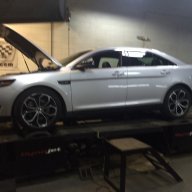
2014 Taurus SHO - Stunning Dyno Results Baseline + K&N

Disclaimer: Links on this page pointing to Amazon, eBay and other sites may include affiliate code. If you click them and make a purchase, we may earn a small commission.

14SHOCAR

New Member
Joined
Mar 19, 2015
Messages
26
Reaction score
14
Location
Oconomowoc, WI
It's a V6 and getting to the back 3 plugs is no walk in the park but isnt too difficult. I would suggest taking your time because the last thing you need to do is drop a piece of dirt into the cylinder or crack the porcelain off of the top of the spark plug. TAKE YOUR TIME and blowing out each of the spark plug tunnels with compressed air while the spark plug still screwed in is advised as well...
I'm going to probably have my tuner do the plugs as he will be re-gapping them as well. I just heard that you need to change out the plugs every 10k.... Kind of set me back for given I during the busy season I put on 10k in 4 months. that would be an expensive year in plugs and labor.
 

Bosscav

Active Member
Joined
Jun 28, 2014
Messages
123
Reaction score
37
Location
PA
I'm going to probably have my tuner do the plugs as he will be re-gapping them as well. I just heard that you need to change out the plugs every 10k.... Kind of set me back for given I during the busy season I put on 10k in 4 months. that would be an expensive year in plugs and labor.

10k is too often. I would say check them every 10k and if they look ok then keep running them. I am on track to put 20k on my car this year and I wont be replacing my plugs that often.
 

14SHOCAR

New Member
Joined
Mar 19, 2015
Messages
26
Reaction score
14
Location
Oconomowoc, WI
10k is too often. I would say check them every 10k and if they look ok then keep running them. I am on track to put 20k on my car this year and I wont be replacing my plugs that often.
Have you gotten any misfire code up to this point?
 

shomethe$$$

SHO Member
Joined
Sep 10, 2007
Messages
480
Reaction score
131
Location
Washington D.C.
Not really that stunning, K&N is all hype, I threw mine in the trash rather quickly when I noticed oil on my inlet plenum and throttle body(Have a Gen 2), went with a paper filter, plastic pipe and MAF ******, and my intake/piping is dry. After reading online other people say the filter oil will slowly ruin your turbo and sensors. Stay away from anything that is reusable, is cotton, and requires oil. Make your own and don't use metal. ABS plastic all the way.

Interested to see your Air Fuel ratio on the dyno.
 

14SHOCAR

New Member
Joined
Mar 19, 2015
Messages
26
Reaction score
14
Location
Oconomowoc, WI
Not really that stunning, K&N is all hype, I threw mine in the trash rather quickly when I noticed oil on my inlet plenum and throttle body(Have a Gen 2), went with a paper filter, plastic pipe and MAF ******, and my intake/piping is dry. After reading online other people say the filter oil will slowly ruin your turbo and sensors. Stay away from anything that is reusable, is cotton, and requires oil. Make your own and don't use metal. ABS plastic all the way.

Interested to see your Air Fuel ratio on the dyno.

I partially disagree with you on this one. I've have a K&N filter on my motorcycle and all of my cars up to this point. With K&N Filters from the factory, I've never had any oil find its way into the intake or intake manifold. Most people run into issues when you "recharge the filter". The biggest mistakes I see people do (due to having to use their vehicles within 6 hours of cleaning/oiling).
I've always had success with:
1. I start the process at night.
2. Wash filter with Cleaning Solution. I clean from the inside -- out, then outside -- in
3. I put fan on the filter and let the filter dry for 4 or more hours (depending if the filter is dry or not). I wait until the filter is FULLY dry.
4. I apply a VERY light later of oil on the inside of the filter. I apply a light layer on the outside of the filter. I let the oil "dry" for 2 hours. I then reapply in the areas that don't have a consistent color. Dry for 2 more hours...
5. I then wipe any excess oil run off from the filter and its good to go.

I do agree with you, however, on the metal vs PVC if the only thing the separates the intake is a single silicone fitting... on the 2014 SHO, There is plenty of plastic pipe that is run between the filter and the intake manifold that I would assume the temperatures would be minimally be impacted given the flow of air, the design of the intake.

The K&N intake box allows for air from under the hood lip to flow into the intake compartment. It also uses a gasket that seals the filter from the rest of the engine.

intake1.png


intake2.png


If I can find inexpensive high flow air inlet temperature gauges, I would consider doing an experiment with inlet temperatures of Metal vs Plastic intakes.
 

shomethe$$$

SHO Member
Joined
Sep 10, 2007
Messages
480
Reaction score
131
Location
Washington D.C.
Don't agree with on that so its your risk. Less filtration, more oil, insignificant power gain...just not worth it. Put the money toward better mods like tuning.
 

14SHOCAR

New Member
Joined
Mar 19, 2015
Messages
26
Reaction score
14
Location
Oconomowoc, WI
Don't agree with on that so its your risk. Less filtration, more oil, insignificant power gain...just not worth it. Put the money toward better mods like tuning.
A few additional points --
1) I am open to testing / experiment to see if one will work better than the other. This is what this thread/my you tube channel is really about... understanding how the car reacts to these types of things...

2) I did see almost a 28AWHP/AWTQ gain at 5820RPM on a stock -- non-tuned SHO -- by just adding the intake. This was across all of the 3 baseline and 3 new intake runs. So the data here is pretty consistent.

3) What were you speculating for the A/F ratio?
 

SHOdded

SHO Member
Joined
Dec 25, 2011
Messages
9,047
Reaction score
4,393
Location
Maryland
Compare the Airaid and K&N intakes. No way the K&N is sealing from the engine bay. The entire area where the filter is exposed needs to be sealed against the hood when the hood is closed. Even with the Airaid's native design that does not happen. An additional, taller strip is needed. So I'd chalkmark the top of the weatherstrip on the K&N intake and see the pattern against the hood/insulator. The metal tube still allows the air to heat up, and that's no good for power. The gains you speak of were with the hood open on a dyno. Try driving with the hood open like that in the "real world". Not fun!
 

14SHOCAR

New Member
Joined
Mar 19, 2015
Messages
26
Reaction score
14
Location
Oconomowoc, WI
So I'd chalkmark the top of the weatherstrip on the K&N intake and see the pattern against the hood/insulator. The metal tube still allows the air to heat up, and that's no good for power. The gains you speak of were with the hood open on a dyno. Try driving with the hood open like that in the "real world". Not fun!
I'm on the road this week traveling for work... But when I get home I'll take a look at what's exposed in the engine bay. I'd be curious to take a thermal tool to sense the temperature difference between the plastic and aluminum piping used in the k&n intake.
 

14SHOCAR

New Member
Joined
Mar 19, 2015
Messages
26
Reaction score
14
Location
Oconomowoc, WI
OK. So I confirmed that one of my friends that has an IR thermal gun that I can use to test the Aluminum intake vs the plastic. The next DYNO run, I will take the different in the temperatures between the plastic and aluminum pieces. Are there any suggestions on how I should test it?

I was thinking the following:
1. Hood down -- do one dyno pull.
2. Use the IR tool to take the initial temperature of the aluminum and plastic intake pieces.
3. Over 2 minutes measure the rate at which the aluminum and plastic pieces dissipate the heat.
4. Hood down do one dyno pull.
5. Open hood and immediately do another dyno pull to determine the temperature decrease between the plastic and aluminum pieces while air is being drawn into the car.

Anything else? I may read the temperature of the engine block near the intake?
 

RonPorter

SHO Club of America
Joined
Feb 25, 2001
Messages
3,723
Reaction score
2,577
Location
Lake Orion, MI
Glad to see that some analysis of the results was done. Too many folks just look at the peaks, and don't look under the curve. It was a similar issue with the Gen 3 V8 SHOs. Back in the day, when I got the first stock V8 into the 14s, we learned a few things. One was that removing the 3rd cat lost midrange torque. Nobody believed us until a coupla guys put them back in, and felt the power that they lost. It gets hard to analyze dyno charts on an automatic with the gear changes (versus a manual where you run the dyno in one gear), but doing a careful analysis of real mod changes is worth it. And not seeing the max numbers increase doesn't mean that you aren't gaining useful power.
 

2011TAURUSSEL

2014 SHO LMS Stage 1 V10
Joined
Jun 16, 2013
Messages
916
Reaction score
510
Location
DFW Metroplex, USA
I am looking at the Livernois Stage 1 Tune....Would I be making a fairly correct in concluding that the Stage 1 tune but since the kit includes the CAI kit it should be tuned for that right?
 

SHOdded

SHO Member
Joined
Dec 25, 2011
Messages
9,047
Reaction score
4,393
Location
Maryland
Because the PCM is an adaptive computer, I would say yes, but it would be very quick. The PCM will adapt as you drive. There is nothing new to interpret. Airflow (oxygen really) is a constantly changing variable anyway, depending on vehicle speed, wind speed, temperature, etc.

Now, it's possible that the intake does something fantastically different to alter airflow in a way that the Ford engineers could never have conceived of. In that case, you would need a tune update, just like you do when upgrading from a 2bar MAP to a 3bar MAP, because the operational parameters (affecting data interpretation) have been altered.
 

Pintony

Active Member
Joined
Jan 21, 2016
Messages
486
Reaction score
168
Location
40 miles N.E. of St; Louis
Because the PCM is an adaptive computer, I would say yes, but it would be very quick. The PCM will adapt as you drive. There is nothing new to interpret. Airflow (oxygen really) is a constantly changing variable anyway, depending on vehicle speed, wind speed, temperature, etc.

Now, it's possible that the intake does something fantastically different to alter airflow in a way that the Ford engineers could never have conceived of. In that case, you would need a tune update, just like you do when upgrading from a 2bar MAP to a 3bar MAP, because the operational parameters (affecting data interpretation) have been altered.

Might explain why "intake" =less gross HP as the engine may have been running lean on first few pulls?
BITD Jet changes were a must with every modification.
Which is why carburetor engines do not like ethanol fuels.
They run lean=less gross HP.
 

Forum statistics

Threads
107,154
Messages
1,181,979
Members
16,205
Latest member
Ashleycat

Members online

Back
Top