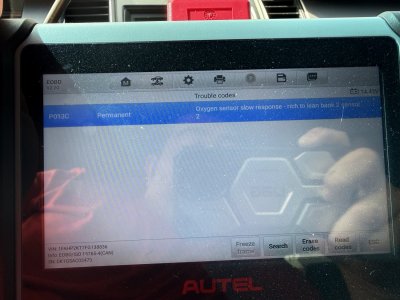
Help with P013c Permanent Code

Disclaimer: Links on this page pointing to Amazon, eBay and other sites may include affiliate code. If you click them and make a purchase, we may earn a small commission.

JGO-SHO

New Member
Joined
Jul 2, 2025
Messages
14
Reaction score
0
Location
DFW TX
Hello All,
2015 PP here... p013c shows on scanner as permanent code. No CEL is on. But I have 3 "not ready" going on about 6 months now.
02 Sensor, Heater, catalyst all not ready.
My bank 2 sensors (1 and 2) show low voltage but do slightly fluctuate. LTFT on bank 1 is about 24 and bank 2 is 17. Bank 1 voltage is normal on both sensors.
I replaced both downstream 02s thinking that would help (before I got the scanner), nothing changed. I have also replaced plugs for basic maintenance during this period and no change.
I have done drive cycles and more drive cycles on top of drive cycles.

Any recommendations, advice, and help would be appreciated. Thank you!!!
 

rubydist

SHO Master
Staff member
Super Moderators
Joined
Jun 25, 2007
Messages
7,521
Reaction score
3,399
Location
Denver
The "permanent" codes will stay until the pcm sees that the problem has been gone for a certain number of key cycles and possibly a certain number of miles, so unless you have driven it for multiple weeks after the repair, it is likely still going through the 'prove out' portion before it removes that code.
 

JGO-SHO

New Member
Joined
Jul 2, 2025
Messages
14
Reaction score
0
Location
DFW TX
The "permanent" codes will stay until the pcm sees that the problem has been gone for a certain number of key cycles and possibly a certain number of miles, so unless you have driven it for multiple weeks after the repair, it is likely still going through the 'prove out' portion before it removes that code.
But the bad readings on the scanner would still remain? It’s been 3 months since I replaced 02s with the car starting every other day and drive cycles done as well
 

Texas Marauder

Supporting Member
Supporting Member
Joined
Jul 20, 2007
Messages
902
Reaction score
811
Location
Lone Star State
What do you consider drive cycles? There is a specific procedure to the drive cycle for each component.
 

JGO-SHO

New Member
Joined
Jul 2, 2025
Messages
14
Reaction score
0
Location
DFW TX
I did Ford generic, did 2015 Taurus specific. Multiple ways on both. Probably around 15 times. Mostly late or overnight so I didn’t have to worry about traffic. Evap and other things that usually take a long time to ready were done almost immediately after the first time
 

rubydist

SHO Master
Staff member
Super Moderators
Joined
Jun 25, 2007
Messages
7,521
Reaction score
3,399
Location
Denver
Yes, the 'bad' reading will continue to show on the scanner until the pcm proves that the problem is gone. However, if it has been 3 months of regular driving, that suggests that the code is reappearing from time to time so that the pcm never proves that it is gone. There may be a wiring issue or bad connector such that it usually is fine but not always. Those kinds of things are the hardest to find and fix...
 

JGO-SHO

New Member
Joined
Jul 2, 2025
Messages
14
Reaction score
0
Location
DFW TX
Yes, the 'bad' reading will continue to show on the scanner until the pcm proves that the problem is gone. However, if it has been 3 months of regular driving, that suggests that the code is reappearing from time to time so that the pcm never proves that it is gone. There may be a wiring issue or bad connector such that it usually is fine but not always. Those kinds of things are the hardest to find and fix...
Hmmm. Makes sense.
Sounds like fun times ahead then….
 

SHO@Sparks

Member
Joined
Aug 9, 2025
Messages
38
Reaction score
16
Location
Mantua Township, NJ, USA
How does the car drive, as in any noticeable issues?

Any tuning, aftermarket parts or exhaust?

Here is an overview of the DTC P013C from the PCED manual.

Your long term fuel trims are definitely on the higher side of lean.

The monitors not completing are a concern.

You can reset the KAM and re-evaluate for any concerns that return. Permanent DTCs are eventually cleared over time of successive drive cycles with no issues.

Notice what is says about the code being very sensitive to exhaust leaks, even very small ones.

PCMP013CO2 Sensor Slow Response - Rich to Lean Bank 2 Sensor 2Description
  • The heated oxygen sensor monitor measures the response rate of the rear heated oxygen sensor (HO2S) to a rich to lean transition. This DTC sets when the measured response rate is slower than the threshold value.
Possible Causes
  • Exhaust leaks before or near the HO2S22
Diagnostic Aids
  • This monitor is highly sensitive to exhaust leaks near the rear HO2S. Check for leaks in the exhaust system.
GO to Pinpoint Test DW
 

JGO-SHO

New Member
Joined
Jul 2, 2025
Messages
14
Reaction score
0
Location
DFW TX
How does the car drive, as in any noticeable issues?

Any tuning, aftermarket parts or exhaust?

Here is an overview of the DTC P013C from the PCED manual.

Your long term fuel trims are definitely on the higher side of lean.

The monitors not completing are a concern.

You can reset the KAM and re-evaluate for any concerns that return. Permanent DTCs are eventually cleared over time of successive drive cycles with no issues.

Notice what is says about the code being very sensitive to exhaust leaks, even very small ones.

PCMP013CO2 Sensor Slow Response - Rich to Lean Bank 2 Sensor 2Description
  • The heated oxygen sensor monitor measures the response rate of the rear heated oxygen sensor (HO2S) to a rich to lean transition. This DTC sets when the measured response rate is slower than the threshold value.
Possible Causes
  • Exhaust leaks before or near the HO2S22
Diagnostic Aids
  • This monitor is highly sensitive to exhaust leaks near the rear HO2S. Check for leaks in the exhaust system.
GO to Pinpoint Test DW
It drives fine… it is tuned for going on 6 years now. Catted downpipes added about 3yrs ago. No issues. This is out of the blue. It does seem like it eats a little more fuel than normal but not substantial. I’ll check for exhaust leaks. And again not throwing any codes but I do need to get through inspection… one way or the other… eventually.
 

SHO@Sparks

Member
Joined
Aug 9, 2025
Messages
38
Reaction score
16
Location
Mantua Township, NJ, USA
I have had exhaust manifold cat leaks for this DTC on other Ford platforms. Ford would tell us to smoke the exhaust for any leaks, even small leaks on welds.

The UEGOS Universal Exhaust Gas Oxygen Sensors (upstream) are very sensitive and quick at responding to upstream fuel changes, rich/lean.

The Catalyst Efficiency sensors (downstream) monitor to effective of the catalytic converters.

Based on the permanent DTC it's relating to what the Bank 2 , left side of the engine as oriented from the rear of the engine looking forward, is seeing. It doesn't usually mean the sensor is defective, but more that it's seeing something it doesn't expect within the parameters/calibration based on engine and outside ambient temps, load, TP, APP, gear, FLI, etc.

When the monitors are run, there are various criteria that must be seen in order for it to complete. Sometimes it will keep trying each drive cycle, but again there are clearly defined parameters for it to test and complete or fail based on federal emissions standards.

Can you supply a VIN so I can search a little deeper?
 

SHO@Sparks

Member
Joined
Aug 9, 2025
Messages
38
Reaction score
16
Location
Mantua Township, NJ, USA
OBD Monitor Exercised​
Drive Cycle Procedure​
Purpose of Drive Cycle Procedure​
Drive Cycle PreparationNote: To bypass the EVAP soak timer (normally 6 hours), the PCM must remain powered after clearing the continuous DTCs and resetting the emission monitors information in the PCM.
1. Install the scan tool. Turn the ignition ON with the engine OFF. Cycle the ignition OFF, then ON. If needed, select the appropriate vehicle and engine qualifier. Clear the continuous DTCs and reset the emission monitors information in the PCM.
Bypasses the engine soak timer. Resets the OBD monitor status.
2. Begin to monitor the following PIDs (if available): AAT, ECT, EVAPDC, FLI, IAT and TP MODE. Start the vehicle without returning the ignition to the OFF position.
3. Idle the vehicle for 15 seconds. Drive at 77 to 104 km/h (48 to 65 mph) until the engine coolant temperature is at least 76.7°C (170°F).
Prep for Monitor Entry4. Is the intake air temperature between 4.4 and 37.8°C (40 and 100°F)? If not, complete the following steps, but note that step 14 is required to bypass the EVAP monitor and complete the OBD drive cycle.Engine warm-up and provides intake air temperature input to the PCM.
HO2S5. Cruise at 77 to 104 km/h (48 to 65 mph) for greater than 5 minutes.Executes the HO2S monitor.
EVAP6. Cruise at 77 to 104 km/h (48 to 65 mph) for 10 minutes (avoid sharp turns and hills). NOTE: To initiate the monitor, the throttle should be at part throttle, EVAPDC must be greater than 75%, and FLI must be between 15 and 85%, and for fuel tanks over 25 gallons FLI must be between 30 and 85%.Executes the EVAP monitor if the intake air temperature is between 4.4 to 37.8°C (40 to 100°F).
Catalyst7. Drive in stop and go traffic conditions. Include 5 different constant cruise speeds, ranging from 40 to 72 km/h (25 to 45 mph) over a 10 minute period.Executes the catalyst monitor.
EGR8. From a stop, idle for 30 seconds, accelerate to 72 km/h (45 mph) at 1/2 to 3/4 throttle, cruise at steady throttle for 1 minute. Repeat idle, acceleration and cruise 3 times.Executes the exhaust gas recirculation (EGR) monitor.
CCM (Engine)9. Bring the vehicle to a stop. Idle with the transmission in drive (neutral for M/T) for 2 minutes.Executes the idle air control portion of the comprehensive component monitor (CCM).
CCM (Transmission)10. For M/T, accelerate from 0 to 80 km/h (0 to 50 mph), and continue to step 11. For A/T, from a stop and in overdrive, moderately accelerate to 80 km/h (50 mph) and cruise for greater than 15 seconds. Stop the vehicle and repeat without overdrive to 64 km/h (40 mph) cruising for greater than 30 seconds. While at 64 km/h (40 mph), activate the overdrive, accelerate to 80 km/h (50 mph) and cruise for greater than 15 seconds. Stop for at least 20 seconds and repeat step 10 five times.Executes the transmission portion of the CCM.
Misfire, Fuel And Deceleration Fuel Shut Off Rear HO2S Monitors11. From a stop, accelerate to 104 km/h (65 mph), hold steady throttle for 5 seconds, then decelerate at closed throttle to 64 km/h (40 mph) (no brakes), accelerate from 64 km/h (40 mph) to 104 km/h (65 mph), hold steady throttle for 5 seconds, repeat deceleration 5 times.Allows learning for the misfire monitor, and completion of the deceleration fuel shut off rear HO2S monitor.
Readiness Check12. Access the On Board System Readiness (OBD monitor status) function on the scan tool. Determine whether all non-continuous monitors have completed. If not, go to step 13.Determines if any monitor has not completed.
Pending Code Check And EVAP Monitor Bypass Check13. With the scan tool, check for pending codes. Conduct the normal repair procedures for any pending code concern. Otherwise, repeat any incomplete monitor. If the EVAP monitor is not complete and the intake air temperature was out of the 4.4 to 37.8°C (40 to 100°F) temperature range in step 4, or the altitude is over 2438 m (8000 ft.), the EVAP bypass procedure must be followed. Go to Step 14.Determines if a pending code is preventing the completion of the OBD drive cycle.
EVAP Monitor Bypass14. Park the vehicle for a minimum of 8 hours. Repeat steps 2 through 11. Do not repeat step 1.Allows the bypass counter to increment to 2.
 

SHO@Sparks

Member
Joined
Aug 9, 2025
Messages
38
Reaction score
16
Location
Mantua Township, NJ, USA
Thanks on the VIN.

I just wanted to search Ford's database with your VIN for any knowns with that DTC. None were found.

I believe you replaced the UEGO sensors?

OEM or after market?

If you smoke test the exhaust system for any leaks, that would be the first direction, if there's nothing obvious leaking. You can also create back pressure on the exhaust and see if you hear any exhaust leaks.

Otherwise, I would reset KAM, clear any and all DTCS.

Since you have a scan tool, I would monitor and record multiple PIDS of the PCM to see what's occurring.

Short and Long Fuel Trims, CHT, FLP ACT, FLP DES, FRP ACT FRP DES, RPM, GEAR, both banks 1 and 2 OXYGEN and Catalyst sensors and check at idle and higher RPMS.
 

JGO-SHO

New Member
Joined
Jul 2, 2025
Messages
14
Reaction score
0
Location
DFW TX
Thanks on the VIN.

I just wanted to search Ford's database with your VIN for any knowns with that DTC. None were found.

I believe you replaced the UEGO sensors?

OEM or after market?

If you smoke test the exhaust system for any leaks, that would be the first direction, if there's nothing obvious leaking. You can also create back pressure on the exhaust and see if you hear any exhaust leaks.

Otherwise, I would reset KAM, clear any and all DTCS.

Since you have a scan tool, I would monitor and record multiple PIDS of the PCM to see what's occurring.

Short and Long Fuel Trims, CHT, FLP ACT, FLP DES, FRP ACT FRP DES, RPM, GEAR, both banks 1 and 2 OXYGEN and Catalyst sensors and check at idle and higher RPMS.
Thank you for this info and advice. I will start with the smoke test and go from there.
Will update once I find the problem. Hopefully, sooner than later.
 

Forum statistics

Threads
107,077
Messages
1,181,199
Members
16,142
Latest member
Kaevorlly

Members online

Back
Top